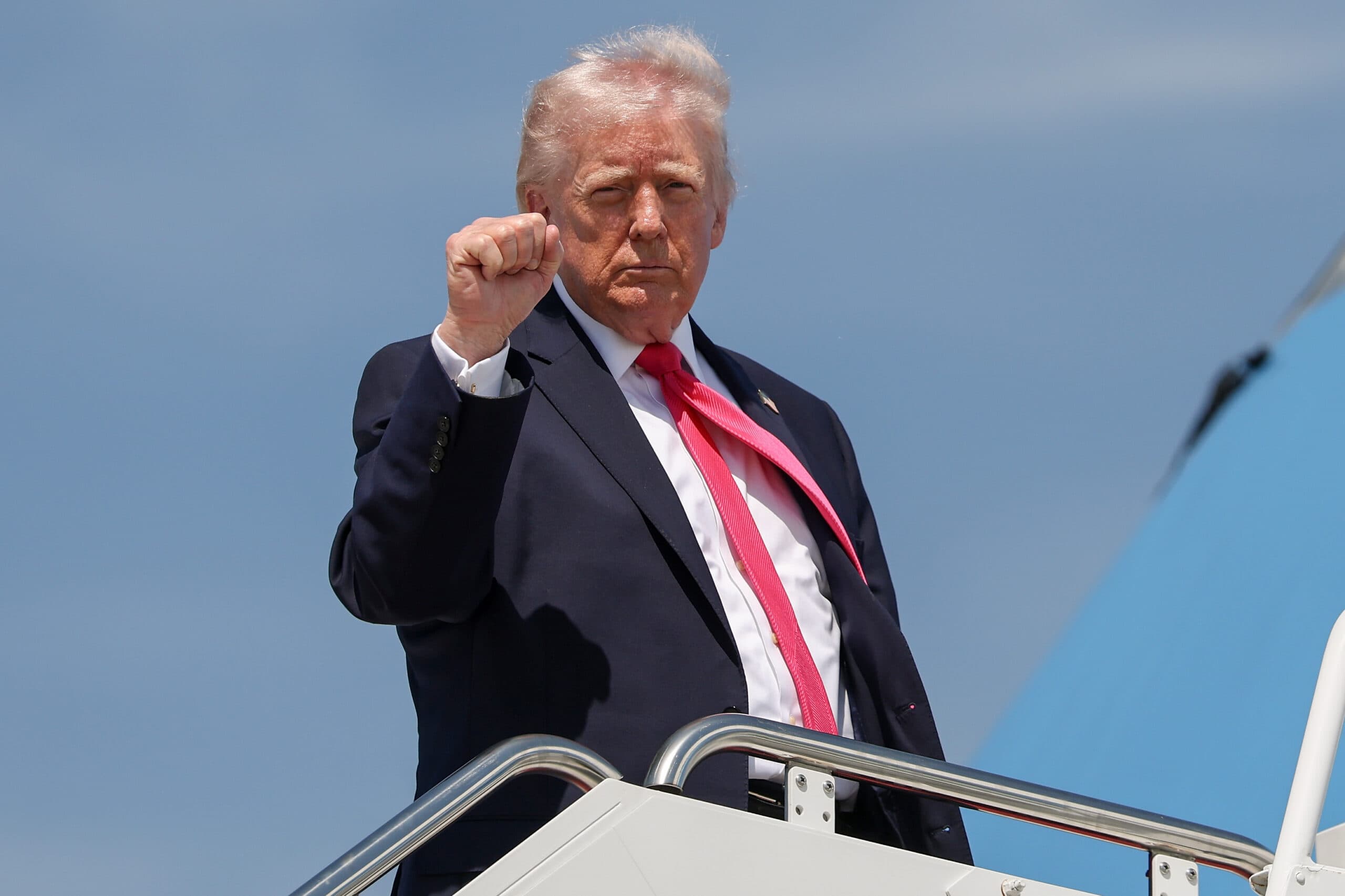
Foreign Affairs A New Nobel Prize for War Finally there’s an award that President Trump deserves to win. (Photo by Win McNamee/Getty Images) With the Middle East in flames, President Donald Trump’s desperate lobbying campaign for the Nobel Peace Prize looks ever more bizarre. Of course, his claim to have ended and prevented numerous wars is more fantasy than reality. Worse, his surprise bombing of Iran amid negotiations, twice, demonstrated that his goal is anything but peace.
Moreover, his proposal for a massive military buildup with no connection to American security suggests he is preparing even more reckless wars of choice. He has ostentatiously flouted Alfred Nobel’s desire to reward those who did “the most or the best work within the past year for building fraternity between nations, for the abolition or reduction of standing armies.” Rather, the president has threatened to commit war crimes, wreck countries, and destroy civilizations. However, it would be a shame to disappoint someone so desperate for public acclaim.
It is time to create a Nobel War Prize, to denounce rather than praise the year’s most ostentatious warmonger or warmongers. Although 2026 is far from over, Trump would be a strong favorite this year. Unfortunately, the 20th and 21st Centuries are filled with atrocious wannabe awardees.
For instance, after sparking the Russo-Japanese War, Czar Nicholas II and Emperor Meiji should share the 1904 prize. The two Balkan Wars began in 1912, launched by a gaggle of ambitious, nationalistic leaders of Bulgaria, Greece, Montenegro, and Serbia, all of whom deserve the high (dis)honor. In 1914 the winner would be Gavrilo Princip, the young Serbian terrorist who assassinated the heir apparent to the Austro-Hungarian throne, lighting the fuse to World War I.
The conflict killed 20 million people, ravaged Europe, consumed three empires, undermined leading democracies, spawned communism, fascism, and Nazism, and led to World War II. Three years later the prize would have gone to President Woodrow Wilson, who was reelected for keeping America out of war and then deceitfully plunged the nation into the continental abattoir. Washington’s entry set up the unbalanced Versailles Treaty, which French Marshall Ferdinand Foch reportedly warned was merely “an armistice for 20 years,” with another big war to follow.
Militaristic generals and pliant politicians deserved a Nobel War Prize in 1931, when Tokyo began its disastrous attempt to coerce and conquer China with its invasion of Manchuria, and in 1937, when Tokyo expanded its campaign. Preventing the otherwise likely victory of the Kuomintang, or Nationalists, over the Communist Party enabled the “Red Emperor,” Mao Zedong, to triumph and become the greatest mass killer in human history. The 1935 war medal would go to Italy’s Benito Mussolini, who began his drive to create a new Roman empire by attacking Ethiopia.
The resulting international opposition and isolation ultimately led him to become an ally of Nazi Germany. In 1939 Adolf Hitler and Joseph Stalin jointly deserved the award after agreeing to erase Poland as a nation and divide the rest of the geographic spoils. In 1941 Hitler would be the sole recipient, launching Operation Barbarossa against his former Soviet partner.
The result was one of history’s worst conflagrations, followed by a divided Germany and Europe. Charles de Gaulle, though a national hero, nevertheless deserved the prize in 1945 for seeking to reconstitute the French empire in Southeast Asia. This ultimately led to Paris’ humiliating defeat and exit from Vietnam.
Tragically, American intervention soon followed. Three years later the first of a series of Arab–Israeli conflicts erupted. An ensemble cast of British officials, Jewish refugees, and Arab nationalists deserves medals for the series of wars between Israel and its neighbors that continue to this day, with Washington’s involvement.
In 1950 North Korea’s Kim Il-sung would get the nod. The peninsula’s division persists, made more threatening by Pyongyang’s acquisition of nuclear weapons. Mao deserved the medal in 1951 for taking his nation into the Korean War.
President Lyndon Johnson would have earned the award in 1964 for dramatically escalating America’s involvement in Vietnam. His predecessor, President John F. Kennedy, shared blame for entangling America in the conflict.
Despite tens of thousands of American battle deaths, the Vietnamese people remain under a unified communist government today. In 1965, Pakistani Gen. Akhtar Hussain Malik would have won the medal.
He planned a covert military offensive in the disputed territory of Kashmir, controlled by India. However, his campaign misfired, triggering a brief but losing war. President Richard Nixon deserved the nod in 1969.
While promising to exit Vietnam he bombed even more and expanded the conflict to Cambodia and Laos. Although primary responsibility for the resulting slaughter in the former remains with the victo