Just how do you replace a legendary car like the 105-series Alfa Romeo Giulia? The range of sporting saloons and sexy coupés was not only backed by motorsport success, it also gained a cult following that has barely faded to this day. So what of its successor?
Although the much later GTV6 coupé reached iconic status thanks to its fantastic engine, it’s fair to say the earlier four-cylinder Alfetta GT and GTV models have been drastically overlooked. The story of the Alfetta starts in 1972, with the launch of the four-door models. They were powered by a range of twin-cam four-cylinder engines and offered exceptional handling, thanks to almost 50:50 weight distribution, achieved by mounting the transaxle gearbox at the rear, with a sophisticated De Dion tube rear suspension.
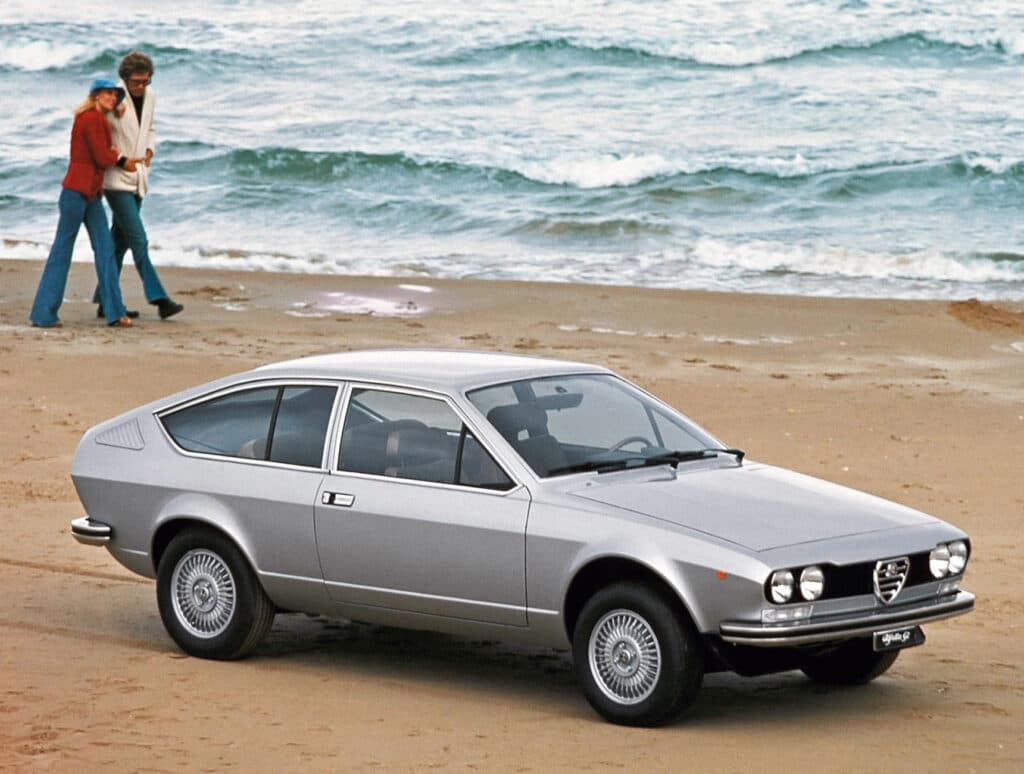
When the Coupé (pictured above) arrived in 1974, based on a slightly shortened version of the same platform, it was offered only with a 122bhp 1.8-litre engine. It was styled by Giorgetto Giugiaro, Alfa’s brief having been to make this a sleek, sporting coupé, but one with a more spacious and comfortable interior – especially for those in the back seats – than its Bertone-designed predecessor. That determined the car’s fastback profile.
In 1976, this model was replaced by two new divergent offerings: an entry-level 1.6-litre GT and a new 2000 GTV. Minor visual tweaks for the latter included bumper overriders and a GTV-labelled triangular trim panel in the C-pillar. The GTV also got a slightly higher standard spec, such as a leather-wrapped steering wheel, but the larger engine didn’t have more power than the outgoing 1.8, just a minor uplift in torque.
The first power-bulge would come in 1979 with the launch of the GTV 2000 L. An improved ignition system and revised camshafts saw power increase to 130bhp. A plusher interior and revised suspension settings make this currently one of the most sought-after model variants.
It’s also worth noting that the GTV was offered in the USA from 1976, with Federal bumpers and a 110bhp engine fitted with Spica mechanical fuel injection, a big change from the carburettor-equipped European-spec cars. Autodelta had some success rallying the GTV in the 1970s and, while it experimented with Montreal V8-engined Group 4 cars, the competition arm settled on a turbocharged version in 1979. A total of 400 homologation road cars was built.
It was all change in 1980, with a significant update to the GTV. Large plastic bumpers replaced the slender chrome items of the original – a theme that continued throughout the car, with all of the GTV’s chrome replaced by matt-black trim in an attempt to bring this ’70s coupé into the 1980s. An updated dashboard added more gauges and was a marginal ergonomic improvement.
Alfa also dropped the Alfetta name and discontinued the 1.6-litre GT in preparation for the launch of the new V6-engined range-topping GTV6. It would be easy to dismiss the earlier Alfetta GTV models if you are swayed by the charms (and musicality) of a Busso V6, but there’s a visual delicacy that only the original can offer. The slender steel bumpers, uncluttered bodywork and chrome brightwork all serve to present the Giugiaro styling as it was originally intended.
They’re still overlooked and offer great value. What to pay Finding an early 1.8-litre Alfetta GT in the UK might be a challenge, but expect prices to start from around £8000, rising to £15,000 for something in excellent condition. Prices in Europe vary, however, where a perfect-condition car could fetch upwards of £25,000.
The chrome-bumper GTV 2000 is probably the most sought-after of the regular four-cylinder cars, especially in L form. Average examples can be picked up for £7500-12,000, but a concours car might command upwards of £27,500. Post-facelift big-bumper cars are more common, but values are broadly in the same range.
In contrast, a pre-facelift 1.6-litre GT should range from £7500 at the bottom end to just over £20,000 for a mint example, making it a somewhat more affordable entry point to the range. For the ultra-rare Turbodelta homologation cars, prices can range anywhere from £30,000 to £60,000, depending on history and condition. For reference, a perfect GTV6 might command £25,000-35,000.
Look out for Finding a rust-free car should be a priority, as what might appear to be small corrosion issues can quickly spiral into full underbody restoration. Check the inner wings, wheelarches, floors, sills and suspension mounting points – basically it needs a full inspection on a ramp. Unlike the 105-series, repair panels are not easily sourced.
South African cars are a safer bet. Four-cylinder engines are strong and reliable if properly maintained. Good oil is vital!
Gearboxes can be a bit of a weak point if abused, so check for grinding synchros or any jumping out of gears. Gear selection wasn’t the nicest, even when new.