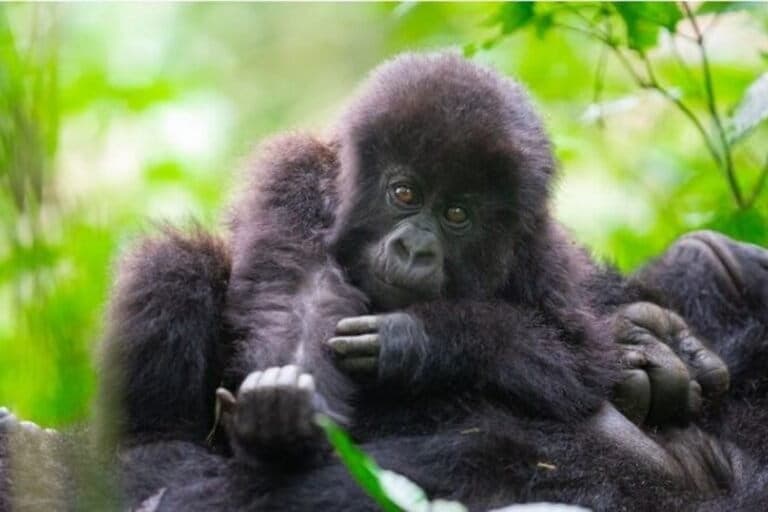
The population of the world’s last mountain gorillas has rebounded by 73% since 1989, allowing the subspecies to be reclassified from critically endangered — one step away from extinction — to endangered. But they remain imperiled, with about 1,063 left. They live in just one place: the Greater Virunga Landscape that straddles Rwanda, Uganda and the Democratic Republic of Congo (DRC).
Conservation here has been extremely challenging, that’s been periodically embroiled in war, beset by armed groups, poachers and a plethora of other serious threats. Though these apes dwell at high altitude, from about 2,400-4,000 meters (8,000-13,000 feet) andoften deep within steep valleys and gorges, they’re still in the crosshairs. These apes are poached for their meat and body parts.
Their infants are snatched for attractions that entertain tourists. Sometimes they’re trapped in snares set by bushmeat hunters for other wildlife. Meanwhile, their habitat falls to farmers and loggers.
Rangers working in the region are increasing the use of cellphone-based software as part of broad efforts to protect mountain gorillas (Gorilla beringei beringei) and the lands they inhabit. This platform, known as the Spatial Monitoring and Reporting Tool (SMART), can be programmed to the specific needs of a species or landscape, incorporating the boundaries of protected areas, wildlife corridors, patrol routes and so much more. It builds maps, has navigation capabilities, incorporates photos, and organizes and analyzes data.
This information sometimes is used as evidence for prosecution of poachers. This information also helps pinpoint where to deploy personnel, and how…This article was originally published on Mongabay