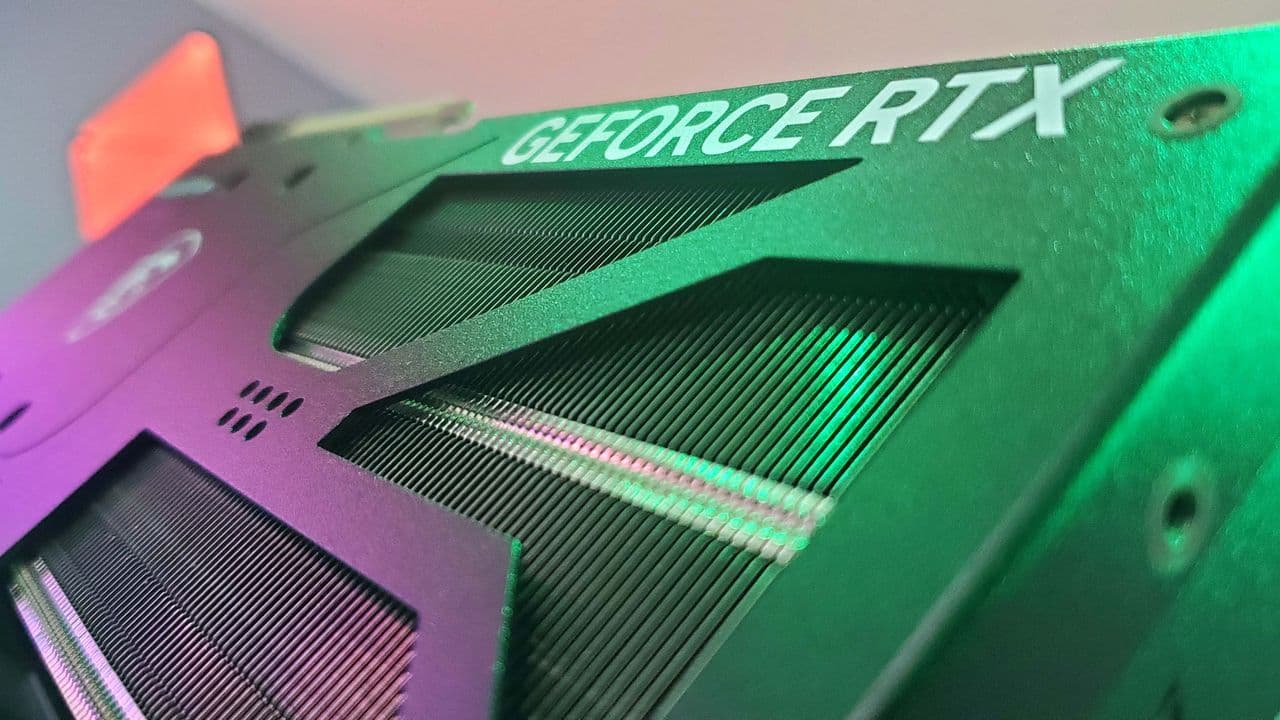
This year will be the tenth anniversary of the GeForce GTX 10-series, and since then Nvidia's gaming GPUs have undergone some fundamental changes to bring ray tracing and AI to the PC gaming masses. While compute performance, cache levels, and VRAM bandwidth are still key to getting high frame rates in games, today's GeForce graphics cards are far more versatile, capable, and complex than those from 2016.But what of the future? What will Nvidia's next generation of gaming GPUs look like?
With the chance of a Super refresh of Blackwell chips looking increasingly less likely, due to supply pressures on affordable VRAM, I've been spending some time mulling over what's next for Team Green.To that end, I've looked back over 10 years' worth of GeForce cards, collated all the key information, and compared four tiers of models: 60-class, 70-class, 80-class, and the one at the very top of the chain. The latter is currently the 90-class, but with the GTX 10-series and RTX 20-series, it was known as the Titan.I've got a few charts for you to peruse, and I'll discuss what each one can potentially tell us about the future.
And then from all of this, a table of specs for the four primary tiers of RTX 60-series graphics cards I think we'll see in the near future.Die size and process node(Image credit: Taiwan Semiconductor Manufacturing Co., Ltd.)As I'm sure you already know, Nvidia doesn't manufacture the GPUs and other products that it designs. For that, it hires the services of TSMC (Taiwan Semiconductor Manufacturing Company), partly because it has a long history with this company, but mostly because it's the world's biggest and best when it comes to churning out hulking chips at the cutting edge of processor technology.Just like all chip makers do, TSMC uses the simple phrase 'process node' to describe the hugely complex sequence of steps it carries out to manufacture hundreds of thousands of silicon wafers, coated with all kinds of materials and etched with light, that eventually get sliced up into individual processor dies.Nvidia employs one of TSMC's most advanced process nodes, N3, to make its Rubin AI behemoths, but the Blackwell gaming chips that power the RTX 50-series graphics cards are made via a custom version of the previous N5 node, called 4N.
The RTX 40-series GPUs were also made on this node, but for the 30-series, Nvidia used Samsung's 8LPH.(Image credit: Locuza / Fritzchens Fritz)That was a bit of a surprise when it was announced because before the Ampere generation of GPUs, Nvidia's GTX 10- and RTX 20-series were both made on a custom TSMC N16 node, and its N28 process for a further three prior GTX generations.I mention all of this because it's the first port of call we need to make before making an educated guess as to what RTX 60-series chips will be like. With Nvidia so heavily invested in AI now, I suspect that it won't use TSMC's most cutting-edge node, N2, but will stick with N3 for cost reasons.This is important to understand because it will determine the approximate die density of these future GPUs, i.e. the number of transistors per square millimetre of die area.
Nvidia's Blackwell and Ada Lovelace gaming chips have roughly the same density, as they're made on the same node: around 120 million transistors/mm2.Relative die density for the last five generations of Nvidia gaming GPUs(Image credit: Future)TSMC's N3 is reported to be in the region of 200 or so (higher with certain variants), and if that's what we can expect for the next round of RTX GPUs, then we're looking at 66% increase in density. However, this doesn't automatically mean we'll see chips with 66% more shaders and cache.That's because the die density figure is for logic only, the stuff that makes up the shader cores and other processing elements.
For GPU parts such as cache and PCIe/VRAM circuitry, the increase in density is much smaller, around 5% at best. So while Nvidia can jam lots more CUDA cores into its next-gen GPUs, it's quite limited as to what it can do with cache and analogue systems.It's also steadily favoured using small dies for the majority of its gaming products, helping to improve wafer yields (the percentage of dies from a wafer that can be used) and profit margins (smaller dies mean more dies per wafer).The exception to this has been at the very top-end of the GPU scale, with the RTX 5090's chip being fairly close to the maximum size that TSMC's equipment can make. The reason for this isn't about making the 'ultimate' gaming GPU: it's all about having a product for prosumer AI market.Relative die sizes for a selection of Nvidia GeForce RTX graphics cards(Image credit: Future)If you're wondering why the GTX 10-series chips were so small, it's because they were made on a heavily refined TSMC N16 process node that Nvidia had been working with for quite some time.Anyway, as so much has changed since the GTX 10-series era of GPUs, it's hard to ascertain whether this trend will continue or if Nvidia's next chips wi