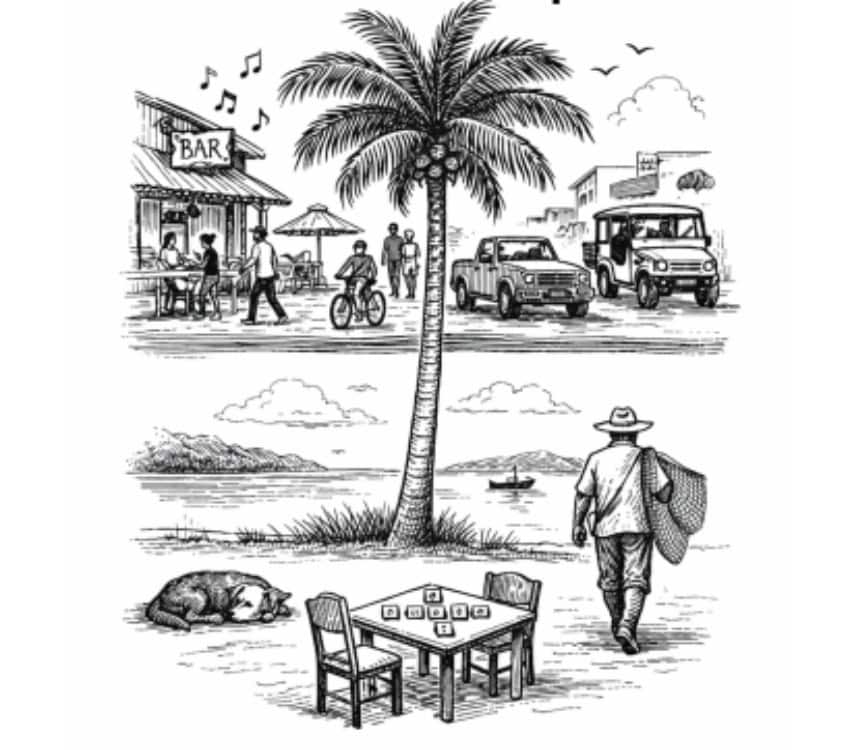
Over the last 10 years, my wife Victoria and I have been residentes permanentes in Barra de Navidad, and we have had the quiet privilege of watching this small Jalisco town change in the way a shoreline changes. Not abruptly, not with drama, but grain by grain. One day, you notice a new building where a coconut tree once leaned, or a parking spot that used to exist only in theory but is now occupied by three vehicles and a golf cart that seems to believe it is also a vehicle.
The most obvious shifts are the construction projects. They rise slowly, like determined mushrooms after a rainstorm: new houses, renovations, clever attempts at turning yesterday’s fishing house into tomorrow’s boutique lodging. Along with the buildings arrive the seasonal migrations of our northern friends, the snowbirds who have wisely decided that ice on a windshield is a design flaw in the universe.
Life proceeds at a stately, sedate pace in Barra during the slow season but picks up intensity during the high season. (Robert Santacroce) High season in Barra Barra de Navidad, like other small Mexican towns, has become a preferred sanctuary, and to be fair, it is not difficult to understand why. A person who has spent several months staring at snowbanks the size of small livestock would naturally feel a kind of spiritual awakening upon encountering warm sand, fresh fish and a margarita that arrives without requiring a shovel. Thus arrives the high season.
High season in a small town is an interesting phenomenon. For roughly four to six months, Barra undergoes a seasonal costume change. The town that normally strolls becomes one that hustles.
Streets that were once leisurely pathways become lightly competitive traffic corridors where pedestrians, cars, bicycles, dogs and the occasional rooster all negotiate their rights of passage with admirable diplomacy. The sidewalks, where they exist, become a philosophical exercise, as one must consider angles, timing and sometimes mild acrobatics. Navigating them can feel less like walking and more like participating in a slow-moving chess match with parked scooters.
Of course, the positive side is undeniable. The arrival of seasonal visitors brings a healthy infusion of capital into the town. Restaurants fill, tiendas sell more goods, fishing charters depart with cheerful regularity and many local families find their most productive months of the year unfolding before them.
This economic rhythm is important because during the summer months, the pace of commerce softens considerably. When the heat deepens and the rains arrive, the town exhales, and the cash registers do as well. High season helps balance that equation.
One could say the town works hard for a few months so that it may relax for the rest of the year. Yet with prosperity comes a certain … density. Those of us who have grown fond of the slower texture of life here notice the difference immediately: A simple walk down the street, which in the low season allows ample time for daydreaming, greeting neighbors and examining the philosophical posture of sleeping dogs, becomes a more structured activity.
One must pay attention to traffic, music, conversations in three languages and the occasional enthusiastic golf cart that appears to be piloted by optimism rather than braking power. Then there is the matter of sound. The sound of the slow season It looks quiet now, but wait until the high season. (Alfonso Hernández M./Mexico Ruta Mágica) In the quieter months, Barra produces a gentle soundtrack.
The ocean murmurs, a fishing boat motor coughs awake in the early morning, someone sweeps the street in front of the house and a distant radio hums politely in the background. High season, however, introduces what might best be described as a cultural symphony. Music flows from restaurants, bars, passing cars and beach speakers.
Rock competes with ranchera, salsa dances with country music and, somewhere, a Jimmy Buffett song bravely attempts to hold its ground. The result is a cheerful cacophony — not unpleasant exactly, but certainly ambitious. In fairness, the seasonal visitors cannot be held solely responsible for the increased decibel levels.
Our local residents are capable of producing impressive musical enthusiasm. The difference seems to be that during high season, restaurants and bars become a little more relaxed about the volume knobs when their northern guests are enjoying dinner or a round of drinks. It is as if the music itself senses an international audience and rises to the occasion.
Still, despite the bustle and the sonic enthusiasm, the town never completely loses its character. Barra remains at heart a fishing village with a deeply relaxed soul. Fishermen still head out before sunrise, neighbors still greet each other in the street and the lagoon still reflects the same evening light it always has.
A well-developed daydream For my part, I confess to having a particular affection for the low season. When the snowbirds gradually mi