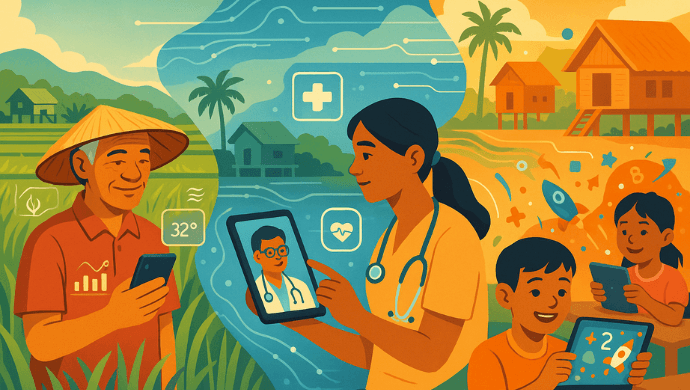
While the world obsesses over the latest AI breakthrough from Silicon Valley or the newest unicorn from China, something far more profound is happening in the rice paddies of Vietnam, the clinics of Indonesia, and the classrooms of the Philippines. Southeast Asia isn’t just adopting technology—it’s fundamentally reimagining what technology should do, who it should serve, and how it should create value. The narrative we’ve been told about technology innovation is fundamentally flawed.
We’ve been conditioned to believe that the most important innovations happen in gleaming corporate campuses, funded by venture capitalists seeking 10x returns, and designed for affluent urban consumers. But what if the most transformative technology innovations are actually happening where smartphones cost a month’s wages and the primary concern isn’t optimising convenience but solving survival? Southeast Asia’s approach represents a paradigm shift that challenges every assumption about how innovation works.
Here, technology isn’t a luxury—it’s a necessity. This is how a region once considered a technology follower is becoming the world’s laboratory for technology that actually matters. The agriculture revolution: 71 million farms, one digital transformation Consider the reality facing Southeast Asia’s 71 million farms.
These aren’t the massive, mechanised operations of the American Midwest. The average farm size is less than two hectares, operated by families who often lack formal education, reliable internet access, or significant capital. Traditional agricultural extension services reach perhaps 10 per cent of farmers, leaving the majority to rely on inherited knowledge that may not reflect current best practices or changing climate conditions.
Into this context comes agricultural technology that prioritises accessibility over sophistication. Farmonaut’s satellite-based crop monitoring system doesn’t require farmers to understand remote sensing—it delivers actionable insights through simple mobile interfaces that work on basic smartphones. The Grow Asia Innovation Challenge isn’t funding autonomous farming robots; it’s supporting climate-smart technologies that smallholder farmers can actually adopt.
This represents a fundamental reimagining of what agricultural technology should accomplish. A farmer in rural Thailand doesn’t need an AI system that can identify 500 different plant diseases; they need a system that helps them recognise the three diseases most likely to affect their specific crops in their specific region. They don’t need real-time soil sensors that cost more than their annual income; they need weather forecasts and planting recommendations delivered via SMS.
Also Read: Need of the hour: How agritech platforms can protect farmers from climate change The impact is already visible. In Cambodia, digital extension services reach farmers who have never had access to agricultural advice beyond their neighbours. In the Philippines, supply chain platforms connect smallholder farmers directly with urban markets, eliminating intermediaries who traditionally captured most of the value.
In Indonesia, climate-smart farming techniques disseminated through mobile platforms help farmers adapt to increasingly unpredictable weather patterns. But perhaps most significantly, Southeast Asia’s agricultural technology revolution recognises that farming isn’t just an economic activity—it’s a social and cultural practice that shapes entire communities. The most successful technologies strengthen rather than disrupt these social networks, creating platforms for farmers to share knowledge collectively and build resilience as communities.
Healthcare democratisation: US$2 billion in digital health, infinite possibilities The healthcare transformation across Southeast Asia represents perhaps the most dramatic example of how technology can fundamentally alter the relationship between services and the people who need them. With US$2 billion in digital health funding in 2024 and 460 telemedicine companies operating across diverse markets, Southeast Asia is pioneering entirely new models of healthcare delivery that prioritise access over affluence. The traditional healthcare paradigm—centralised hospitals, specialist-driven care, expensive diagnostic equipment—simply cannot work in a region where the nearest hospital might be a day’s journey away and where a single medical consultation can represent a significant portion of a family’s monthly income.
Doctor Anywhere and Halodoc don’t just offer video consultations—they provide comprehensive healthcare ecosystems that include medication delivery, health monitoring, and integration with local providers. Malaysia’s Qmed Asia pioneers AI-driven healthcare kiosks that bring diagnostic capabilities directly to communities that have never had access to modern medical equipment. These kiosks don’t replace doctors—they extend medical expertise to places where it has never existed before. This democrati