Scarville's work will be displayed at Brooklyn Museum's Iris Cantor Plaza and the exterior of Bushwick's OUVO facility this May Read Culture Brooklyn-Born Photographer Keisha Scarville Wins the 2026 UOVO Prize Scarville’s work will be displayed at Brooklyn Museum’s Iris Cantor Plaza and the exterior of Bushwick’s OUVO facility this May Afrodet Zuri 21 April 2026 A Brooklyn native whose lens has long turned toward memory, migration and the Caribbean diaspora, Keisha Scarville has been named the sixth recipient of the UOVO Prize, an annual award administered by the Brooklyn Museum to honor emerging artists rooted in the borough. Along with a $25,000 unrestricted grant, Scarville will see her work take over two prominent public spaces: the Museum’s Iris Cantor Plaza and the exterior facade of UOVO’s Bushwick facility, where a massive 50-by-50-foot mural will go up.
Her plaza installation, titled Where Salt Meets Black Water, opens 8 May, 2026, marking her first work at this scale. Photo by Ana Dias The installation draws from a body of work deeply personal in origin. Scarville was born in Brooklyn to Guyanese parents who arrived in the United States during the 1960s, and her practice has long woven together photography, collage and archival objects to map the emotional terrain of that inheritance.
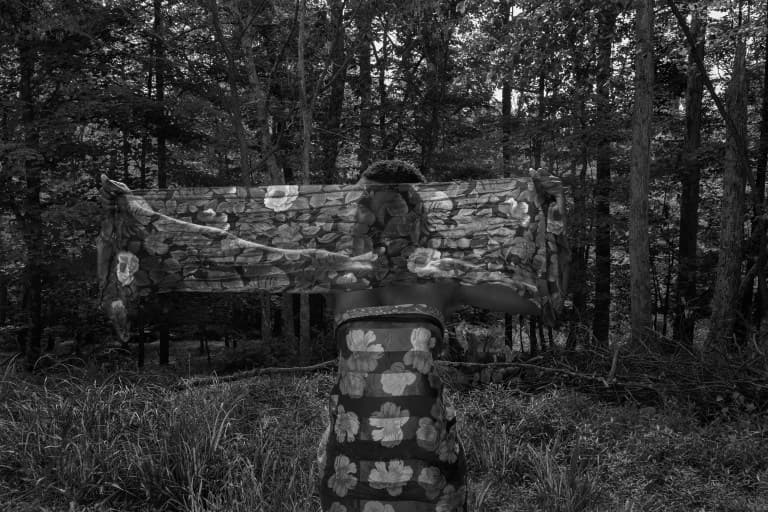
The plaza piece centers on her series Mama’s Clothes, in which images are layered onto garments belonging to her late mother, Alma. Rendered as large-scale vinyl prints across the Museum’s stoop and surrounding walls, the black-and-white photographs transform private grief into something open and communal, an invitation for passersby to pause and find themselves immersed in someone else’s story. The title nods to the dark, mineral-laden waters found in Guyana, long thought to hold restorative qualities, a metaphor that resonates throughout Scarville’s approach to art-making, in which loss becomes a site of care and renewal.
Artwork by Keisha Scarville, Courtesy ©Keisha Scarville The UOVO facade commission takes a similarly intimate archival image as its starting point: a photograph of a mother and child that Scarville’s own mother brought with her when she emigrated, preserved by the artist and now enlarged to monumental proportions alongside one of Alma’s garments. That work will remain on view through October 2026. Scarville’s resume is substantial for an artist at this stage.
Her work has appeared in institutions including the International Center of Photography, the Studio Museum in Harlem, ICA Philadelphia and the Brooklyn Museum itself. Her debut monograph, lick of tongue rub of finger on soft wound, was published by MACK in 2023 and shortlisted at the Paris Photo–Aperture PhotoBook Awards. A second book with MACK is expected this spring.
She currently holds teaching positions at both Harvard University and Parsons School of Design. Scarville has spent years making photographs that refuse to stay still, images that absorb cloth, memory, and absence into their surfaces until the boundary between picture and object dissolves. We sat down with her ahead of the opening of Where Salt Meets Black Water to talk about heritage, scale, and what it means to bring deeply personal work into one of Brooklyn’s most public spaces—and why Brooklyn, for her, has always been the center of everything.
COOL HUNTING: The title Where Salt Meets Black Water references Guyana’s mineral-rich waters believed to carry healing properties. How did you land on this title, and what does healing mean in the context of this work?Keisha Scarville: I wanted the title to evoke a space between lands, specifically between the United States and Guyana. The expanse of the ocean and these unique waters of Guyana became a metaphor for thresholds.
For me, these waters are a meeting place where grief can be encountered, and healing begins in that liminal space. CH: You’ve worked intimately with your mother’s garments in the Mama’s Clothes series for years. How does scaling these images to a monumental public installation change their meaning for you or your relationship to them?Scarville: Scaling these images up for public display has deepened my connection to the project.
Presenting work about my mother in Brooklyn, her longtime home, expands both the emotional impact and personal meaning for me. Artwork by Keisha Scarville, Courtesy ©Keisha Scarville CH: Your work has been described as transforming “individual remembrance into communal memory.” When you’re making something so personal, at what point do you start thinking about the viewer’s experience?Scarville: I am interested in how photography memorializes experiences and can summon the presence of someone in the wake of death. Using my mother’s clothing and, at times, my own body, I sought ways to conjure her within the images.
Over time, this led me to reflect on Caribbean immigrants in Brooklyn, where my parents settled in the late 1960s. I hope the installation serves as both a memorial to my mot