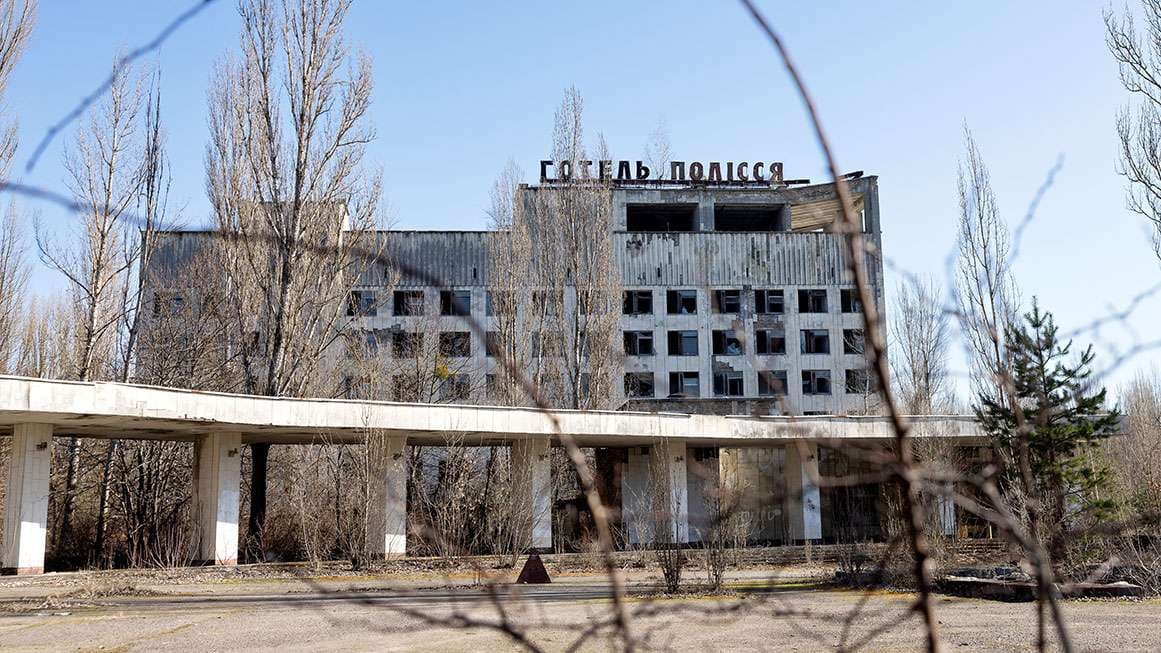
The world's worst nuclear disaster began 40 years ago at 1:23 a.m. on April 26, 1986, when Unit 4 at the Chernobyl nuclear power generation facility experienced an explosion and meltdown. Ironically, the explosion was caused by a botched safety test. The point of the test had been to see what would happen if the power plant lost its main electrical supply: Could spinning turbines generate enough power to run the coolant pumps until emergency backup diesel generators could kick in?
The experiment had failed three times previously, but never as catastrophically as it did that night. Before the meltdown, Soviet officials had bragged regularly about the safety of their nuclear power plants and disparaged those in the West. In 1983, state-sponsored news agency Novosti reported that Soviet scientists had estimated the probability of a nuclear accident involving a radioactive discharge at one in 1 million.
In 1984, Minister of Power and Electrification Petr Neporozhny called the country's nuclear plants "totally safe." Just two months before the disaster, the English-language propaganda magazine Soviet Life claimed: "Even if the incredible should happen, the automatic control and safety systems would shut down the reactor in a matter of seconds. The plant has emergency core cooling systems and many other technological safety designs and systems."
Soviet officials initially tried to hide the disaster, but it was detected in the West two days later when an employee's contaminated shoes triggered radiation alarms at Sweden's Forsmark Nuclear Power Plant. The Swedes at first feared that their own plant was leaking radiation, but they soon traced the issue back to Chernobyl by analyzing wind patterns and specific radioactive isotopes. Chernobyl's radioactive plume spread over Belorussia, Ukraine, western Russia, and much of Europe.
Two workers died from the initial explosion, and the 28 firefighters and emergency workers who doused most of the reactor's flames in the following three and a half hours died over the next three months from acute radiation poisoning. Their bodies were so radioactive that they were buried in lead coffins encased in concrete. Anatomy of a Meltdown The Chernobyl explosion is "the only accident in the history of commercial nuclear power to cause fatalities from radiation," as the Nuclear Energy Institute points out.
"It was the product of a severely flawed Soviet-era reactor design, combined with human error." Chernobyl's RBMK-1000 reactors—the initials stand for reaktor bolshoy moshchnosty kanalny, which means high-power channel reactor—used a combination of graphite and water as moderators to slow down fast neutrons. Slowing neutrons enables them to collide with fissile materials (uranium) to sustain a nuclear chain reaction, and that reaction produces heat that boils the water that turns the turbines that generate electricity.
Chernobyl's reactors had a critical flaw known as a "positive void coefficient," in which coolant water's moderating effect on reactivity decreased when it was turned into steam, leading to uncontrollable power spikes. Before the test was to begin, the reactor was supposed to be stabilized at the raw heat output of 700–1,000 megawatts thermal. But shortly after midnight, the power fell to just 30 megawatts thermal.
Operator efforts to boost power back to the level originally planned for the test were stymied by increases in neutron-absorbing xenon and steam condensing into coolant water. To compensate, the operators withdrew neutron-absorbing boron carbide control rods to increase reactivity, raising reactor output to 200 megawatts thermal. At 1:23 a.m., operators cut the regular steam supply.
The coolant water supplied by pumps powered by the slowing turbines began to boil into steam. This led to a rapid feedback loop where rising reactivity produced more steam and burned off xenon, causing ever greater reactivity. The result was an overwhelming power surge, estimated to be 100 times the nominal power output.
Thirty-six seconds after the test began, someone tried to shut down the reactor by lowering the boron control rods. The operators apparently didn't realize that the control rods were tipped with graphite, which enhanced rather than reduced reactivity as they began their descent into the reactor. Plant operators reported two explosions at 1:24 a.m.
The first was caused by the extreme buildup in steam pressure, the second by hydrogen accumulation from zirconium-steam interactions. Together, they blew off the reactor's 2,000-ton cover plates and completely destroyed the reactor core. Since the reactor was not enclosed within a containment structure, these explosions spewed roughly 50 tons of radioactive substances into the atmosphere and across the landscape.
As Chernobyl disaster lead investigator Valery Legasov later observed, "The only way of stopping the nuclear reaction was for the reactor to rearrange itself: which it did." Later that day, a memo from the Mini