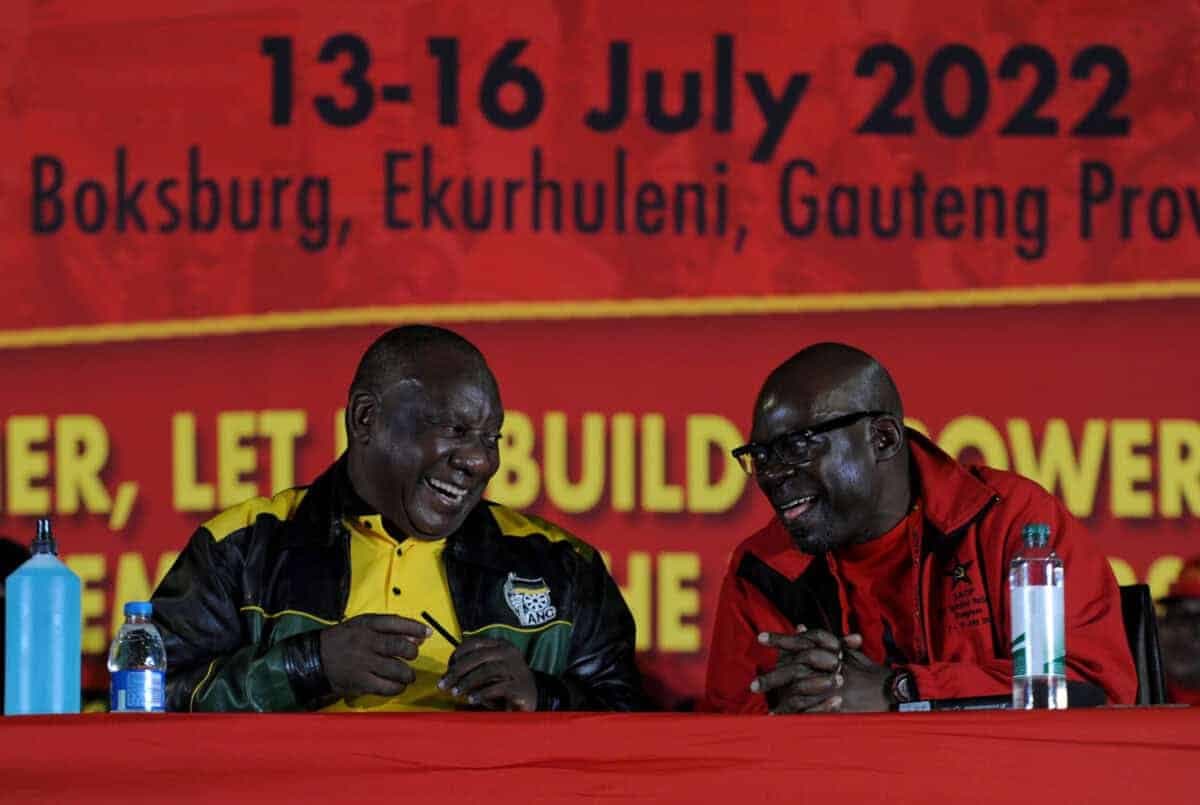
The growing tension between the ANC and its struggle-era ally, the South African Communist Party (SACP), is thickening – and you can cut it with a knife. ANC secretary-general Fikile Mbalula’s tone suggests a man no longer invested in the relationship. It’s not just him; the ANC leadership appears to be discounting the SACP, with Mbalula serving as its mouthpiece, spinning the situation as less dire than it is.
Last Tuesday’s ANC media briefing sparked an exchange of sharp words. SACP spokesperson Mbulelo Mandlana challenged the ANC in a manner that carried “enough is enough” undertones. Earlier, Mbalula had issued ANC members a 10-day ultimatum: declare whether they would campaign for the ANC or the SACP.
His message was blunt, choose one. That hardly sounded like a couple intent on staying together. It seems only a matter of time before the alliance dissolves permanently.
Like a marriage in separation, the countdown to divorce has begun. Political analyst Prof George Tsibani says the alliance is already gone, blaming the SACP for missteps. In a short opinion piece, he wrote: “The premature decision of the SACP to contest the 2026 local government elections outside the ambit of the ANC alliance marks a departure from the historical trajectory and foundational ethos of the alliance.
“It portrays a failure to grasp the dialectical character of SA’s politics, which are at once global in orientation and local in application.” The Tripartite Alliance of the ANC, SACP, and Cosatu was forged to fight apartheid, achieve democracy and, ultimately, pursue a socialist economic future. But the second stage of the revolution was derailed by former president Nelson Mandela, who led the ANC into embracing neoliberalism, abandoning nationalisation and the reconstruction and development agenda under pressure from business leaders. The adoption of the growth, employment, and redistribution policy pitted the alliance’s left against its right.
While later leaders carried the policy forward, it was Mandela who forced it through, despite fierce opposition from the SACP and Cosatu. Only Julius Malema became brave enough to call it “selling out”. At this week’s briefing, Mbalula again warned ANC members against campaigning for the SACP, rejecting what he called “dual voting”.
He promised consequences for those who crossed the line. Yet he sidestepped the reality that some ANC members may still vote for the SACP even if they don’t campaign for it. The campaign to undermine each other is already underway, even before the ANC’s official election drive begins in July.
Since the SACP resolved to contest elections independently, experts have debated the implications. The symbolism of the split is as important as its practical effects. For decades, the alliance served as the backbone of South Africa’s post-apartheid political order, sustained by compromise.
The SACP’s decision does not formally dissolve the alliance, but it exposes its fragility. Pretending unity while campaigning separately is a contradiction that will test both organisations’ credibility. Whether the SACP’s move reshapes local politics, or remains symbolic dissent, is uncertain.
What is clear is the alliance, once central to SA’s democratic transition, is entering uncharted territory. The ANC must confront a divided electorate, while the SACP must prove its independence is more than a gesture, that it can mobilise communities and deliver results. Analysts caution that voter anger at the ANC may spill over to the SACP, given their shared governance record over three decades.