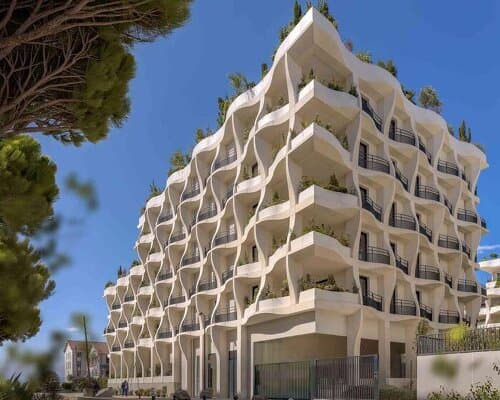
Bioclimatic shell facades shape Jardins Secrets housing in France Situated in Montpellier’s Cité Créative, France, Jardins Secrets is a residential development designed by Vincent Callebaut. The project brings together two housing schemes, Théia (75 units) and Opale & Sens (38 units), for a total of 113 dwellings developed in line with RE2020 environmental standards. Located on the former site of the Infantry Application School, the intervention engages with the site’s transformation through a combination of historical continuity and contemporary urban strategies.
The architecture is defined by a system of curved, shell-like facades that operate as bioclimatic envelopes. These external structures function as exoskeletons, filtering sunlight, facilitating natural ventilation, and moderating exposure to wind. Their geometry contributes to thermal regulation by enhancing solar protection and supporting airflow, while establishing a formal language informed by biomimicry and references to Art Nouveau precedents.
The buildings are positioned within a landscape framework that extends toward Parc Montcalm, forming part of a larger ecological corridor within the city. all images courtesy of Vincent Callebaut Architectures a planted courtyard anchors the climate-responsive housing Environmental strategies are integrated across multiple scales. The project incorporates rainwater harvesting and greywater recycling systems to support irrigation, alongside low-carbon construction methods and high-performance insulation. Dense planting, inspired by Mediterranean garrigue ecosystems, contributes to evapotranspiration and the formation of localized cooling conditions while supporting biodiversity.
Energy supply combines a biomass district heating connection with on-site photovoltaic panels. The overall urban configuration, developed by Studio Vincent Callebaut Architectures, balances density with permeability. Residential units are arranged around a central open courtyard designed to facilitate water infiltration and improve thermal comfort.
Pedestrian pathways, shaded passages, and planted patios connect the development to its surroundings, while elevated ground floors provide privacy without disrupting the continuity of the streetscape. Jardins Secrets is located in Montpellier’s Cité Créative district loggias, patios, and shared terraces organize the housing blocks The Théia block is organized in an L-shaped configuration, allowing for dual-aspect and multi-oriented apartments extended by deep loggias and balconies. Roof terraces provide shared outdoor spaces, while parking is located underground to maintain ground permeability.
Opale & Sens adopts a more compact layout, structured around a central patio that supports ventilation and circulation. Units are oriented toward planted loggias facing the courtyard and balconies along the street, with ground-floor apartments benefiting from raised private gardens. Through its spatial, environmental, and material strategies, Jardins Secrets positions residential architecture as part of a broader ecological and urban system, where climate responsiveness, landscape integration, and collective living are addressed within a unified framework. two housing schemes combine into a single residential development Théia and Opale & Sens together provide 113 dwellings sunlight is filtered through the layered building skin a central courtyard organizes the residential layout curved facades define the architecture of the complex shell-like envelopes wrap the buildings as external structures natural ventilation is integrated into the facade design the buildings are positioned within a broader landscape framework the project integrates housing, landscape, and climate into a unified system project info: name: Jardins Secrets, A Duo of Bioclimatic Shells at Montpellier’s Cité Créative architect: Vincent Callebaut Architectures | @vincentcallebautarchitectures location: Cité Créative, Jardins Secrets, Montpellier, France Théia client: Bouygues Immobilier – 75 residential units (including 17 affordable ones) Opale & Sens client: Vestia Groupe – 38 residential units (including 11 affordable ones) total: 113 residential units (including 28 affordable ones – 25%) ground floor area: 5,364 sqm + 2,845 sqm = 8,209 sqm structure: André Verdier Ingénieur Conseil MEP: Dexo landscape designer: Land’Act Paysages & Territoires control office: Groupe Qualiconsult City of Montpellier: Groupe SERM/SA3M Montpellier, Ville, Métropole et Ccas urban planner: West 8 MOEX Théia: CIC DELMAS MOEX Opale & Sens: Rémi Bonnaure main contractor: Sectp facade: Rampa Prefa plant & tree nursery: Sariviere grey water recycling: Fgwrs designboom has received this project from our DIY submissions feature, where we welcome our readers to submit their own work for publication. see more project submissions from our readers here. edited by: christina vergopoulou | designboom The post curved shell-like f