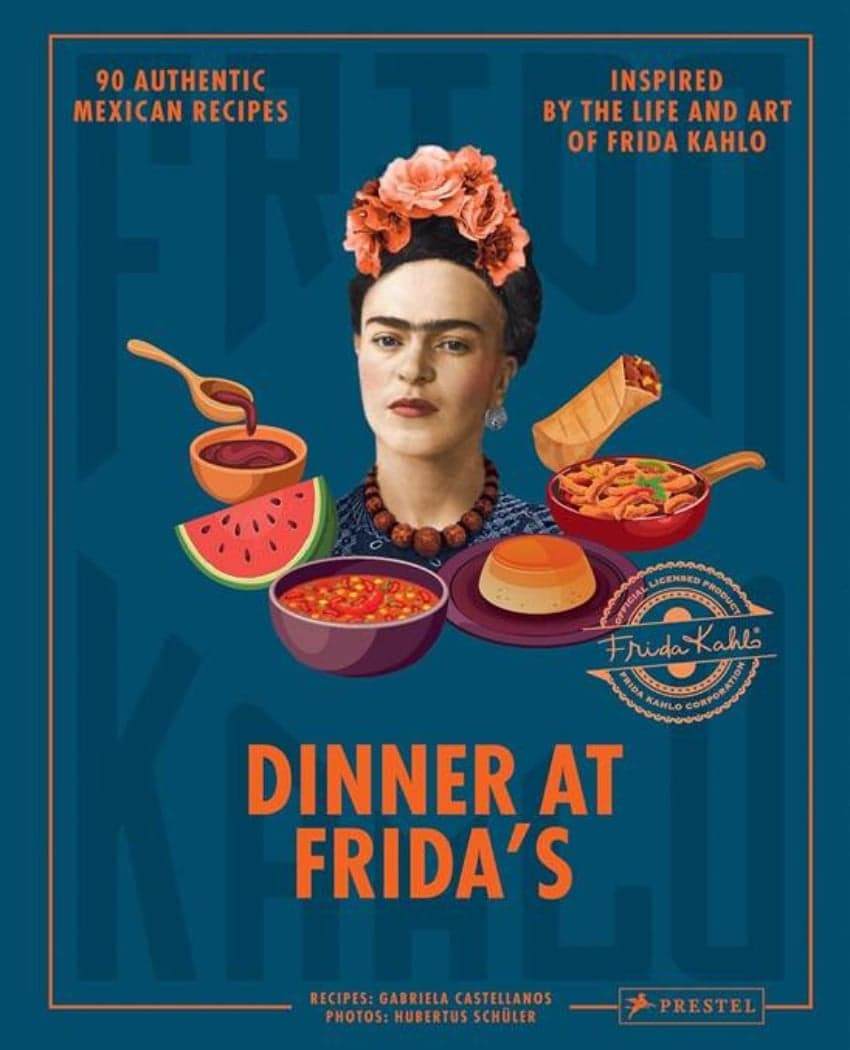
This is the fourth installment of our Mexico Well-Read series. To catch up on the first three entries, click here, here and here. It may raise an eyebrow or two among regular readers of this column to find a cookbook under review this month rather than the usual work of literary fiction.
There are no unreliable narrators or morally ambiguous protagonists this time, no labyrinthine plots or elliptical timelines. And yet “Dinner At Frida’s: 90 Authentic Mexican Recipes Inspired by the Life and Art of Frida,” by Gabriela Castellanos and Hubertus Schüler, demonstrates with considerable charm that a cookbook, like any good book, can have a point of view, a sense of place and a strong narrative voice that carries the reader through. Chef Gabriela Castellanos asks an intriguing question: What would it have been like to sit down to dinner with Frida Kahlo at her Casa Azul residence?
Castellanos curates a selection of recipes inspired by the culinary traditions of Kahlo’s household, while photographer Hubertus Schüler provides accompanying images that are rich, saturated and faintly dreamlike, as though the dishes themselves had passed through Kahlo’s imaginative lens. The premise of “Dinner at Frida’s” is irresistible: What might it have been like to dine at Kahlo’s table? (Prestel Publishing) Recipes that tell stories “Dinner at Frida’s” draws deeply from the atmosphere of Casa Azul — now a museum but reanimated in the book as a vibrant domestic space. Castellanos, who was born and raised in Oaxaca, does not attempt the impossible task of reconstructing exact menus but instead offers a plausible, affectionate portrait of the kinds of meals that might have graced Kahlo’s table — rooted in regional traditions, attentive to seasonality and unabashedly celebratory.
Brief headnotes situate each dish within a web of associations: historical anecdotes, geographic origins and tantalizing glimpses of Kahlo’s own tastes and habits. Once one has read through several recipes and notes, a portrait begins to emerge of Kahlo as the woman who entertained, who nourished and who gathered people around her table — she welcomed guests from all walks of life, including Leon Trotsky, the Rockefellers and Orson Welles. Certain patterns become clear that also situate the food within the broader Mexican culinary tradition: the importance of particular ingredients, the rhythms of seasonal cooking and the way flavors build and balance over time.
At its core, this is a practical cookbook, and Castellanos writes with clarity, avoiding the florid excess that sometimes mars contemporary food writing. She favors straightforward instructions that make even the more complex dishes feel approachable. Whether it’s a rich mole, a celebratory chile en nogada or a simple breakfast dish, each recipe is designed to be actually cooked, not just admired.
There is an implicit trust in the reader; one is not merely following directions but participating in a shared tradition, enjoying a conversation between past and present. The visual language of food Schüler’s photographs feel tactile, immediate and faintly, comfortingly, imperfect; surfaces bear the marks of use. There’s a clear nod to Kahlo’s aesthetic — bold colors, strong textures and a sense that beauty can be found in ordinary objects.
A bowl of sauce becomes an exercise in chiaroscuro while a cluster of fruit suggests a still life that Kahlo herself might have painted. And a plate of food is never just a plate of food; it sits within a larger scene that might include a worn wooden table or a traditional textile. These details matter.
They remind us that food does not exist in isolation; it is always embedded in a network of meanings, ritual and history. The recipes do double duty: they are instructions, yes, but also small windows into a way of life. Food, memory and community There is an irresistible pleasure in the book’s premise: the idea of dining with Kahlo, sharing in her hospitality and glimpsing her domestic world.
Kahlo’s life has, of course, been endlessly interpreted, romanticized and commodified, but Castellanos takes care to strike a careful, respectful balance, resulting in a thoughtful exploration of Mexican cuisine. What, then, does it mean to review a cookbook in a space typically reserved for literary fiction? It is acknowledged that narrative takes many forms.
In “Dinner at Frida’s,” the story unfolds in courses rather than chapters; it is not linear but cumulative, built through repetition, variation and sensory detail. Hubertus Schüler’s photographs evoke Kahlo’s own visual vocabulary, echoing her fascination with texture, color and the interplay between the sensual and symbolic. (Prestel Publishing) There is, moreover, a distinctly Mexican sensibility at work here — a recognition that food is inseparable from identity, memory and community. The most memorable stories are often the ones you share, plate by plate, with family and friends.
Buen provecho! Ann Marie Jackson is a boo