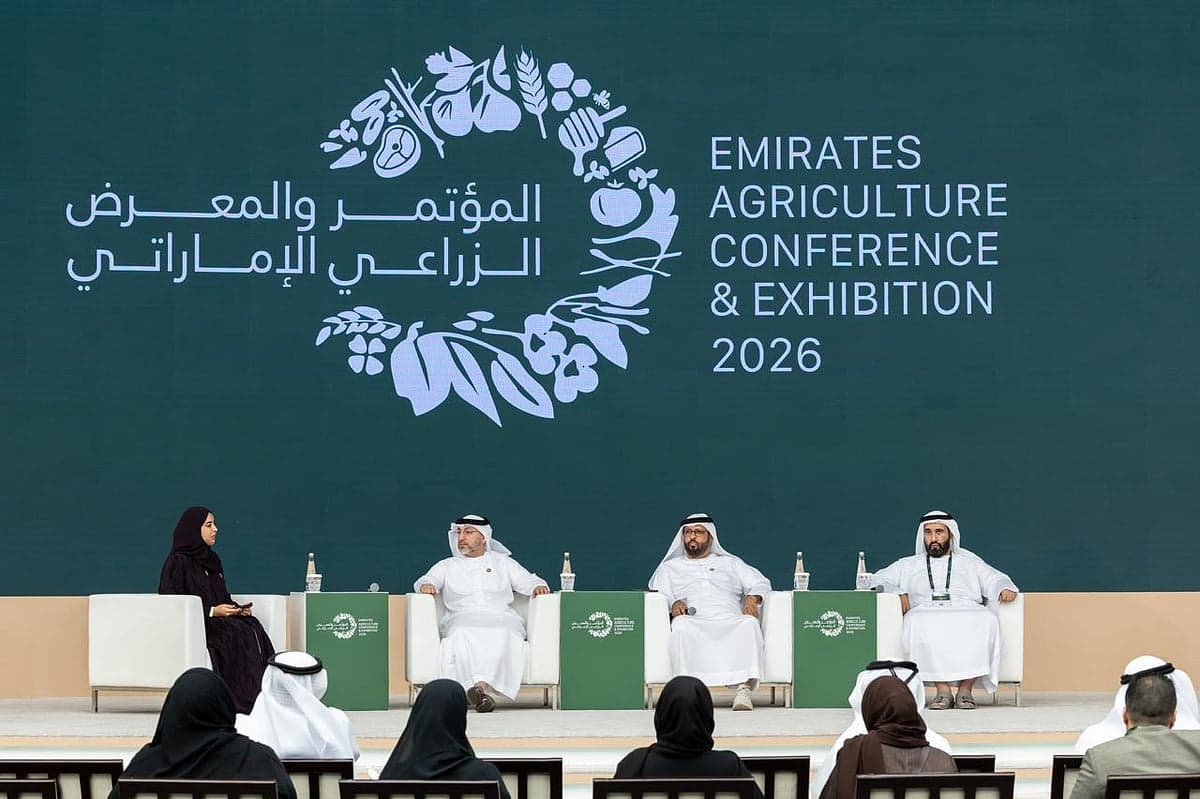
AL AIN: On the second day of the Emirates Agriculture Conference and Exhibition 2026, discussions centred on strengthening national food industries, creating value chains for local products, and attracting investment in agriculture.These efforts aim to boost the competitiveness of Emirati products and position agriculture and food industries as a key economic sector ready for investment.The day brought together senior officials, industry experts, business leaders, and private sector representatives across four high-level panel discussions. Topics covered the future of agriculture and investment in food industries, the development of local product-based industries, food innovation, and opportunities to expand the beekeeping and honey sector within the broader value-added ecosystem.The discussions aligned with the vision of the Emirates Agriculture Conference and Exhibition 2026, organised by the Ministry of Climate Change and Environment under the theme "A Comprehensive Emirati Agricultural Platform...Towards a Sustainable Community and Global Innovation".
Bridge-buildingThe event bridges agricultural production, food processing, investment, and innovation through dialogue, building a more integrated, sustainable, and resilient food system.In his keynote address, Sheikh Salem bin Sultan bin Saqr Al Qasimi, Chairman of the Department of Civil Aviation and Chairman of Ras Al Khaimah International Airport and Chairman of One Hive for honey production, emphasised that beekeeping is a key pillar of the food industry, valued for its premium and healthy products. Sheikh Salem made clear that bees are more than honey makers, they are essential contributors to a vibrant food and economic ecosystem.Global demand for natural honeySheikh Salem highlighted that with global demand for natural honey on the rise, the UAE is well-positioned to build a fully integrated national industry in honey and its derivatives, a goal that aligns seamlessly with the ‘Made in the UAE’ campaign.
He called on young people to explore this growing field and harness its vast potential.Agricultural innovation fundIn his opening remarks, Zafer Rashed Al Qasimi, CEO of Silal Group, announced that applications are now open for the Agricultural Innovation Fund, an initiative under the Group’s Innovation Oasis. He stressed that farmers are central partners in advancing the agriculture and food sector, and the primary drivers of production, growth, and innovation.Al Qasimi explained that the Fund aims to support local farmers by transforming their promising ideas into practical, on-the-ground projects that enhance production efficiency and strengthen the competitiveness of the agricultural sector.
He noted that five farmers are selected annually, each receiving financial support of up to Dh200,000 to implement their projects in the Al Ain region, alongside dedicated technical supervision from Innovation Oasis experts, engineers, and partners — ensuring these ideas translate into tangible, real-world results.Investment in agriculture, foodThe day began with the opening session "The Future of Investment in Agriculture and Food Industries", which explored investment opportunities in agriculture and food through the lens of regulatory frameworks and economic potential. The session also explored the private sector’s role in building value chains and positioning agriculture and food industries as a sustainable and attractive investment destination.Panellists included Mohammed Saeed Al Nuaimi, Undersecretary of the Ministry of Climate Change and Environment; Dr.
Khalifa Musabbeh Al Tunaiji, Chairman of the Department of Agriculture and Livestock and CEO of IKTVA Foundation; Abdullah Al Saleh, Undersecretary of the Ministry of Economy and Tourism; and Dhafer Rashid Al Qasimi, CEO of Silal Group. The discussion was moderated by Marwan Abdullah Al Zaabi, Assistant Undersecretary for Regions Sector.From farming to marketingMohammed Saeed Al Nuaimi, Undersecretary of the Ministry of Climate Change and Environment, emphasised the importance of fostering an economic mindset among farmers. This would help enhance production as well as their marketing capabilities in a more efficient and sustainable way.
He noted that the percentage of farmers who now handle the marketing of their own products has increased over time. He explained that studies indicate that adopting both agricultural and business mindsets contributes to about 20-25% added value to products, in addition to reducing waste of up to 40%.Abdullah Al Saleh affirmed that investing in the agricultural sector represents a promising opportunity. Focus on agri-tech, marketingHe noted that the success of any project in this field requires sound planning, an accurate feasibility study, and a clear understanding of market needs, alongside product improvement, production cost analysis, and search for the best technologies to support the production process. Al Saleh also highlighted the need to keep in step with th