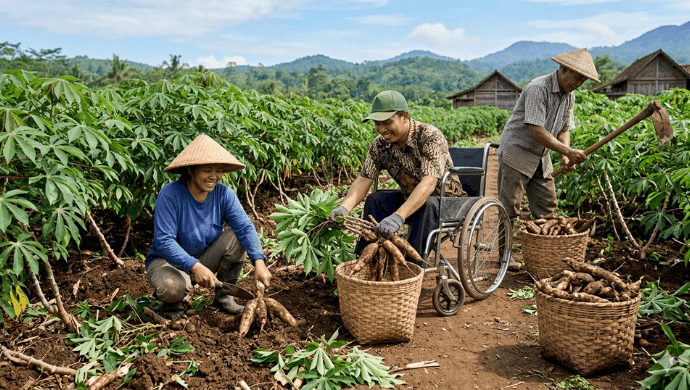
At the end of 2025, a group of cassava farmers gathered not to celebrate a harvest but to protest. The price of cassava had collapsed again, bought by formal markets at below US$0.06 per kilogram, despite a recognised standard of US$0.08 for cassava with 24 per cent tapioca content. Chilli farmers across the country know the same story: middlemen manipulate the prices, and nobody in the system has the structural leverage to push back.
Even until now, this unstable price structure remains. The root of this problem is not productivity. The problem is governance.
Products from other districts flow freely into local markets without coordination, underselling prices and leaving farmers with no pricing power and no identity in the supply chain. Efforts to fix this have come and gone, such as credit programs, modernisation schemes, and marketing training. Each program mostly only addresses one layer.
One Village One Product: A framework Indonesia already has, but underuses One Village One Product, or OVOP, was first launched in Japan in 1979 to revitalise rural economies by anchoring each community to its most distinctive product. Instead of competing on volume, compete on identity. Thailand understood this early.
Its OTOP program produced Thung Kula Rong-Hai Thai Hom Mali Rice for the European market and Hauymon Pineapple exports across Asia and the United States. These are not niche results. They came from a national commitment to treating agricultural origin as an economic asset.
Indonesia has that asset, too. Lampung is known for coffee and cassava. South Sumatera for citrus. West Java for tea.
Gorontalo for corn. The Great Giant Pineapple in Lampung already shows what is possible when a local product competes globally against exports from Thailand and the Philippines. The potential exists, but the architecture to replicate it at the smallholder level does not yet.
Also Read: Turning crisis into capital: Indonesia’s climate x health pivot gains global attention Indonesia has implemented OVOP in a limited form, but almost entirely for handicraft and textile products. The agricultural sector has largely been left outside its scope, and that needs to change. Why OVOP is also a GEDSI intervention Expanding OVOP into agriculture matters beyond economics.
When it is applied thoughtfully, it becomes one of the most effective delivery mechanisms for Gender Equality, Disability and Social Inclusion (GEDSI). On gender equality, OVOP works because it demands collective participation across the full production and decision-making chain. Deciding which product best represents a village, how it should be processed, and how it should reach buyers: these cannot be carried out by one group in isolation.
Female farmers who engage directly with market dynamics develop a sharper understanding of what buyers want and why. When women are embedded in the design of a village’s product identity rather than added as an afterthought, they become indispensable to its success. On disability and social inclusion, OVOP’s cooperative model is significant.
When a village organises a single product, work is distributed across many roles such as cultivation, quality control, processing, packaging, documentation, and market liaison. A cooperative designed for broad participation can accommodate members across a wide range of physical capacities. A person with a mobility limitation may not harvest in the field, but can lead quality grading at the processing stage.
This is not charity. It is a design choice that makes the cooperative more resilient by drawing on a wider talent base. Social inclusion follows naturally.
The market access will be easier to enter when it is mediated through collective identity rather than individual bargaining power. Also Read: Underfunded and under fire: Indonesia’s cyber startups face 2025 reality The farmers who gathered in Lampung to protest a collapsed price were not asking for charity. They were asking for a system that works.
OVOP would give Indonesia’s smallholder farmers something that credit programs and modernisation schemes have never provided, that is, a structural position in the market that is difficult to undercut and a collective identity for a sustainable agribusiness system. — Editor’s note: e27 aims to foster thought leadership by publishing views from the community. You can also share your perspective by submitting an article, video, podcast, or infographic. The views expressed in this article are those of the author and do not necessarily reflect the official policy or position of e27. Join us on WhatsApp, Instagram, Facebook, X, and LinkedIn to stay connected.