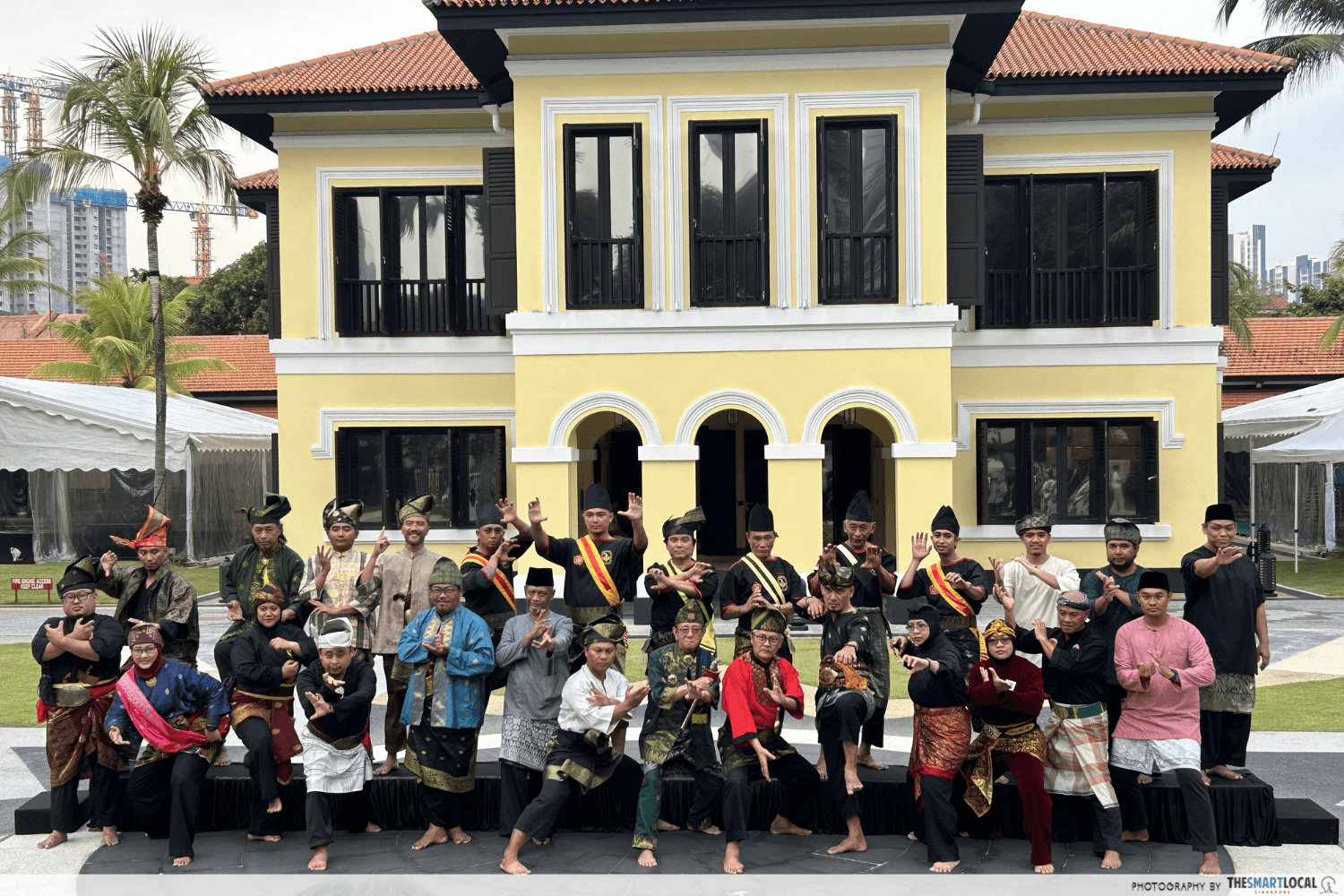
Malay Heritage Centre After 4 long years, the Malay Heritage Centre is finally reopening its doors and welcoming visitors on 25th April 2026. You can expect refreshed galleries housing more artefacts and newly commissioned artworks – perfect for stepping back in time and exploring the culture of the Malay community. We went down for a visit before the centre officially reopens – here’s what you can look forward to: What is new at the revamped Malay Heritage Centre?
The Malay Heritage Centre showcases the history, culture, and contributions of the Malay community in Singapore. Its permanent 6 galleries have undergone renovations and now include new artefacts and artworks that highlight centuries of trade and cultural exchange across the Malay Archipelago. To mark the reopening of the centre, there’ll be a 9-day festival, Pesta Pecah Panggung — Transcending Boundaries, which revolves around the theme of Dari Rantau Ke Rumah (From the Region to Home).
Featuring exhibitions, workshops, community programmes, and performances, the festival will explore Singapore’s Malay heritage and its connections in relation to the broader Malay world, touching on questions such as “What is heritage?” and “What does it mean to be a Singaporean Malay?” More on that below. What to expect at the revamped Malay Heritage Centre? Aside from the 6 refreshed and permanent galleries, the centre is also hosting a series of performances and workshops where you can make your own jong or graffiti your name in Jawi on a permanent exhibition in the centre. 6 permanent galleries The 6 galleries revolve around different themes in Malay heritage, ranging from the fostering of relationships between different Malay ethnic groups to family dynamics within the Malay community.
What they all have in common is the highlighted roles played by women in the community, shedding light on their contributions throughout centuries, be it in kinship or the arts and entertainment industry. Most notable is Gallery 4, City of Dreams: Making A Mark, which focuses on the changing visibility and roles of Malay women in the 1950s and 1960s. The gallery features notable women, such as Saleha Mohd Shah, Siput Sarawak, and Normadiah, who have contributed to the rise and recognition of the modern Malay woman in film and media.
You’ll even get to see original costumes, like the red and black kebaya worn by K Fatimah in the film Ibu Mertuaku, as well as tapestry prints of magazine covers featuring the women. We also tried our hand at an interactive sound installation, Sistem penyulitan masyarakat lusa (sipemalu) (encryption system for society of the future / the shy one) by Bani Haykal, where you key in a message or word using the piano keys to transmit unique sounds. Commissioned artworks by local artists NEO_ARTEFACTS by Fazleen Karlan, which investigates the intersection of art and archaeology, is drawn from her own experience as a post-excavation technician.
Something new to check out at the centre is the Corridors of Cultural Memories, which houses commissioned artworks by local Malay artists. Each piece is aimed at getting visitors to reflect on the question “What will we choose to inherit, and what will we evolve?” as part of the Dari Rantau Ke Rumah narrative. Our New Home by Tumadi Patri, which tells the story of a storyteller who controls and narrates the performances of characters such as Semar, Petruk, and Garuda.
These pieces can be found all over the museum, even in the stairwells, so keep an eye out for hidden stories within the building. There is also a graffiti feature by local artist Boon that’s still a work-in-progress. The wall depicts scenes from popular folktales such as Sang Nila Utama’s founding of Singapore, the tale of how Redhill got its name, and will also feature Malay ethnic groups such as the Orang Laut.
Interactive stations with fun activities Another fun activity you wouldn’t want to miss is the Scripts of the Malay Archipelago station, where you’ll get to write your name in Jawi, Renjang, or Lontara. Simply type in your name, and you will be guided to write it out. At the end of it, the machine will print out your name in the selected script for you to keep.
Then there’s the Burung Petala Wati, where a carved wooden congkak set stands out on the 2nd floor due to its imposing size and design. Modelled after a mythical bird, this artefact is an example of how Malay artisans were influenced by Hindu-Buddhist and Muslim kingdoms from across the Siamese border. Congkak, or mancala, is a game that requires 2 players to share a wooden board with 1 row of 7 holes along each side, with a bigger hole at both ends.
The objective is to get as many “seeds” or stones as possible in the bigger hole. Try your hand at the game through the interactive screen adapted from the artefact itself. 9-day festival featuring community events To celebrate the reopening, the Malay Heritage Centre will be hosting Pesta Pecah Panggung, a 9-day festival with a range of f