LONDON — England’s two insurgent populist parties will break through in London’s May elections and are likely to take the lead in several of the capital’s 32 council areas, an extensive new poll suggests. The left-wing Green Party is projected to win the highest vote share on four authorities long held by the Labour Party — Hackney, Lambeth, Lewisham and Waltham Forest — according to a YouGov polling model shared with POLITICO. The same model projects that the right-wing Reform UK will become the largest party on three suburban councils: Labour-run Barking and Dagenham, Conservative-run Bromley, and Havering, which is currently in no overall control.
The survey provides more evidence of the scale of the challenge facing Britain’s ruling Labour Party and its leader, Prime Minister Keir Starmer, in some of its most treasured strongholds ahead of elections across England, Scotland and Wales on May 7. It comes as centrist parties across Europe try to fend off populists on the left and right. Lewisham and Hackney have not been run by a party other Labour since the 1970s, Waltham Forest since the 1980s and Lambeth since the 2000s.
By contrast, the Greens currently have only 49 councillors across the entire capital while Reform has a far smaller number than that. But the state of play is highly volatile. Half of London’s 32 councils are rated by the polling firm as either “very close” or “super close.” Patrick English, YouGov’s head of elections, said: “This is broadly reflective of what we are seeing nationally — a great big fragmentation of the vote into all these different parties.
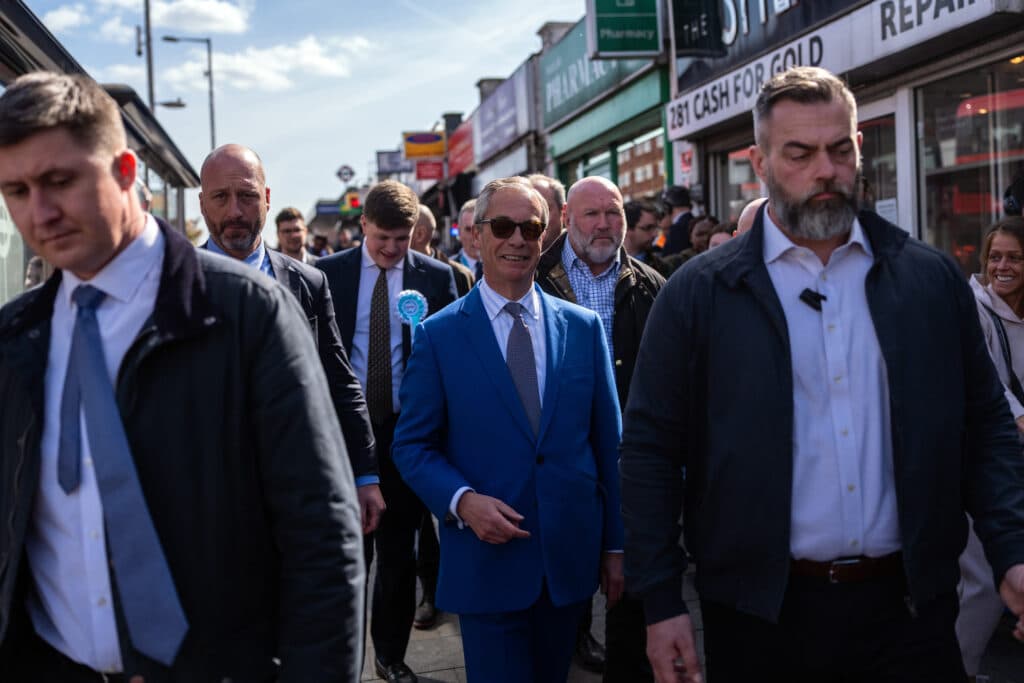
Reform UK Leader Nigel Farage, center, campaigns in Dagenham, April 10, 2026. | Carl Court/Getty Images “They’re all eating each other’s pies and creating this situation where the largest party vote shares for each council could be 23 to 25 percent of the vote. Fragmentation means that winning post gets lower and lower, and slight changes in the voting intention numbers could dramatically change the picture.” YouGov projected vote shares for each of the 32 areas in its first multilevel regression and post-stratification (MRP) poll of the capital’s council areas. It is designed to map results at a more granular level but does not predict the number of seats won or who will end up running each council.
London has become the area of highest concern in the May elections for many in Starmer’s ruling Labour Party, who fear the traditional “donut” — of left-wing voters in the inner city and conservative voters in the outer boroughs — will pivot to the Greens and Reform simultaneously. This could turn the capital’s boroughs into a “patchwork quilt” run by a mixture of established and insurgent parties, sometimes in coalition with each other, while Labour Mayor Sadiq Khan continues to preside over City Hall until 2028. Reform leader Nigel Farage said in December that his party had a “very real chance” of winning in “half a dozen” London boroughs.
The YouGov model projects Reform to win three — although in two further councils, Bexley and Hillingdon, it is predicted to be the second-largest party behind the Conservatives. In 2022 Labour won control of 21 councils and the Conservatives won control of five. The poll projects Labour will win the highest vote share on 15 councils, the Conservatives on five and the Liberal Democrats on four, though some of these results are very narrow.
Of the 15 areas where Labour is predicted to be the largest party, the Green Party would be in second place in 12. Half of those — Brent, Ealing, Enfield, Haringey, Hounslow and Newham — are rated as “very close” or “super close.” The poll tips the Conservative Party to remain the largest party in Bexley, Harrow, Hillingdon and Kensington and Chelsea, and to knock Labour off the top spot in Barnet, but Reform is posing difficulties for the Tories too. Meanwhile the poll predicts that the Conservatives will not win back their prized councils of Westminster or Wandsworth, in which Labour is projected to remain the largest party — though both areas are rated as “fairly close.” YouGov interviewed 4,548 people between March 27 and April 21, of which 1,520 were included in the final model.