In a “wet lab” in San Francisco, The Biological Computing Co. is growing computers from brain cells. It is creating a new class of compute that integrates living neurons with modern AI, becoming the first to deploy applied biological computing for computer vision, generative video, and AI infrastructure. We’ll address whether the brain cells are living or not as well as the company’s views of the ethical way to do this.
And we’ll delve into its aim of saving the planet from inefficient computing that could run us out of energy. It’s a long story, but I find it fascinating. The company known as TBC recently came out of stealth in February after decades of gestation and announced a $25 million seed round led by Primary Ventures.
We joined a small group of journalists who got a full briefing and toured the lab in San Francisco. Formerly known as Biological Black Box (BBB), The Biological Computing Company connects living neurons with modern AI to make frontier models more stable, scalable, and efficient. The plan in a nutshell The company’s neural-based solution integrates directly with foundation models to improve performance while reducing compute cost, reflecting a belief that the future of high-performance computing will increasingly incorporate real biology.
It comes from the natural advantage that living neurons have in creating “algorithms” with their natural functions of connecting and networking and learning. “The takeaway is that this is happening now. This is not a science project.
Biological computing is here,” said Jon Pomeraniec, cofounder of TBC, in an interview with GamesBeat. “We are the only people in the world to commercialize it in a very meaningful way. I think that’s the big picture.
We are taking real neurons, which you’ll see from start to finish. We use real neurons as products to make models better, faster and cheaper. That’s that’s the big picture.” The perfect storm driving low-power biocomputing TBC was founded at the intersection of three global forces: breakthroughs in neuroscience, growing constraints of today’s AI systems, and an accelerating climate and energy crisis.
Today’s dominant architectures rely heavily on brute-force scaling and repeated optimization cycles. I’ll call this “dry” computing, because it’s based on silicon-based chips and electronic hardware. These approaches — embodied in the graphics processing units (GPUs) that are responsible for Nvidia’s $4.92 trillion valuation — have become increasingly expensive and difficult to sustain as systems move beyond static training, exposing the need for new computing paradigms that prioritize efficiency, stability, and reliability.
“The pinnacle of performant compute will closely resemble the brain in more ways than we can imagine,” said Scott Belsky, partner at A24 and previous chief of strategy at Adobe, in a statement. “TBC is pursuing a north star that I believe is the most promising direction to explore the future of computing.” Naveen Rao, managing editor at Neurotech Futures, was on the lab tour with me. He’s a Forbes contributor and market analyst operating a global neurotech business ecosystem after spending two decades across digital health, federal policy, and patient advocacy.
I asked him what promise he sees in TBC. “It represents an important direction of applied research methods in neuroscience, wherein labiratory methods are focusing on driving real world business value rather than academic value vis a vis publishing papers or unlocking grants,” Rao said. From living neurons to deployable AI TBC’s neuroscience and engineering team encodes real-world data (e.g., images, video) into living neurons, then decodes neural activity into richer representations mapped onto state-of-the-art AI models through modular adapters.
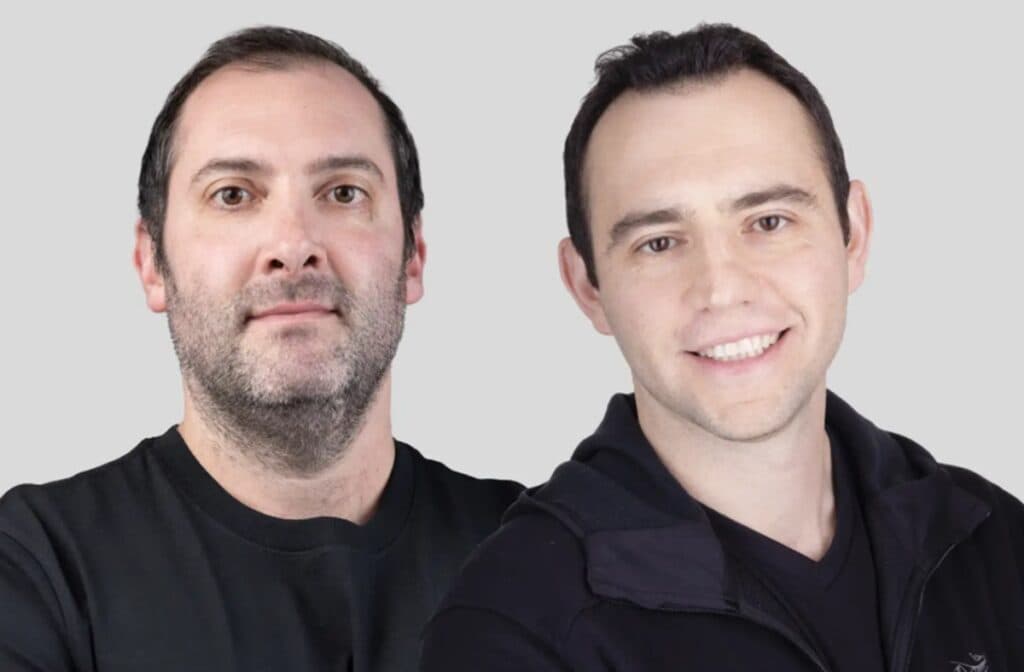
In parallel, TBC’s Algorithm Discovery platform applies biologically derived principles to inform new AI system design beyond transformers, creating a compute layer that strengthens existing architectures rather than replacing them. “Having worked at the intersection of neuroscience and AI, what excites me about TBC is that they’re not just borrowing metaphors – they’re using living neuronal cultures to discover learning rules for the next generation of AI,” noted Tim Gardner, cofounder of Neuralink, in a statement. Origins The Biological Computing Company cofounders Jon Pomeraniec (left) and Alex Ksendsovsky.
Believing that better computers require a revolution in computing itself, TBC cofounders Alex Ksendsovsky and Pomeraniec were both established neurosurgeons and neuroscientists. They believed they could establish a new computing category where biological networks complement silicon to unlock new performance and efficiency capabilities across modern AI systems – demonstrating scalable quality gains that are critical for real-world products operating under tight energy constraints. “I’ve been growing neurons on electrodes for about 20 years, since about 2005 and that’s that’s really when