Last year, my plans to celebrate Eid in Iran were dismantled by the sudden escalation of regional aggression. What was meant to be a personal pilgrimage became a casualty of geopolitics. Yet, in a twist of fate this past September, I found myself touching down at Tehran’s IKA Airport, not for a holiday, but as an invitee to the “Nobel of the Muslim World” or the Mustafa (PBUH) Prize granted to top science and technology researchers from the Organisation of Islamic Cooperation member states.
The September 6 to 10, 2025, award week is organised by the Mustafa (PBUH) Science and Technology Foundation, which stands as a testament to the enduring power of human inquiry. I had expected it to be a sombre affair. The mystics of Qom I was keen to visit the holy city of Qom before the events kicked off and so the organisers assigned me guides, two cheerful women, who led me through its striking salt ranges and mineral-dense rainbow rocks.
Qom greets you with pristine air and radiance. It was a Friday so the city was moving at an unbothered grace. Roads filled for prayers, yet nothing felt strained.
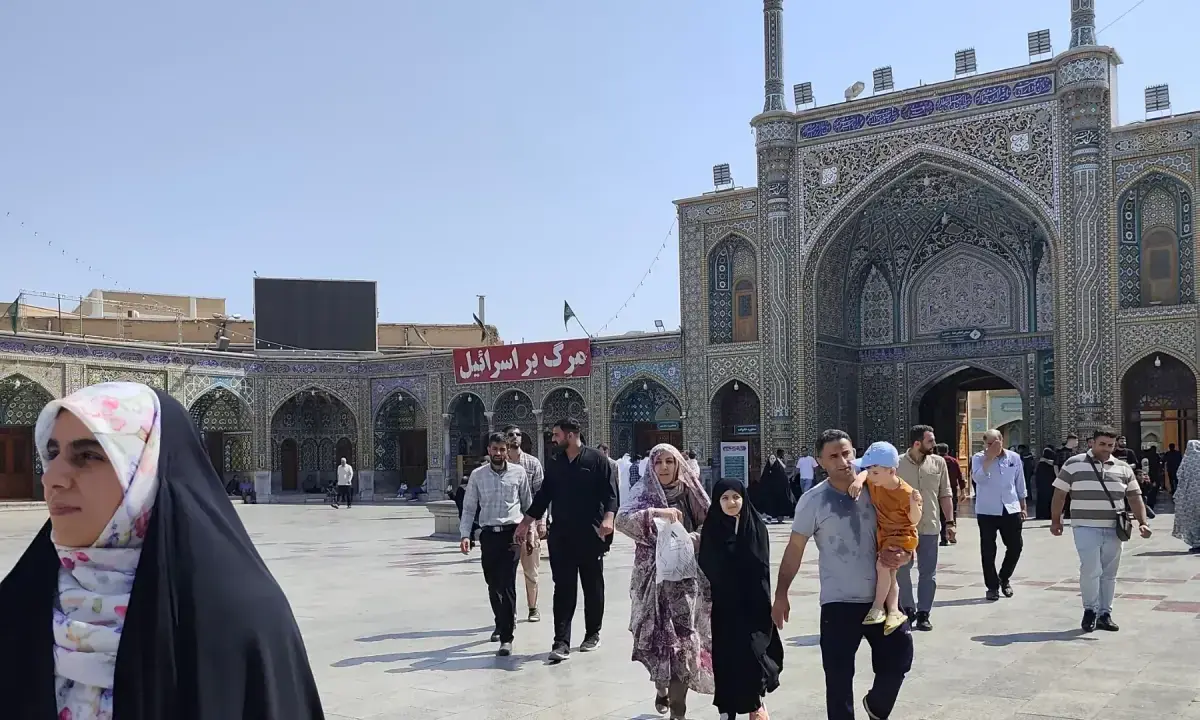
As we walked through garden-lined streets toward Bibi Masuma’s shrine, the resting place of the 27-year-old sister of Imam Ali Reza (AS), the eighth Shia imam, I understood why Qom is called the land of mystics. A monument facing the Holy Shrine of Bibi Ma’sooma in Qom, dedicated to an Afghan family who tragically perished in heavy snow while on pilgrimage to Mashhad. — photo by author Lady Masuma remains one of the most revered women in Shia Islam, and her presence has transformed the city into a centre of spirituality and learning, much like Najaf, the resting place of Imam Ali (AS). Yet, Qom resists a singular definition.
From across the shrine, Bollywood movie posters stared back at me from the window of an Indian store. Next to it, scholarly bookstores and quiet cafes welcomed visitors and tourists. On my previous visit to Iran, I watched a Mission Impossible movie dubbed in Farsi on a bus from Qom to Kashan.
I bought the dubbed Jodhaa Akbar, a version that felt more historically grounded, given that Farsi was the language of Mughal Emperor Akbar’s court. This is what continues to inspire me about Iran. It is a civilisation deeply intertwined with South Asia, its language, aesthetics, and traditions shaping our region long before colonial interruptions.
Before visiting the Jamkaran Mosque, a must-see ziarat in Qom, we stopped for lunch near the mountains, where charred kebabs, grilled tomatoes and saffron rice awaited us. Located on the outskirts of Qom, the sprawling complex of the mosque, its courtyards, and bookstores offered a space for reflection in contrast to the “war-torn” image of Iran so often projected by the Western media. But what stayed with me the most was the seamlessness of life, where spirituality, well-being, and urban design were not separate spheres but part of a coherent whole.
The city was green, walkable, and alive with gossipy families, cheery children, and talkative couples strolling about without their heads bent over screens. A traditional dinner in Tehran featuring saffron-infused Chelo Kebab, grilled tomatoes, Zereshk Polo (barberry rice) and Joojah (chicken) kebab. — photos by author It was the ordinary moments of a scholar dressed in an amama (ready-to-wear turban), another eating pizza with his family that felt unimaginable given the dominant portrayals of Iran. Years of rigid narratives have obscured these realities, making it difficult to envision progress, prosperity, and spirituality coexisting.
But Qom unsettled that fragmentation. Here, mysticism does not retreat from the world but shapes it. Men and women are encouraged to exercise, pursue education, wake for salat al-layl, and see environmental stewardship as a moral duty.
Poetry and heritage are not preserved relics, but living forces woven into everyday life. Decolonising the aesthetic Back in Tehran, the traffic, which doubled the otherwise two-hour journey to the capital, served as a grumbling reminder of a city very much alive. The Mustafa (PBUH) Prize Week commenced with a reception that felt more like a homecoming.
Mahdi Amini, the director of the International Cooperation Department at MSTF, greeted me with a sentiment that captured the spirit of the week: “I love Imam Hussain (AS); I had no worries that you would reach here safely.” This theme followed me everywhere. In my room, a stereo lithographic 3D-printed pen sat in an elegant box, accompanied by the Quranic verse: “Nun. By the pen and what they inscribe.” Alongside it was a message: “By the pen and all that it sets down… Bind knowledge by writing it.” The pen, shaped like a beam of light, conveyed the semantics very well; it was meant to be the light in one’s hand. Science and technology meeting at the University of Tehran’s cultural centre within Negarestan Garden. — photo by author This philosophy seemed to permeate every corner of the event, even at dinner la