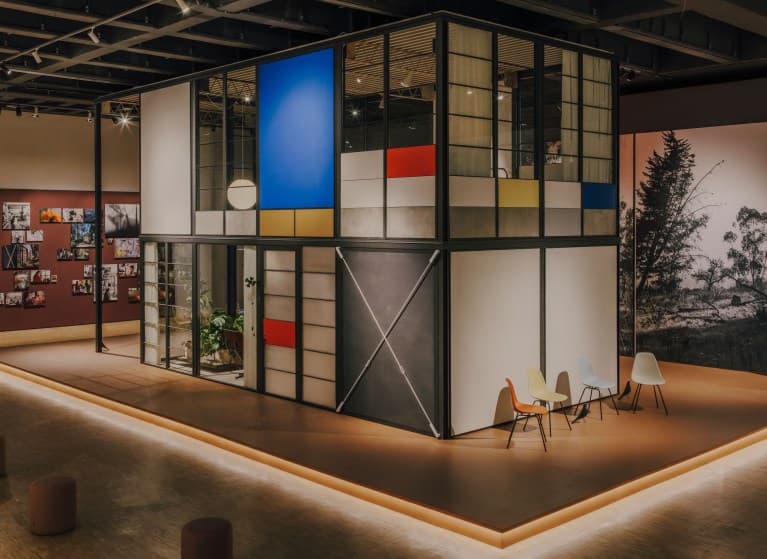
A new pavilion developed with Kettal, eight never-before-seen residential models and a landmark Phaidon volume reveal the full scope of the Eames vision Read Design The Eames Office Brings a Modular Architecture System to Life at Milan Design Week A new pavilion developed with Kettal, eight never-before-seen residential models and a landmark Phaidon volume reveal the full scope of the Eames vision Josh Rubin 22 April 2026 During the 2026 Milan Design Week, the Eames Office unveiled an ambitious architectural initiative at the Triennale Milano. Centered on an 800-square-meter exhibition titled The Eames Houses, the event marked the global debut of the Eames Pavilion System, developed in partnership with Barcelona-based manufacturer Kettal, alongside the release of a landmark sourcebook published by Phaidon, and has been one of the most talked about launches this year.
By Salva Lopez, Courtesy of Eames Office Grounded in nearly three years of archival research, the exhibition makes a sustained argument for Charles and Ray Eames as architects whose spatial thinking was as consequential as their furniture. Two full-scale, walk-in structures anchor the installation, giving visitors a physical encounter with the system’s logic and materiality. Newly commissioned 1:33 scale models of eight Eames houses—spanning both celebrated landmarks and previously undiscovered residential projects—extend that argument across a range of typologies: single-story structures, two-story buildings, specialized balconies and one example of an integrated Buckminster Fuller dome.
Eames Office Creative Director Eckart Maise framed the intent directly: “the Eames house is not the one and only house. It is about all these houses, and it was important to us to show all the houses fresh but also in the same quality and basically on the same eye level.” By Salva Lopez, Courtesy of Eames OfficeBy Salva Lopez, Courtesy of Eames OfficeCourtesy of Eames Office and KettalCourtesy of Eames Office and KettalCourtesy of Eames Office and KettalCourtesy of Eames Office and KettalCourtesy of Eames Office and KettalCourtesy of Eames Office and Kettal The Pavilion System itself is the centerpiece.
Rather than simply replicating Case Study House No. 8—the couple’s own Pacific Palisades home, completed in 1949 and among the most studied domestic structures of the 20th century—the project translates the Eameses’ experimental steel- and timber-frame concepts from the 1940s and ’50s into a fully engineered, industrialized construction kit available globally. Built on a rational grid of interchangeable modules, it prioritizes maximum volume within a modest footprint, while concealing wiring and heating systems within walls and profiles to preserve clean visual lines. Courtesy of Eames Office and Kettal The facade’s color blocking—panels of cobalt blue, ochre yellow, red and white set within a black steel grid—are instantly recognizable to anyone familiar with the duo’s furniture designs, while the warm wood cladding and sheer curtains that soften the interior are equally signature notes throughout their legacy.
A reissued sculptural cross-shaped mechanical doorbell (which will also be for sale) signals the same conviction that utility and beauty need not be separate concerns. Maise described the underlying philosophy: “It was also about open space. It was about flexibility of use.
It was this idea that life changes, the usage changes, the needs change and that the house should adapt.” By Salva Lopez, Courtesy of Eames Office That adaptability is palpable on entry. Despite a compact plan, the pavilion produces an outsized sense of volume—what Maise described as the ability to “experience on a very small footprint, you get a feeling of generosity and a volume, and it’s like a gift of space.” Courtesy of Phaidon Completing the initiative is The Eames Houses, a 288-page Phaidon volume containing over 1,000 images and recognized as the first comprehensive sourcebook of the duo’s residential architecture.
Its existence was, by Maise’s own account, unplanned. “The second outcome of this project, which wasn’t planned in the beginning, was a project that just got bigger and bigger and bigger,” he noted. The decision to publish came late: “So last year, in October, we said, why don’t we make this a real book and we bring it into the worldwide bookstores?” It made the finish line—and in doing so, positioned architecture as a third pillar of the Eames legacy, alongside the furniture and films that have long defined their public reputation.