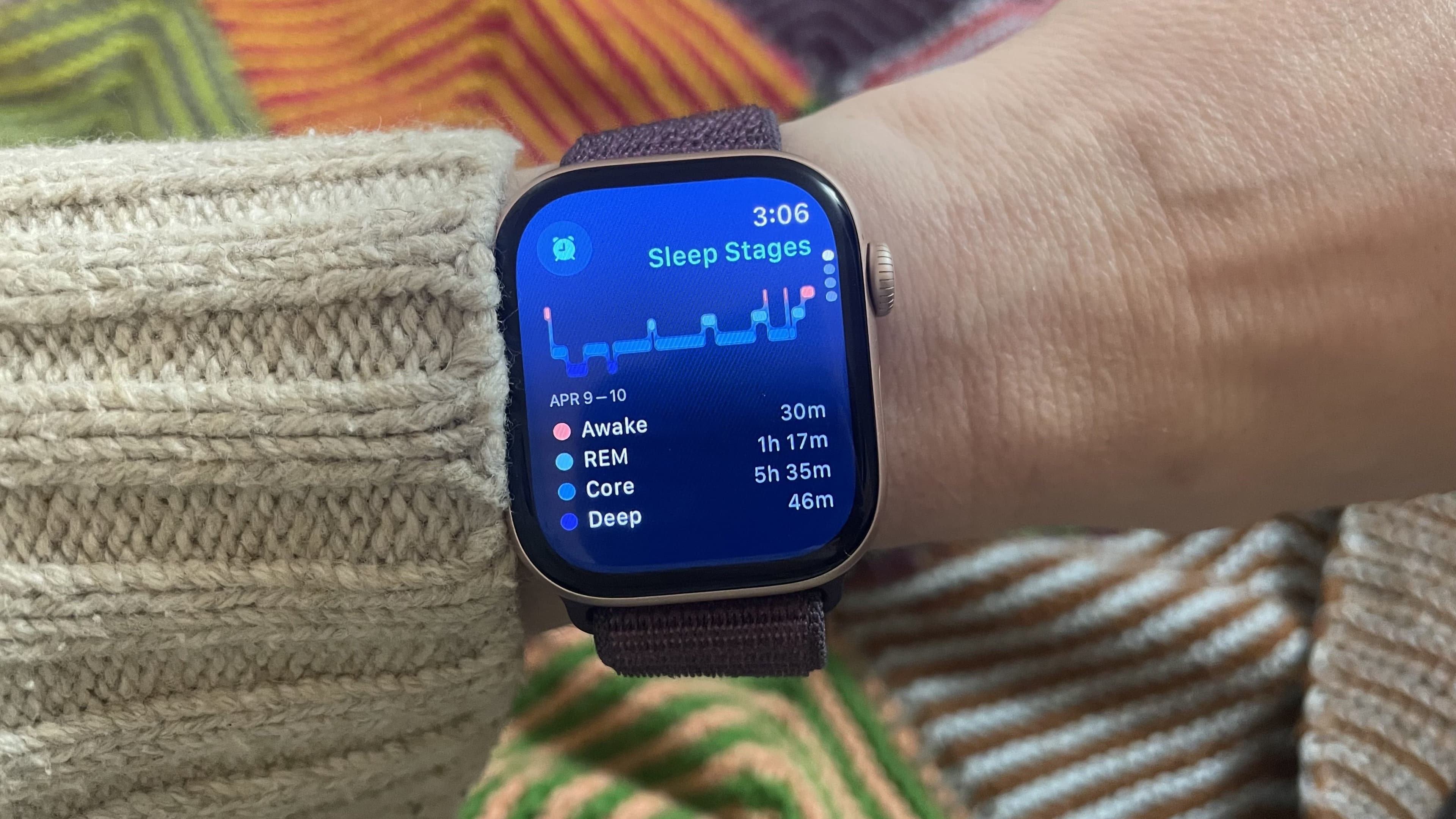
We may earn a commission from links on this page.Let's talk about one of the most confusing terms you’ll see on your fitness tracker—specifically your Apple Watch. Next to REM sleep, which you’ve probably heard of, and “deep” sleep, which feels self explanatory, there’s “core” sleep. And if you search or ask AI what core sleep means, you’ll often get a definition that is completely different from how Apple uses the term.
So let’s break it down. Apple Watch Series 11 46mm GPS Smartwatch (Space Gray, Black Sports Band) $329.00 at Amazon $429.00 Save $100.00 Get Deal Get Deal $329.00 at Amazon $429.00 Save $100.00 On an Apple Watch, "core sleep" is another name for light sleep, which scientists also call stages N1-N2. It is not a type of deep sleep, and has no relation to REM.
But in the scientific literature, "core sleep" is not a sleep stage at all. It can refer to a portion of the night that includes both deep and light sleep stages, and in other cases can be used to mean your longest or most important stretch of time in bed. There are a few other definitions, which I'll go into below.
But first, since you're probably here because you saw that term in Apple Health, let's talk about how Apple uses it."Core sleep" in the Apple Watch is the same as light sleepLet me give you a straightforward explanation of what you’re seeing when you look at your Apple sleep data. Your Apple Watch tries to guess, mainly through your movements, when you’re in each stage of sleep. (To truly know your sleep stages would require a sleep study with more sophisticated equipment, like an electroencephalogram. The watch is just doing its best with the data it has.) Apple says its watch can tell the difference between four different states: AwakeLight (“core”) sleepDeep sleepREM sleepThese categories roughly correspond to the sleep stages that neuroscientists can observe with polysomnography, which involves hooking you up to an electroencephalogram, or EEG. (That’s the thing where they attach wires to your head.) Scientists recognize three stages of non-REM sleep, with the third being described as deep sleep.
That means stages 1 and 2, which are sometimes called “light” sleep, are being labeled as “core” sleep by your wearable. In other words: Apple's definition of "core sleep" is identical to scientists' definition of "light sleep." It is otherwise known as N2 sleep. (More on that in a minute.) So why didn’t Apple use the same wording as everyone else?
The company says in a document on its sleep stage algorithm that it was worried people would misunderstand the term "light sleep" if it called it that. It writes: "The label Core was chosen to avoid possible unintended implications of the term light, because the N2 stage is predominant (often making up more than 50 percent of a night’s sleep), normal, and an important aspect of sleep physiology, containing sleep spindles and K-complexes." In other words, Apple thought we might assume that "light" sleep is less important than "deep" sleep, so it chose a new, important-sounding name to use in place of "light."A chart on the same page lays it out: non-REM stages 1 and 2 fall under the Apple category of “core” sleep, while stage 3 is “deep” sleep.
That’s how Apple defined it in testing: If an EEG said a person was in stage 2 when the watch said they were in “core,” that was counted as a success for the algorithm.What are the known sleep stages, and where does core sleep fit in?Let’s back up to consider what was known about sleep stages before Apple started renaming them. The current scientific understanding, which is based on brain wave patterns that can be read with an EEG, includes these stages: Non-REM stage 1 (N1) N1 only lasts a few minutes. You’re breathing normally.
Your body is beginning to relax, and your brain waves start to look different than they do when you’re awake. This would be considered part of your “light” sleep. The Apple Watch considers this to be part of your core sleep stage.Non-REM stage 2 (N2)Also usually considered “light” sleep, N2 makes up about half of your sleep time.
This stage includes spikes of brain activity called sleep spindles, and distinctive brainwave patterns called K complexes. (These are what the Apple document mentioned above.) This stage of sleep is thought to be when we consolidate our memories. Fun fact: if you grind your teeth in your sleep, it will mostly be in this stage. This stage makes up most of what Apple reports as your core sleep.Non-REM stage 3 (N3) N3 is often called “deep” sleep, and this stage accounts for about a quarter of your night.
It has the slowest brain waves, so it’s sometimes called “slow wave sleep.” It’s hard to wake someone up from this stage, and if you succeed, they’ll be groggy for a little while afterward. This is the stage where the most body repair tends to happen, including muscle recovery, bone growth in children, and immune system strengthening. As we age, we spend less time in N3 and more time in N2.(There