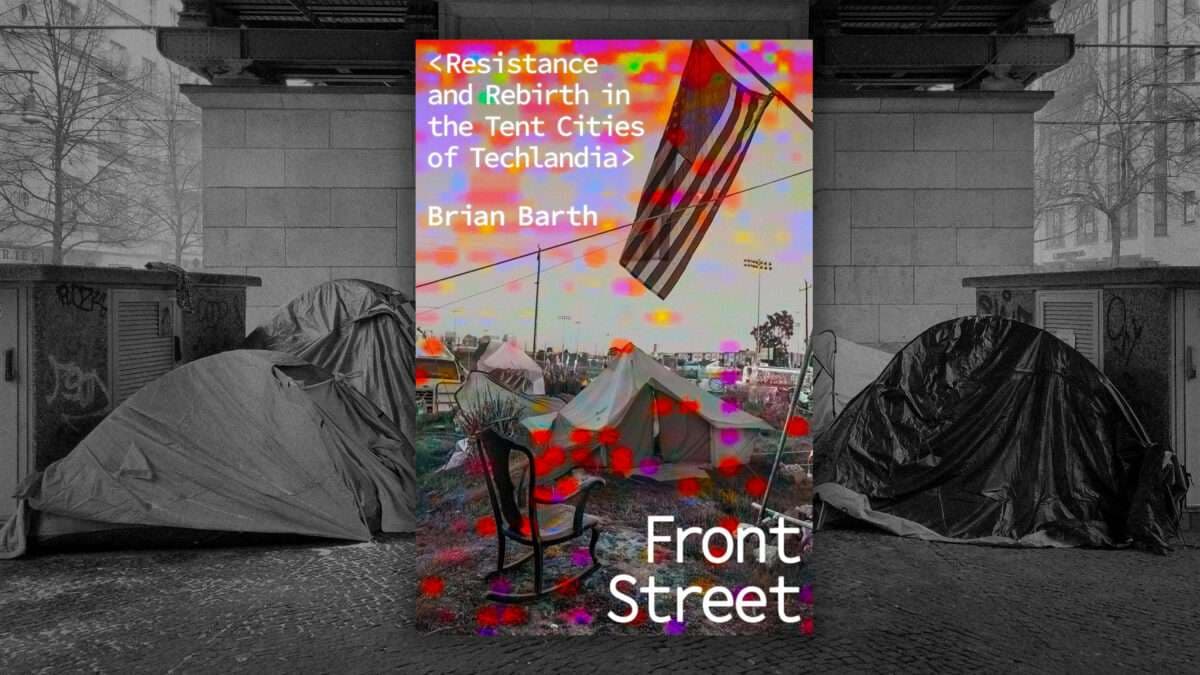
Front Street: Resistance and Rebirth in the Tent Cities of Techlandia, by Brian Barth, Astra House, 287 pages, $29 One lesson of Front Street, Brian Barth's book of immersive reporting from the sprawling homeless encampments of Silicon Valley, is that there is no full-bore solution to the problems presented by the homeless. The unhoused, and the larger community they aggravate, have only least-worst options. Barth's well-reported stories stem from three sprawling multiblock or multiacre tent cities, chronicling the types of people who compose them and the communities—troubled communities, but in some ways surprisingly effective ones—that they form.
All three are eventually bulldozed away. But such destructive reactions don't make the homeless disappear, even if they solve short-term problems for neighbors by making them fade from sight at least temporarily (and at least on that particular site, though they often regroup a mile away). Barth is on the side of the subjects (and eventual friends and frenemies) he meets in these makeshift minicities.
Yet he's an honest observer of what's awful about them: the rampant theft, the arson, the screaming, the hypodermic needles, the dead rats. These hobohemias are rife with things the modal taxpaying denizens of wealthy and expensive enclaves such as Cupertino and San Jose don't want to have around. Nonetheless, Barth concludes that it's better to let such sprawling encampments exist and evolve, rather than destroying them and attempting to relocate the inhabitants at great expense and trouble (not to mention destruction of property and disruption of lives).
Better both for the homeless and for the culture that would rather they didn't exist. *** The book's three tent cities are Wood Street Commons, in a decaying industrial sector of Oakland; the Crash Zone, near the airport in San Jose; and Wolfe Camp, abutting Apple headquarters in Cupertino. Some people who end up in these places want a normal life with a normal job and a normal apartment. But the characters Barth brings most vividly to life want nothing to do with being shoved into cubicle-sized tiny homes, repurposed crummy motels, trailer-filled parking lots, or other proposed solutions to homelessness.
In the words of Dave, one Wolfe Camp resident: "Affordable housing sucks because not only are you squished in this little box, you have to do all these things on time and in a certain order. I don't see that as attractive. For some of us, coming out of homelessness is worse than being in it."
The more articulate of Barth's subjects prefer the barely functional anarchy of their camps, complete with unsettling threats of violence and lack of such amenities as running water or garbage collection, but also a surprising amount of camaraderie, community, mutual aid, impromptu "social services" from the more high-functioning homeless to their lower-functioning comrades, and a sense of family from people whose problems often began with their utter alienation from the families they were born into. Who wants to live indoors if they can't cook their own food, bring in their own furniture, or have any guests?
One of Barth's central characters, a former property manager in his 50s who can be charismatic and compelling but has a self-destructive impulsive streak, reports that he has had friends who just rushed ahead to drug-induced suicide when their lives were reduced to that. A single woman tells Barth she feels safer in a community of people who know and care about her than in a barbed-wire fence with guards. Such camps are decidedly no paradise, Barth reports, but for the type of people who end up in them, such camps can provide a somewhat functional "sensible, modest, egalitarian lifestyle…based on resource sharing." (Because of both charity and dumpster diving, these dense encampments do not generally lack food, clothes, or other basics of survival.) In Wolfe Camp, none of the people Barth interviewed had goals that involved "working a job they hate, or any scenario in which they spend their waking hours engaged in unfulfilling tasks."
But some do work hard—like Kent, who used to enjoy biking by Apple HQ shouting "Fuck you!" at the company, and who pulls in around $3,000 a month dumpster diving in the office parks of billionaire tech companies. *** California has about a third of the nation's homeless. This makes waiting lists for official city-provided low-income shelter in the Golden State absurdly long, and the alternate shelter on offer to the denizens of the bulldozed encampments never covers all the people being displaced. Barth wants us to see these tent cities as not a problem but a solution to the intractable fact that our society will produce people not prepared or able to thrive in it in a standardized job-and-house style. (He also, especially among "homeless" people who live in parked mobile homes or vans, finds many with good jobs and reasonably high incomes.) His characters can be troubled and troublesome b