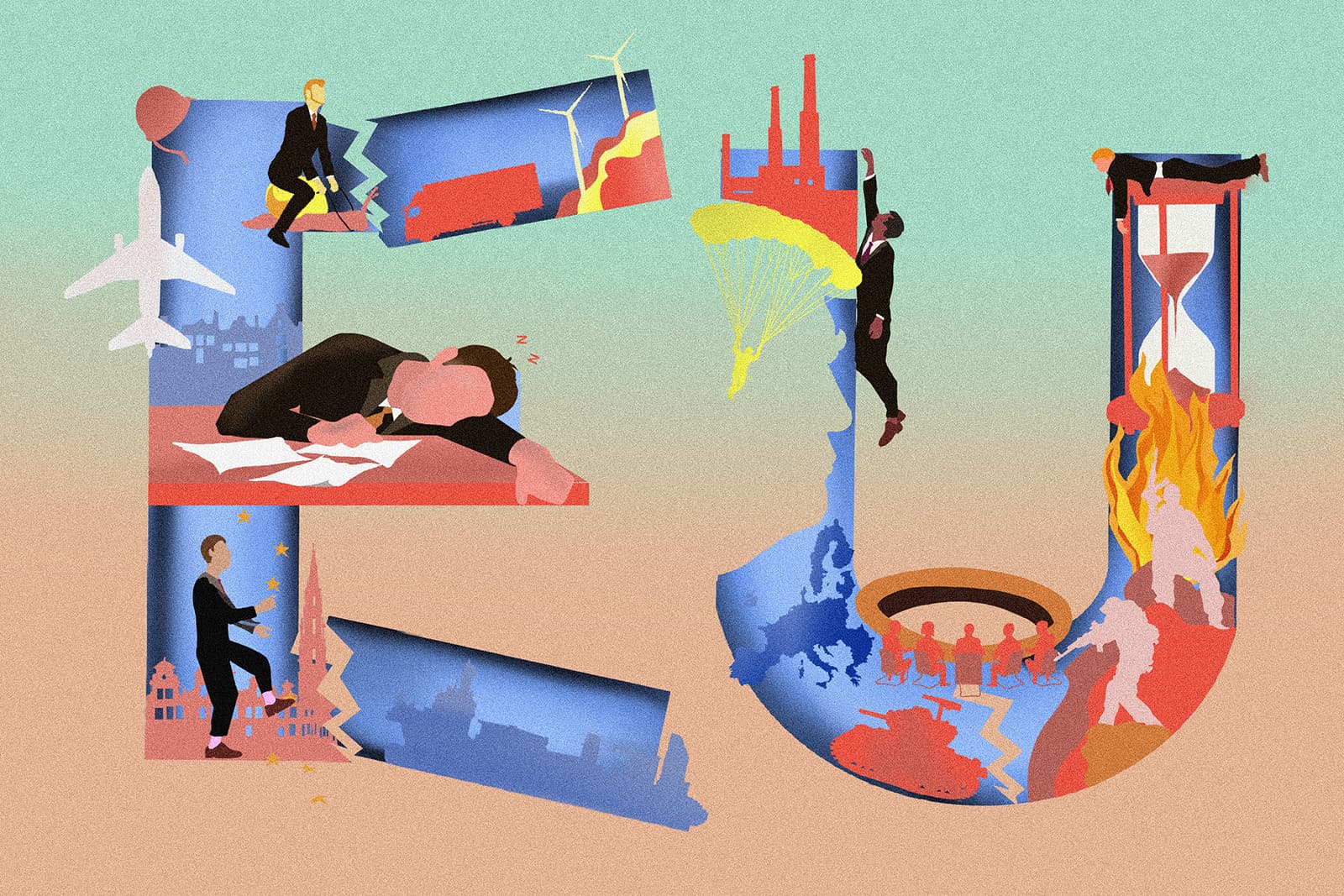
How summits of EU leaders became dysfunctional Is the European Council unfit for purpose? Plenty of those who have sat around the table believe the new world order demands changes to the EU. By SEBASTIAN STARCEVIC Illustration by Natália Delgado/POLITICO When the EU was formed in the shadow of World War II, it was built for economic integration, not hard power — its security outsourced to the U.S., and its politics and institutions set up for consensus.
But the world that birthed the bloc is no more. And in Brussels and beyond, aggravation is growing at the speed and urgency — or lack thereof — with which its 27 leaders, collectively known as the European Council, confront challenges and make decisions, especially on security and foreign policy. “Europe today is in permanent crisis mode and its decision-making architecture was simply not designed for it,” former Danish Prime Minister and NATO Secretary-General Anders Fogh Rasmussen told POLITICO.
“You cannot wait for the Council to agree a statement while the world is burning.” The EU has failed repeatedly in recent months to make unified calls on issues of seismic geopolitical importance — from unblocking a €90 billion tranche of funds for Ukraine, to imposing sanctions on Russia and violent West Bank settlers, to responding cohesively to the war in Iran. At the most recent EU leaders’ summit in March, leaders spent hours squabbling about the finer details of the bloc’s ETS carbon permit scheme even as Tehran struck Europe’s energy supplies in the Middle East. “To say ETS is the biggest issue when big gas fields are burning is a bit weird,” an exasperated EU official, granted anonymity like others in this article to discuss the sensitive diplomacy they were involved in, told POLITICO.
Former Danish Prime Minister Anders Fogh Rasmussen addresses participants at the Copenhagen Democracy Summit on May 13, 2025. | Mads Claus Rasmussen/Ritzau Scanpix/AFP via Getty Images A large share of the agendas of the October, December and March summits were dedicated to unfinished business from previous meetings, revisiting issues that were never resolved: from defense readiness to financing Kyiv and plans to fix the EU’s economy. The idea that Europe is too slow to make decisions has almost become a cliché. Dutch Prime Minister Rob Jetten used his first trip to Brussels in the role last month to urge the EU to get a move on.
“We cannot explain to our constituents that Europe is sometimes way too slow in reacting on great issues that affect us all,” he said. At the World Economic Forum in Davos in January, French President Emmanuel Macron, sporting sunglasses, declared that the EU “sometimes is too slow, for sure, and needs to be reformed, for sure.” And last week, European Commission President Ursula von der Leyen criticized the EU’s need for unanimity to take decisions on international affairs, saying it had created “systemic blockages” and calling for an end to the national veto, specifically on foreign policy. Rasmussen argued the EU needed to move away from late-night talking shops and accelerate its ability to respond to security threats “with fast-moving structures that this era demands.” Don’t blame Europe Of course, the nature of the EU, its whole raison d’être even, is consensus-based decision-making among its member countries.
Under its ungainly structure, all 27 European leaders gather periodically to discuss the bloc’s priorities, set the political direction and, after hours of negotiating, wrangling and compromise, agree on collective statements. Much of what gets decided is pre-negotiated by national diplomats in formats such as Coreper, the committee of EU ambassadors. “Could it be more efficient?” an EU official mused to POLITICO.
“Probably. I do understand the criticism.” “There are some issues that can be a little bit difficult to tackle at the European Council level,” the official added. “Where there is a huge focus right now is how to change those policy agreements into concrete action, because there is so much pressure on Europe right now.” That said, the Council is “by far the best forum” to tackle the most pressing issues of the day, the official insisted.
A second EU official agreed. “It’s a democratic institution, it gathers all the heads of state, it is the right place to discuss these kinds of issues,” the official said, arguing there was no real alternative to the mandate and legitimacy of the Council. It’s “not entirely fair to evaluate” the Council by its response to crises alone because it was set up to decide the EU’s “long-term” political goals, said Steven Van Hecke, professor in European Politics at KU Leuven Public Governance Institute.
But it has been “acting like a supreme executive” when it needs to, including during the financial crisis and the Covid-19 pandemic. The body certainly has its defenders, including former Belgian Prime Minister and United Nations Development Programme chief Alexander De Croo. “The European construction