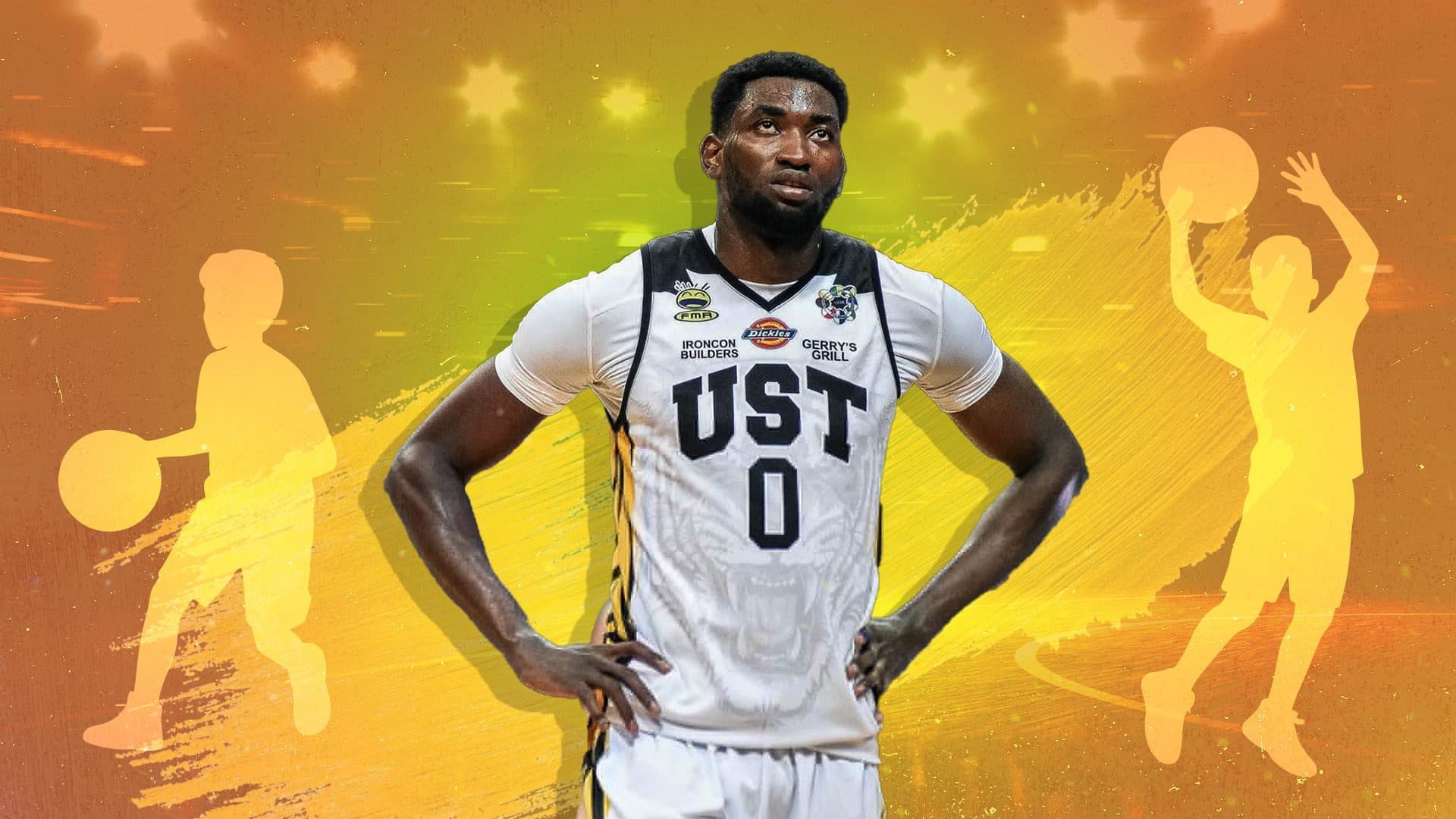
The tall, broad-shouldered figure on the sidelines barely drew attention inside a Cebu arena as youth basketball teams warmed up. Dressed in jeans and a plain white shirt, he scrolled through his phone, responding to messages. He blended into the background, almost invisible — not exactly what one would expect from a 6-foot-8 bruiser.
“I’m in the shadows now. I like watching kids reach their dreams. I want them to be inspired, especially in chasing those dreams,” said Steve Akomo, the quiet figure standing behind the basketball goal, once a foreign student-athlete for the UST Growling Tigers.
Today, few recognize him. His presence is subdued. But nearly a decade ago, Akomo was anything but. He was a prized prospect in Cebu, a dominant center for the University of the Visayas, a team he led to three CESAFI finals appearances and a championship.
Moving from Cameroon to the Philippines in 2012 at 17 years old to pursue his basketball ambitions, Akomo eventually made his way to UST, where he became a must-watch talent during an era when foreign student-athletes, including La Salle standout Ben Mbala, often headlined games. Then, everything changed on September 22, 2018. Costly collision In a game against the Adamson Soaring Falcons, Akomo drove to the basket and collided with fellow foreign student-athlete Papi Sarr, his head hitting the shoulder of his fellow foreign player.
He stayed in the game and even took his earned free throws, unaware of what it truly cost him. Akomo went on to finish that game and played again the following week against the Ateneo Blue Eagles. Soon after, his condition worsened.
He was diagnosed with a blood clot stroke, a condition in which a clot blocks blood flow to the brain, potentially causing severe damage. At first, the symptoms were mistaken for food poisoning. He experienced constant vomiting and intense headaches, but the true cause was unclear for days.
“Four days after the symptoms showed up, that’s how I ended up in the hospital. I went straight to the emergency room. That’s where they found out that I had a blood clot,” Akomo said.
“During those four days, we couldn’t figure out what the real problem was. I told them, ‘I don’t feel good. I keep vomiting.
If you can’t find anything, I’ll just go home.'” “I thank God that only the symptoms showed up. Most of the time, people die from it right away, based on what the doctor told me,” he added. “The doctor said it was a blessing that I was an athlete, that I was physically active, because it gave me a better chance of surviving.” Akomo knew he was in a unique situation.
It was unlike any injury an athlete typically sustains in a career, or even in a lifetime. For him, it became more of a mental battle than a physical one. “It’s like taking control of you 100%,” Akomo said of the blood clot.
“It’s not like an ACL injury. It’s not like an MCL tear or a fracture. This is totally different. It’s your brain.” “It was a long process because I never gave up.
I always told myself I would be better; I will be better. You just have to be positive. You don’t have to hear what other people will say about yourself.” UST chose not to field him again after the incident.
A year later, in 2019, the Growling Tigers reached the UAAP Finals for the first time in four years with a different foreign player. That team featured Beninese Soulemane Chabi Yo, who went on to win the Most Valuable Player award, alongside rising stars Rhenz Abando, Mark Nonoy, CJ Cansino, and veteran Renzo Subido. Akomo played with them in scrimmages and practices before his condition.
They were coached by Aldin Ayo, who steadied the program in 2018 after Akomo’s loss and reshaped the team into a contender the following season. Akomo watched from the sidelines as UST reached heights he never got the chance to experience. He revealed that he had an offer to play professionally in Spain after his collegiate career, an opportunity that vanished after his diagnosis.
New purpose Just two months after being hospitalized, Akomo returned to the court. He believed that simply touching a basketball could help him regain his strength. In a way, it did.
But more than strength, it gave him something else: hope. “I feel good now, but before, I didn’t,” he said. “I didn’t know if I wanted to cry, be sad, or shout at the people around me.
I didn’t know if I should be mad at someone, even though I knew it wasn’t their fault.” “I was in that kind of situation where I just wanted to hate everything around me.” Eventually, Akomo realized that no emotion, not even the anger from lost opportunities, would help him heal. “At the end of the day, it is what it is. It happened,” he said.
“I just had to gather myself and start thinking about what comes next.” Everything came back slowly during his recovery, but Akomo remained focused on one goal: returning to his physical prime. He immersed himself in basketball once more, watching games, returning to the court, and completing training drills. At