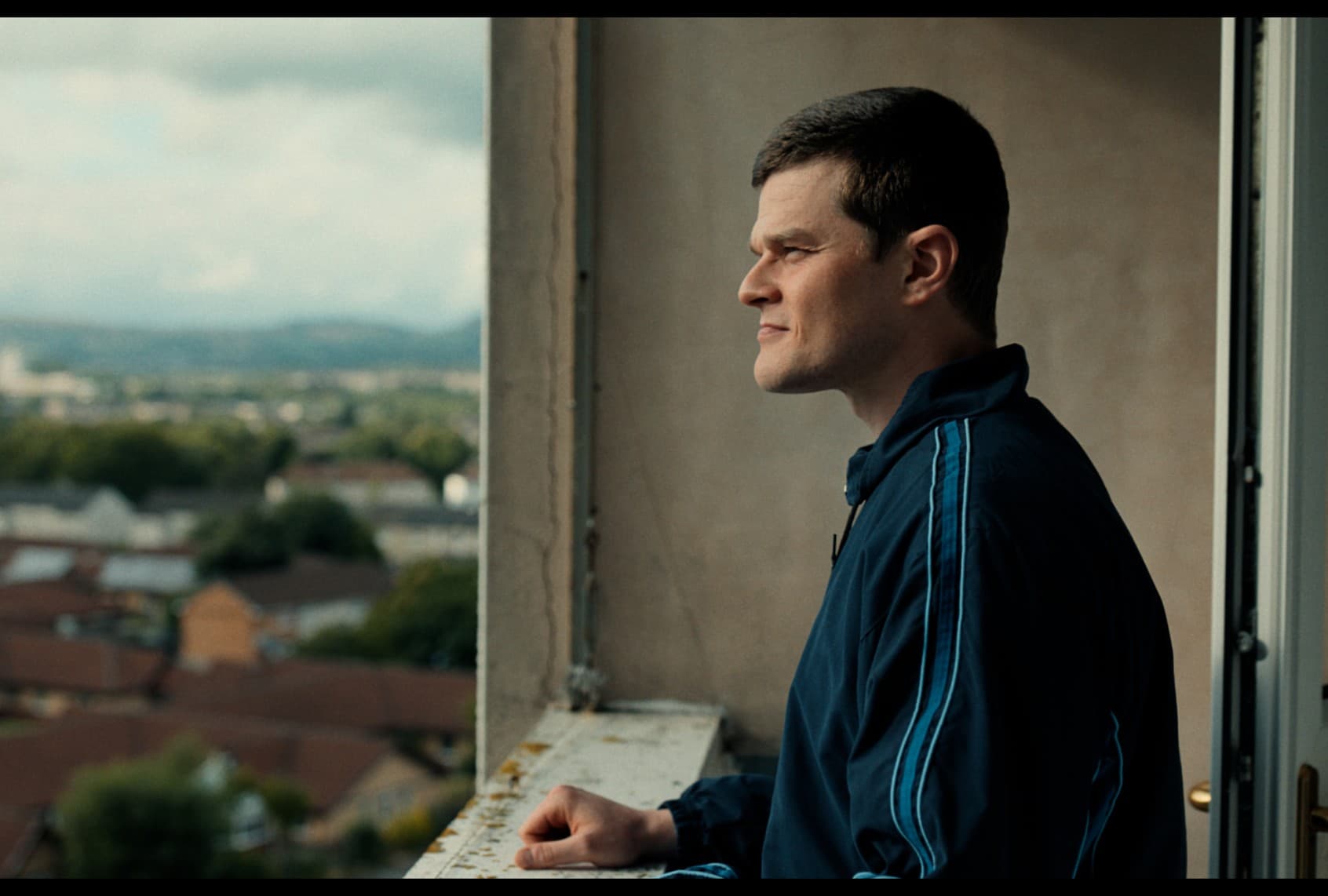
It’s remarkably unfortunate that the way most Americans learned about “I Swear,” Kirk Jones’ biographical drama about Tourette syndrome advocate John Davidson, was by the exact kind of unintentional public gaffe the film exists to assuage. While Tourette syndrome has many complex symptoms, “I Swear” focuses largely on coprolalia, a symptom affecting approximately 10% of individuals with Tourette’s and manifests in the involuntary use of obscene language. Throughout the film, Davidson (played with exceptional depth by Robert Aramayo) wrestles with the public’s misunderstanding of his condition, enduring the voluntary violence doled out as a result of his involuntary tics.
Though the film can be both overly didactic and schmaltzy, it earnestly attempts to dredge up compassion in the viewer, helping them to understand the nuances of Tourette syndrome as a way of championing both accessibility and acceptance. But earlier this year, Davidson inadvertently found himself and his condition at the center of a media firestorm. While Delroy Lindo and Michael B.
Jordan presented an award during February’s BAFTA ceremony, Davidson shouted the N-word, which was picked up by the microphones placed throughout the auditorium. According to reports, Warner Bros. — which distributed Jordan and Lindo’s smash hit, “Sinners” — and BAFTA called for the racial slur to be scrubbed from the broadcast, which aired pre-recorded on a two-hour delay. Still, the ceremony aired without the slur being censored, allowing viewers not only to hear the word but also to witness Jordan and Lindo’s visibly wearied frustration. (Graeme Hunter/Sony Pictures Classics) Robert Aramayo as John Davidson in “I Swear” By simply telling us that compassion is possible without depicting the subtleties of human growth, “I Swear” functions more like an educational drama than a portrait of how to make real-life change.
In the hours, days and weeks that followed, reactions flew across the digital battlefield, aiming so fiercely for one side or the other that few could examine the nuance in the middle without being caught in the crossfire. Those hurt by hearing the word and seeing the clip proliferated online by racist trolls were broadly labeled as ableists for trying to express how, regardless of intent, the word can still cause an instinctual, sharp pain and embolden further use when broadcast to millions. Others were quick to jump in and defend Davidson from actual ableism — statements that Davidson should’ve never been allowed at the show, or in public — without fully acknowledging that the incident hurt others, too.
As my colleague Melanie McFarland pointed out in March, it was the BBC — a network notorious for its carelessness when it comes to anti-Black racism — that was most culpable in this situation. Davidson told Variety that he shouted other obscene language during the show that was all censored, and that he felt a “wave of shame” after the incident, removing himself from the ceremony. But it’s the BBC’s negligence that highlights both the importance of “I Swear” and its innate shortcomings.
Jones’ film is a palatable, pleasing story of tenacity in the face of marginalization. It’s also a film caught up in idealism, presenting a this-or-that way to approach situations like the one Davidson found himself embroiled in earlier this year. By simply telling us that compassion is possible without depicting the subtleties of human growth, “I Swear” functions more like an educational drama than a portrait of how to make real-life change.
Related The BAFTAs have us arguing over the wrong words And that’s not a bad thing, at least not necessarily. There are so few depictions of Tourette syndrome in the media as it is, and even fewer that accurately render the potentially debilitating complications of coprolalia. Growing up with a sibling who has Obsessive Compulsive Disorder and witnessing the dissonance between her condition and the unrealistic portrayals in the media — or worse, the claims of being “soooo OCD” for something like carrying hand sanitizer — drilled into my head from a young age that education about these types of disorders is crucial.
There is so much that the public doesn’t know, and even more that can be contorted by disinformation and colloquial slang, making these important subjects the butt of the joke. When Davidson was first introduced to U.K. audiences in the 1988 TV documentary, “John’s Not Mad,” the film was as much of an inspiration story as it was a cause for mass mockery. Despite the filmmakers’ earnest intentions, the nature of Davidson’s condition, combined with the fact that he was only 15 at the time and Tourette’s was so unexplored in the media, meant that Davidson was an easy target.
In many ways, a narrative film like “I Swear” bridges the gap between a viewer’s head and their heart more easily than a 30-minute television documentary. By identifying a start and tentative end point in Davidson’s story, along with a specific se