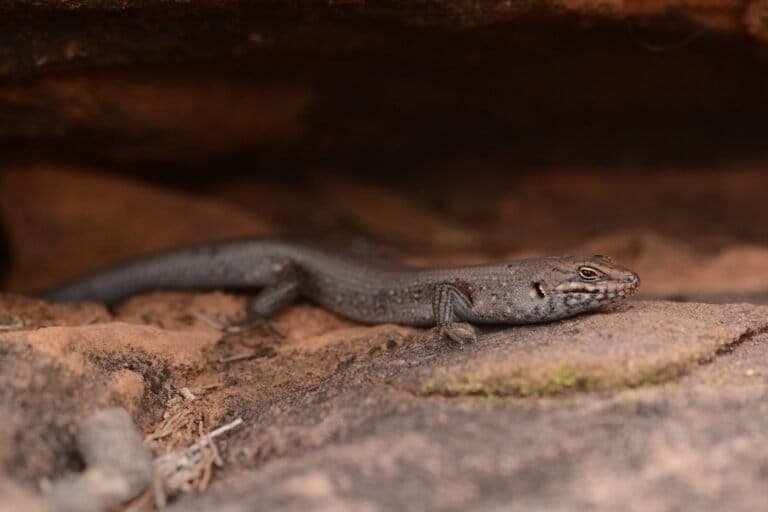
Researchers have described a new-to-science species of skink that may be one of Australia’s most threatened reptiles. The small population of the skink, possibly fewer than 20 individuals, lives in a pocket of rocky gorge within the arid Mutawintji National Park in New South Wales state, the researchers report in a new paper. The skink has been named Liopholis mutawintji, in a nod to the park, the only place it’s currently known from.
Its common name is Kungaka, meaning “the Hidden One” to Wiimpatja Aboriginal Owners. This refers to the species’ habit of hiding in crevices and burrows. Scientists from the Australian Museum Research Institute (AMRI) partnered with Wiimpatja Aboriginal Owners and the New South Wales National Parks & Wildlife Service to confirm the Kungaka as a distinct species.
Thomas Parkin, the study’s lead author with AMRI, told Mongabay by email that the Kungaka was previously thought to be a highly isolated population of White’s skink (L. whitii), a species widely distributed in southeastern Australia. But with Mutawintji roughly 500 kilometers (300 miles) away from the closest White’s skink population, the team decided to revisit the reptile’s taxonomy. The team analyzed DNA samples and compared physical traits of White’s skinks from different populations across Australia.
Their analyses revealed that White’s skink is not one species, but three deeply divergent lineages. The three species in the revised taxonomy are the southern White’s skink (L. whitii), northern White’s skink (L. compressicauda), and the Kungaka. Parkin said the Kungaka can be distinguished from…This article was originally published on Mongabay