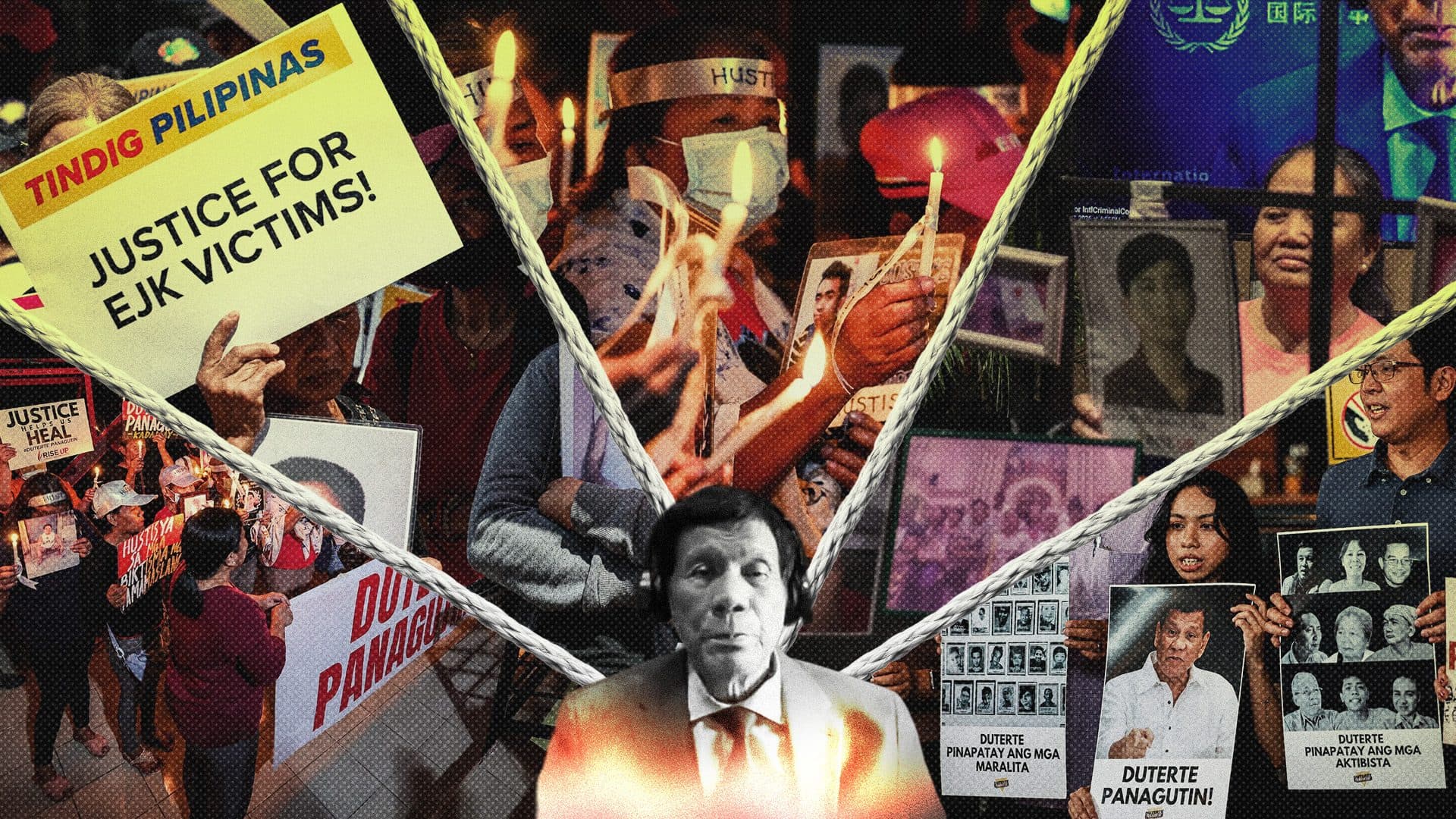
The tide has indeed shifted. That was apparent to me as I caught up with the women who have, for 10 years now, carried the burden of fighting for justice in Rodrigo Duterte’s war on drugs. The last time I saw Mary Ann Domingo was in November 2024 at the House of Representatives.
She told me she felt utterly defeated. Mary Ann’s son Gabriel and common-law husband Luis Bonifacio were killed by policemen in Caloocan City in 2016. Four cops had been convicted for the lower crime of homicide, and her case may be one of the last cases to get a conviction locally.
Former president Rodrigo Duterte had just faced the House quad committee that day. It was a surprise appearance in many respects, as he never explicitly confirmed he would show up. Congressmen were just basing off of statements from his lawyers that the former president was game to face the sensational “quad comm.” In contrast, Mary Ann had been diligently going to the Batasan for several months.
She and many other relatives of victims had been going and staying for hours at the People’s Center. On some days, they neither got the chance to speak nor were acknowledged. Yet there was Duterte, no longer president, waltzing into the People’s Center like it was his.
In that session, he and former senator Antonio Trillanes IV nearly figured in a brawl. It was a show. Duterte admitted, once more, to teaching cops how to goad suspects to fight.
Mary Ann, at one point, ran to the bathroom and cried. “Sa CR, umiiyak ako, naalala ko ’yung mag-ama ko na para bang gusto kong humingi ng tawad sa kanila na hanggang dito lang ’yung nagawa naming kalakasan,” she said at the time. (I cried in the toilet, thinking of my husband and my son. I wanted to apologize to them that this was all we could do for them.) “Ito na ba ang hustisya?” Mary Ann said. (Is this how far we could go in getting justice?) On Wednesday, April 22, 2026, when the International Criminal Court (ICC) appeals chamber confirmed it had jurisdiction over the Duterte case, I wasn’t able to spot Mary Ann immediately.
She’d worn a face mask because she still felt uneasy being on camera. Then I spotted her in the corner. She also saw me.
We caught up. I asked if I could interview her, without a camera, and she agreed. I told her she looked at peace now, far different from the last time I saw her.
“Siguro isang pasasalamat na marinig na ito na ’yung hustisya. Sa kabila nung dito sa sistema sa ating Pilipinas na ang hirap makamit ng hustisya,” she said. (Maybe it’s because — and I am thankful to hear this — that there is in fact justice. This is despite the system in the Philippines where justice is elusive.) “Isa ako sa magpapatunay na mahirap maabot ang hustisya,” she said, recalling that the conviction only came in 2024, or eight years after the murder of her husband and son. (I am proof of how hard it is to get justice here.) Duterte’s supporters scoff at having a foreign court judge a Filipino citizen.
Try him at home, they say. But no one knows more than the likes of Mary Ann how much they tried, and how much of themselves they have lost trying to go up a powerful system while also just trying to survive, despite losing their providers — the husbands and sons and fathers who were killed. We all hate that we have to get justice from a foreign court.
We would all rather do this at home. But home has not been kind to them. Home is where they get harassed, mocked, and intimidated.
Now that the case is with the ICC, Mary Ann said she feels hope. “Napakalaking pag-asa. Kaya pasalamat kami sa ICC.” (I feel great hope.
That’s why we’re really thankful to the ICC.) I was able to spot Mary Ann because she stayed behind, waiting for Nanette Castillo so they could go home together. Nanette’s son Aldrin was killed by masked vigilantes in 2017. Nanette has been the face of this movement since Aldrin was killed.
It’s like I saw her grow older. I sometimes see Nanette at the Silingan cafe in Cubao, where she works alongside other victims. That cafe was put up to provide livelihood to those who lost their loved ones during the drug war.
She told me stories about her family, of Aldrin’s sister and her children who miss their uncle. How every occasion has a sting — because they’re happy at the moment, only to realize at the end of the day that Aldrin is gone. Mary Ann told me she was having some pains in her stomach, finding it hard to go through life without her partner and her son.
They would ask me how I was, and I always didn’t want to answer. Everything I am going through in my life will sound so trivial compared to theirs. But I answer anyway, because it’s only fair to share parts of my life when these women have been sharing intimate parts of theirs to me all these years.
On Thursday, April 23, when I was about to close my laptop, done with follow-up stories from the previous day’s big ICC decision upholding jurisdiction over Duterte’s case, I saw a message on WhatsApp. The pre-trial chamber had just dropped its dec