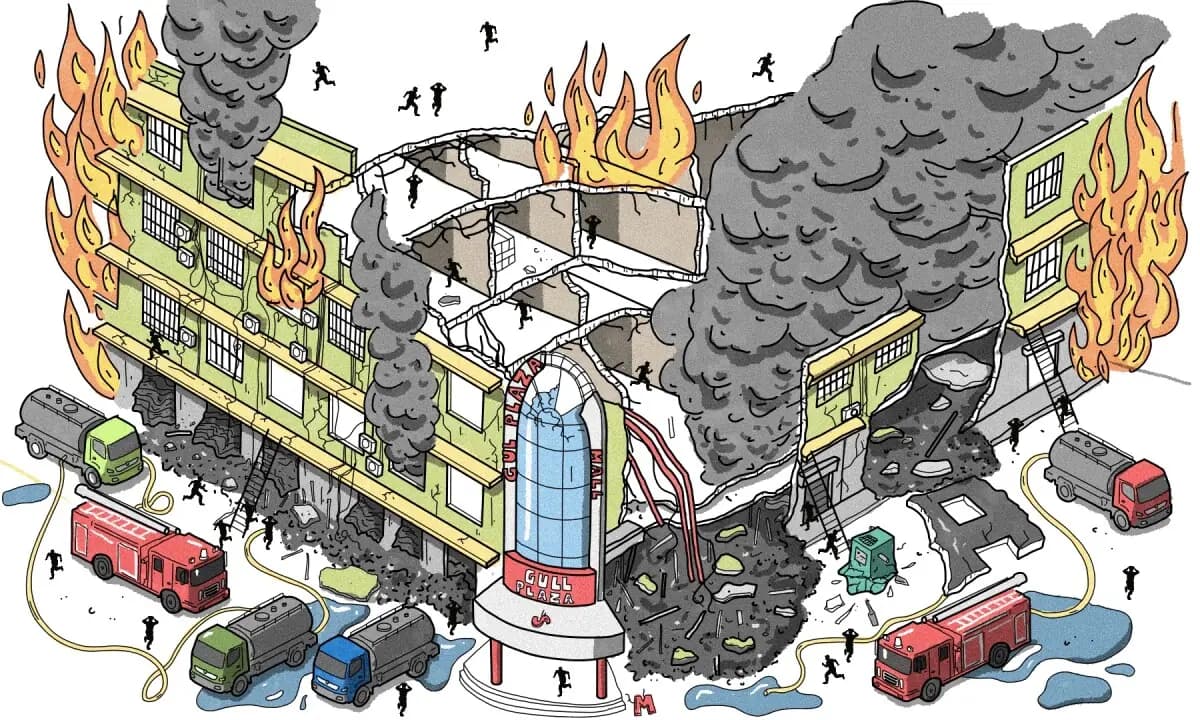
Gul Plaza’s three facades were clearly damaged in the stage II and III January 18 fire which killed 70 people, but when a building inspector came afterwards, he held back. “It was impossible to go inside,” he said, “the heat was too intense even after two days.” That same month, one after another, three other market fires erupted in Karachi, intensifying the feeling of anger and helplessness that the city had turned into a tinderbox because of years of neglect. The bodies just keep piling up.
The preventable deaths from urban negligence — fires, open manholes, building collapses, electrocution, rains, bad road design — all speak to the systemic weakening of Karachi. At least 300 have been reported in newspapers so far in 2026 by rough count. Many of these deaths are evidence of the failure of vertical expansion of informality.
You cannot allow floor upon floor, shop upon shop, to be slowly added to urban spaces and infrastructure that was never designed to support such density in the first place. Neither the Karachi Metropolitan Corporation (KMC), its fire brigade nor the regulatory Sindh Building Control Authority (SBCA) seemed to respond to this state of affairs in any way that would persuade us that they were aware or care about just how unliveable they were making the city. Instead of focusing on the accountability of these governing institutions and their actors, so much of the talk surrounding these preventable deaths skips to championing what is described as informalisation as resilience or a rose-tinted tale of survival against odds.
But for the oppressed with no choice but to live and work in Karachi, resilience’s ugly reality consists of working in a building with no safety standards. There is no ventilation when smoke chokes it, and the flames swallow the stairwells or when its exits are blocked or structurally insufficient to cater to the actual volume of people inside. That is not the resilience of a people.
It is the abandonment of the system supposed to serve them. Fire station coverage The international benchmark, guided by the National Fire Protection Association, says that the first responding unit should take no more than 4 minutes to reach a fire. Full deployment should take no more than 8 minutes.
In cities with thin traffic, this translates into a 2-3km service radius for a fire station. In places where fires spread rapidly, such as high-risk commercial hubs and industrial zones, the standard is for a station to be located within a distance of 1.5kms. But in Karachi, however, congestion shrinks this safety zone to a mere 0.5km.
In other words, a fire station should be 500m away. By these standards, the city needs over 200 fire stations. It has only 26.
In high-density zones, where water infrastructure is already unreliable, spatial shortage ensures that by the time help arrives, the window for containment has already slammed shut. The following data shows the huge gap between population density and the available emergency infrastructure. Given the shortage of fire stations, the state needs to reconsider how the existing ones should serve their areas.
It should not allow taller buildings (through floor-area-ratio relaxations) until it is confident it can tackle their fires. This applies to vertical intensification, for cases when a builder wants to turn an old two-story bungalow in PECHS into six floors of apartments. This adds to the load of the service areas of existing fire stations.
Since the 1980s, land values and floor area permissions have drastically changed in the city. This has raised concerns about the idea of “disposable architecture” — buildings designed for short-term profit at the expense of long-term human survival. Fire station coverage by district Karachi population by district in 2017 and 2023, alongside existing fire stations (in 2025) and stations needed.
District 2017 2023 Fire Stations Stations Needed Central2,972,6393,820,388438 East2,909,9213,913,656639 South1,791,7512,329,764623 West3,914,7572,679,380327 Korangi2,457,0193,127,976331 Malir2,008,9012,419,736224 Kaemari—2,066,574221 Total16,054,98820,357,47426203 '> The money trail Poor safety in Karachi is often blamed on oversight, but in the fire department’s case, it is also a symptom of cost-cutting, or worse, the creative diversion of funds. As recently as the 2024-25 financial year, audits from its ledgers provide ample damnation. In one instance, the Auditor General of Pakistan found that Rs33 million was paid out for vehicle repairs, but the work was not authenticated with original vouchers, daily work orders or logbooks.
In earlier years (from 2020-21 and 2023-24), KMC didn’t ensure mandatory five-year fire and building safety inspections. Other discrepancies speak to sheer neglect, such as KMC forgetting for three years to register 55 fire vehicles sent as a gift from the federal government, in violation of its own Sindh Motor Vehicles Ordinance, 1965. The Auditor General’s office was cognisant of the s