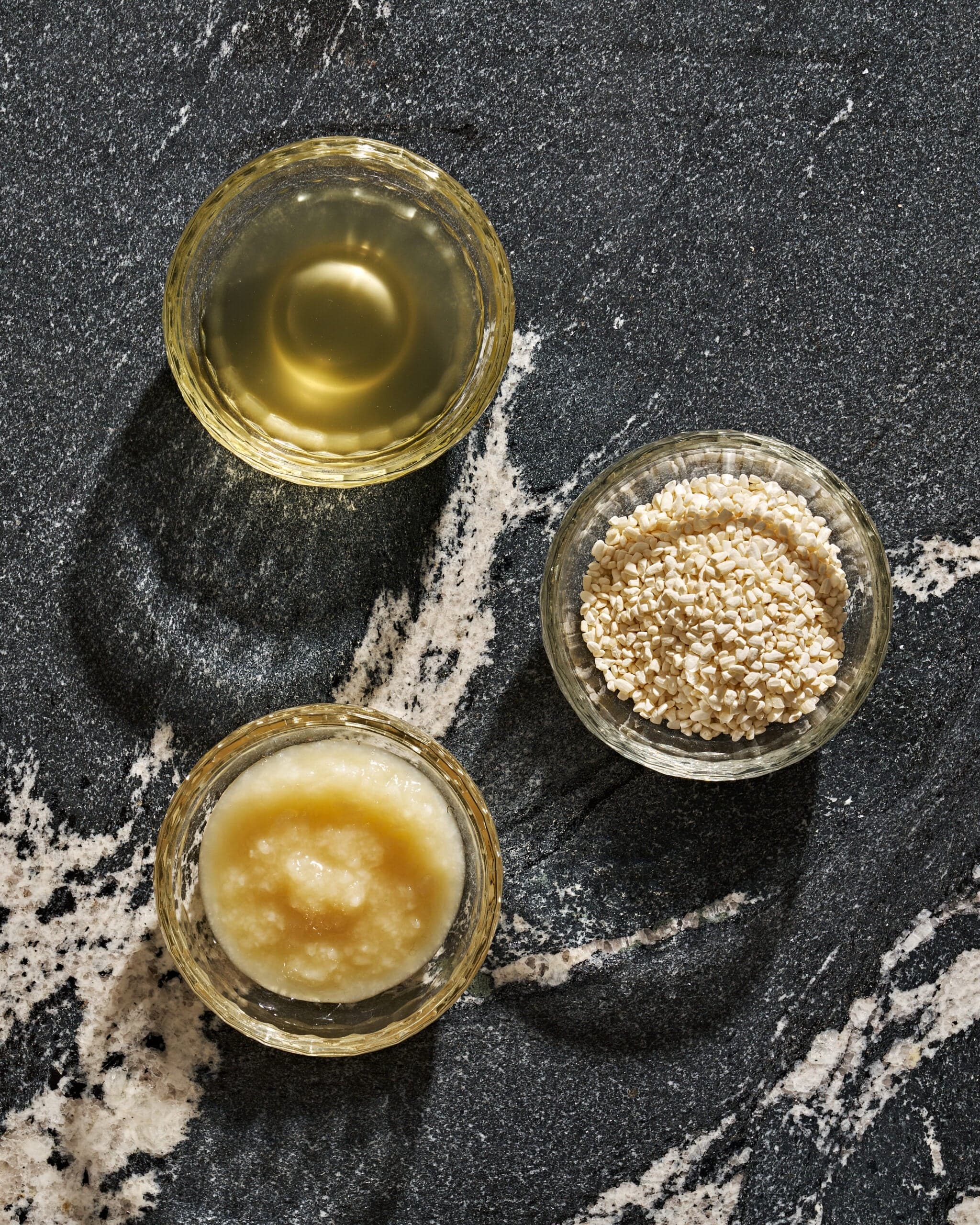
Photo: Andrew Bui • Food Styling: Jessie YuChen Jeremy Umansky had no idea mold could smell delightful until he grew Aspergillus oryzae. “It’s a combination of the sweetest, most aromatic tropical fruits you’ve ever smelled, mixed with pollen and nectar,” the chef and fermentation specialist says. The scent also had an alluring savory, earthlike quality—like mushrooms or moist soil.
“I can see why somebody 9,000 years ago saw that growing on some rice they left out and was like, ‘Huh, that looks weird, but I’ll eat it.” You may not have sniffed A. oryzae before, but you’ve almost certainly consumed it. When the fungus grows on grains or legumes, it produces enzymes that deconstruct the foods’ starches into simple sugars, proteins into amino acids, and fats into fatty acids. The resulting starter culture—of which there are thousands of permutations derived from different preparation methods, substrates, and strains—is the catalyst for a vast range of fermented foods and drinks across Asia, from soy sauce and miso to mirin and beyond.
Archaeological evidence suggests that A. oryzae was first domesticated thousands of years ago in China, where early written records referred to such fermentation starters as qu. Its preservation powers proved revolutionary, allowing humans to extend the shelf life of ingredients while coaxing out new depths of flavor. Qu cultivation eventually spread to other parts of Asia.
In Japan, people began to refine specific strains of A. oryzae for distinct purposes, harnessing the metamorphic powers of the inoculated grains to make amazake, a sweet rice drink; shochu, a distilled liquor; and kasuzuke, a dish of fish or vegetables pickled in sake lees; and much more. Photo: Andrew Bui • Food Styling: Jessie YuChen Umansky, who co-wrote Koji Alchemy with Rich Shih, says that Japan’s use and refinement of the microorganism, coupled with the spread of Japanese culture after World War II, explain why English speakers usually refer to the fungus as koji—a word you’ve likely heard with increasing frequency.
A growing number of chefs and home cooks across the U.S. are exploring the culinary possibilities of A. oryzae, whether that’s to extract flavor, tenderize ingredients, or give scraps a second life. Most people, Umansky says, are “missing out on so much taste and flavor” because only a fraction of digestion happens in the mouth; the rest happens further down in the digestive tract. “When we take [A. oryzae] and allow it to live its life cycle on our food, it kind of pre-digests it,” he explains, “and all these compounds of flavor and aroma and taste that were previously locked up in really big molecules are now free for us to experience on our tongue instead of in our gut.” More than just a catalyst for fermented pantry staples, koji is a foundational cooking ingredient in its own right.
Much like salt, the microorganism’s enzymes amplify the natural flavors of the ingredients you pair it with, making whatever you’re cooking taste more like itself. For example, marinate a pork loin in shio koji (made from inoculated rice, water, salt) prior to cooking, and the meat will be deeply savory, explains Klementine Song, chef de cuisine at Tsubaki in Los Angeles. When Song cooks vegetables, she often gives them “extra oomph” by splashing in some liquid shio koji, using it much like fish sauce or soy sauce.
“It [brings out] a little bit of saltiness, a little bit of sweetness,” she says. Recipe: Koji-Marinated Pork Loin Photo: Andrew Bui • Food Styling: Jessie YuChen Get the recipe > Koji’s flavor-enhancing enzymes lend themselves to an infinite range of applications. At Washington, D.C., restaurant Oyster Oyster, chef Rob Rubba estimates that A. oryzae sneaks into about 70 percent of his dishes.
In 2009, while cooking in Chicago at now-closed modernist seafood restaurant L2O, Rubba learned that koji could achieve a level of umami most Western-trained chefs associate with a long-simmered stock or slowly reduced sauce. “I was blown away by the intensity of the flavor you could bring out, and the satiating richness it provided to ingredients,” he recalls. Many of Rubba’s koji experiments have produced unexpected yet delicious results, like grinding up beets past their prime with leftover bread to make a miso-like paste that tasted like “umami-rich salted chocolate brownies,” he says.
Rubba also regularly uses the mold to ferment onions, scallions, and other aromatics to create a versatile, deeply savory sauce that’s ideal for drenching sautéed or roasted vegetables. Whenever it feels like a dish is missing something, koji is often the answer, Rubba says. “It gives things life.
It makes things taste more electric.” Recipe: Sautéed Mushrooms With Koji Sauce Photo: Andrew Bui • Food Styling: Jessie YuChen Get the recipe > Koji’s fruity aroma can do plenty for sweet dishes, too. Japanese granola brand Oryzae uses naturally sweet koji-fermented rice to flavor oats, which are then combined with mix-ins l