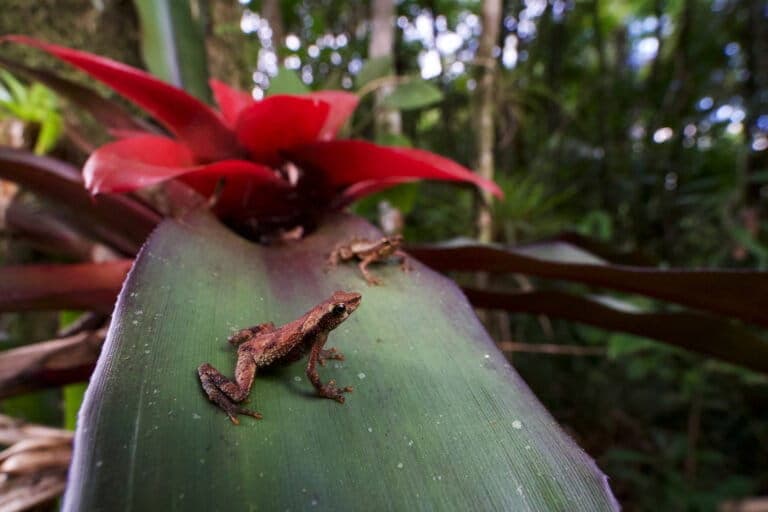
A new study has found that when deforestation and land use change break up key habitats vital to amphibian life cycles, those disconnects can play havoc with the animals’ microbiome, leaving them more susceptible to disease. This troubling finding could also apply to a host of other species, the study researchers say, but may also have positive implications for conservation to counteract the problem. Habitat split, first associated with amphibian decline in a 2007 study, occurs when multiple “classes” of aquatic and terrestrial habitat — such as forests, streams and ponds — vital to a species’ life cycle are separated by human activities (such as agriculture), causing the species to decline.
Studies have already shown that this phenomenon is a driver of localized frog extinctions in Brazil’s Atlantic Forest. In the new study, published in the Proceedings of the National Academy of Sciences, scientists investigated the effect of “habitat split” on the microbiome of four frog species (Haddadus binotatus, Rhinella ornata, Boana faber and Ischnocnema henselii), all dwelling in the highly fragmented Atlantic Forest. They found that where forest and aquatic habitats are linked, frogs are more likely to host skin microbes that inhibit the deadly fungal pathogen, Batrachochytrium dendrobatidis.
This fungus, known as chytrid, is responsible for large-scale declines of hundreds of amphibian species across the globe. Importantly, the skin microbiome of frogs living in areas where these habitats were split hosted fewer pathogen-fighting microbes, leaving the frogs more susceptible to infection. Two of the frog species sampled also…This article was originally published on Mongabay