You almost certainly have never heard of the early-20th-century crusading newspaperman Carlos M. Wood, whose star-crossed, peripatetic life met an early end in 1914 at the hands of the Texas Rangers. But his story — which began in his birthplace of Matamoros, Tamaulipas, and ended in Marfa, Texas — was filled with controversy, conflict and even a historical mystery.
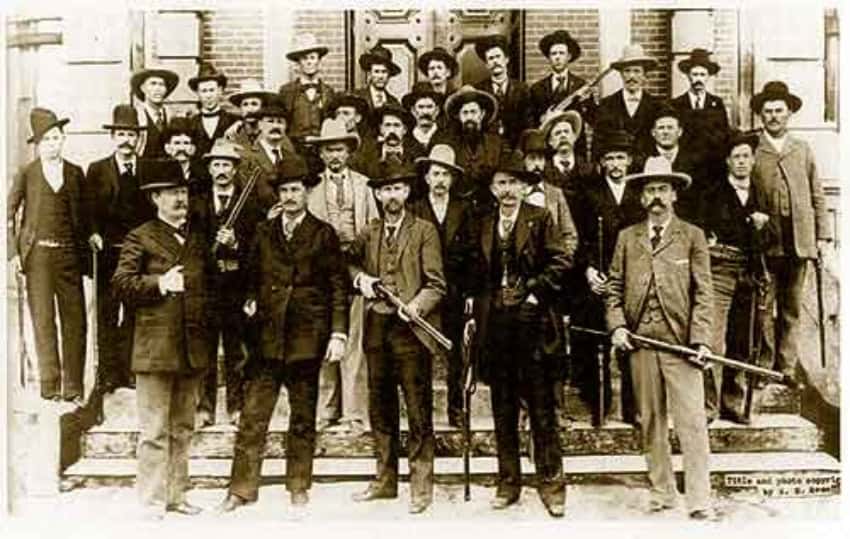
Wood’s story is that of a young man who, in the space of a decade, went from attending rallies for the Mexican conservative dictator Porfirio Díaz to using his border newspaper in Marfa, Texas, to call out local politicians, as well as the Texas Rangers, for bad behavior — particularly the Rangers, who had a local reputation among Mexicans in Texas at the time for brutality and impunity. Texas Rangers like those in this 1896 photo, had a reputation for brutality and impunity among Mexicans living in Texas during this time. (Public Domain) And, as a newly discovered report found in Mexico’s archives reveals, Wood may have paid the ultimate price for his words: He died in 1914 after being shot multiple times by Rangers who had been serving him with an arrest warrant — most likely for criminal libel.
According to a report made at the time by one of the arresting officers, they shot Wood because he resisted arrest. Testimony in the newly discovered Mexican report, however, suggests that Wood did not resist arrest but was rather stalked and assassinated by the Rangers sent to serve him the warrant. Killed with ‘malicious premeditation’?
Last fall, a new and unexpected chapter unfolded in the mystery of Wood’s killing, thanks to the discovery of a 1914 report sitting unnoticed for over 100 years in Mexico’s Diplomatic History Collection in Mexico City. Fernando Serrano, the Mexican consul in Marfa at the time, investigated Wood’s death. What he learned, according to his report to his superiors in Mexico, was that Wood had been stalked and assassinated by the Texas Rangers sent to serve the warrant, H.L.
Roberson and Ira W. Cline. According to Serrano’s report, Wood was “gravely wounded” by four bullets on June 22 and died two days later at 4 a.m.
More importantly, Serrano’s report included a damning, never previously published statement by Presidio County sheriff Milton B. Chastain against one of the Rangers involved in the shooting. In his statement for Serrano’s report, Chastain, himself an ex-Ranger, told Serrano that the Rangers who had served the warrant — H.L.
Roberson and Ira W. Cline — had killed Wood “with malicious premeditation.” Who was Carlos M. Wood? Virtually nothing is known of Carlos’ early life.
He was born to a Mexican father and an American mother in Tamaulipas, thanks in part to a decision made many years before by his grandfather, David L. Wood — himself a Texas newspaperman of some note. David emigrated in 1856 from Texas to Reynosa, Tamaulipas, out of concern for his family’s safety: His wife, Sophronia Primm, was biracial, and while miscegenation laws were not consistently enforced in Texas, the family felt vulnerable enough that it decamped to more egalitarian climes over the border in Mexico.
Carlos first appears in the historical record in Mexico City periodicals in September 1901, at age 26, identified as a member of the Guild of Lithographers, Printers and Book Binders, at a rally in Monterrey, Nuevo León. The rally Carlos attended supported then Mexican president Porfirio Díaz, suggesting that at this point, Wood’s politics were establishmentarian. Wood launches El Relámpago By May 1904, Carlos Morales Wood was in the United States, publishing a heartfelt ode to his mother, Laura, in the Santa Fe, New Mexico, publication La Voz del Pueblo (The Voice of the People).
Two months later, now 175 miles north in Ratón, New Mexico, he launched a Spanish-language weekly, El Relámpago (The Lightning), now as Carlos M. Wood. Surviving issues from the newspaper’s several-month run show Wood as a stalwart of the Progressive wing of the Republican party at the time, backing Theodore Roosevelt and still supporting Porfirio Díaz — Roosevelt and Díaz were cordial allies.
The news sections of El Relámpago paid sparse attention to local issues, such as New Mexico statehood, but inexplicably devoted much space to the Russo-Japanese War. A small story about defense funds being organized for a young Mexican facing a murder prosecution in Texas was a singular hint of social justice concerns. The ‘jailbird’ journalist A parade in Marfa, Texas, the town where Carlos M.
Wood was shot by two Texas Rangers, in the 1920s. (Facebook) Wood abandoned El Relámpago that fall, and for the next decade led a star-crossed life full of movement. He was affiliated in one capacity or another with at least seven southwestern newspapers, including several in New Mexico: La Voz del Pueblo (1904) and La Unión Social (1914?) in Santa Fe; El Relámpago in Raton (1904); and El Independiente (1904-1906) in Las Vegas, New Mexico. He also had connections to three other pu