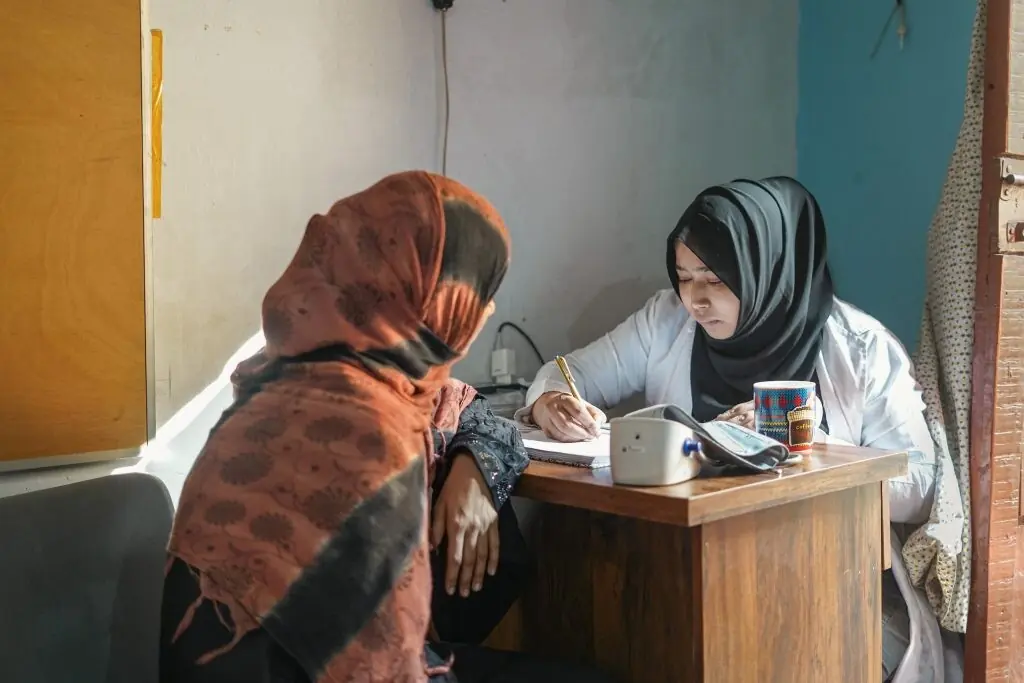
Inside the gynaecology clinic of Karachi’s largest public hospital, the air felt several degrees hotter. It was only 9:30am on a Friday in late February, and the windowless waiting room was already packed with women jostling for a place to sit, calling nurses for help, and scuffling for an ultrasound. Asiya, 21, was pregnant with her third child.
The baby was due in May, when the mercury often crosses 38 degrees Celsius, and humidity soars past 70 per cent, making the heat unbearable. As temperatures rose in the room, Asiya felt nauseated and dizzy. “The heat exhausts me,” she said.
“My body feels like lead, I’m barely able to stomach food. I am afraid that my child might be born sick.” Asiya lives in Lyari, one of Karachi’s most densely populated neighbourhoods, with narrow alleys and little to no green space. Inside her home, ventilation is poor and cooling scant.
Intense summer heat in her neighbourhood is compounded by power outages that last up to 12 hours a day, shutting down fans and other appliances that might provide relief. “During my last pregnancy two years ago, I took showers thrice a day to cool down because I could feel my baby kicking in distress,” she told Dialogue Earth. Evenings in Karachi are often pleasant, with temperatures dipping to a palatable 25 degrees Celsius, bolstered by a sea breeze.
But this is no help as Asiya dresses modestly, veils and when she ventures outside, wears an abaya — a loose but heavy cloak, often made of polyester. “My husband won’t let me stand near the window either.” Heat, inequalities and pregnancy Home to over 20 million people, Karachi, is projected to become substantially hotter in the years to come — an additional 2 to 7 degrees Celsius on top of global warming projections. In 2024, temperatures climbed above 40 degrees Celsius, which, combined with high humidity, created conditions at the very limits of human tolerance.
City temperatures are driven higher than surrounding rural locations due to the urban heat island effect. This fuels health problems, including heatstroke, respiratory and cardiovascular problems, mental health issues, and even deaths. Karachi is an exemplar of many overlapping problems of urban heat and pregnancy.
It has high levels of humidity and very little tree cover and green spaces. Over half of the city’s population lives in densely packed informal settlements. High fertility rates and low contraceptive use among women are compounded by often poor antenatal care.
Emerging evidence suggests that extreme heat is associated with an increased risk of complications that may result in adverse outcomes for both mother and baby. These include preterm births, low birth weights and stillbirths. These risks are higher for women in low- and middle-income countries without the means to mitigate high temperatures, such as purchasing relatively inexpensive fans or air conditioners.
Rubina Hussain, a gynaecologist associated with Ziauddin University in Karachi, told Dialogue Earth that the impact of heat on pregnant women and newborns is disproportionate. “They are far more likely to develop dehydration-related complications, UTIs, even pyelonephritis,” a serious kidney infection. Medicine stocked at the Baba Island clinic run by Mama Baby Fund, including Peditral oral rehydration salts often used to treat heat exhaustion. — Mama Baby Fund And Karachi is a city rife with inequalities.
The rich have access to generators and solar power, meaning they have air conditioning that can keep running through the power cuts that trouble Asiya’s neighbourhood. The poor contend with no power for 22 hours on some summer days due to loadshedding from increased demand. The less well-off also face a serious lack of reliable healthcare.
A 2020 provincial ombudsman report noted that Karachi has not seen a new public hospital since 1974, and that the quality of services available in such hospitals has led the public to have “no confidence” in them. Pregnancy adds another vulnerability on top. Savera, 19, gave birth to her first child in July last year.
On a hot afternoon two weeks later, she felt his body heating up. There was no electricity inside her 400 sq ft, poorly ventilated apartment. Savera tried fanning him, and then, in a desperate attempt to cool him down, swaddled the baby in a damp towel.
“I was scolded by the doctor later because that could have caused pneumonia,” she told Dialogue Earth. “I didn’t know what else to do.” Grassroots organisations step in While there is growing evidence that climate change and rising levels of heat have a negative impact on pregnancies, Neha Mankani, a midwife who runs a nonprofit called Mama Baby Fund, said reality on the ground feels much worse than many studies suggest. At her clinic on Baba Island — a 0.15 sq km settlement just off the coast of Karachi that is among the most densely populated islands in the world — Mankani has been witnessing second-trimester pregnancy losses at an alarming rate. Cases of hyperte