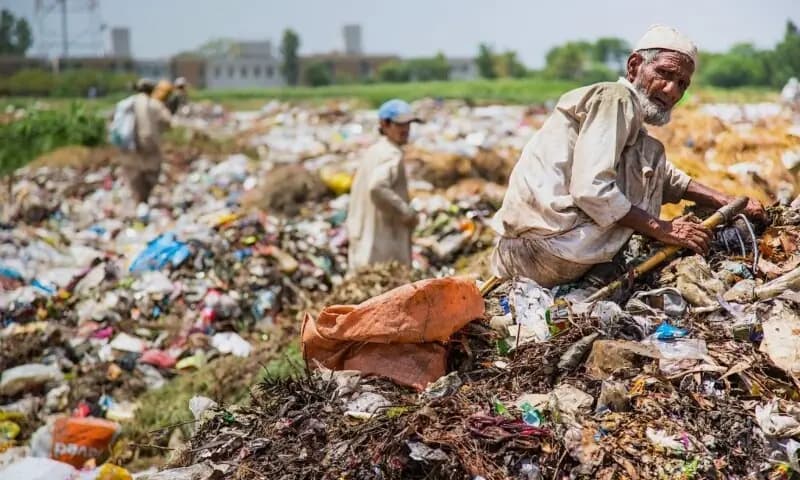
On a balmy winter day, Irfanullah Wahid and his cousin Faisal Asadullah amble through a maze of carts in Karachi’s Shireen Jinnah neighbourhood. They are young — only 11 and 10 years old respectively — and the white bags they carry are almost as tall as they are. They laugh and joke, but their eyes are peeled.
Every few steps, they pause, bend, pick something up off the street and slip it into the bags. Wahid collects only metal cans. Asadullah sticks to thick plastics.
Asadullah stoops to pull out a flimsy plastic bag, commonly known as ‘shopper’ across Pakistan, stuck in the wheel of a cart. His practised hands rip it off with ease. “I don’t collect these”, he says, holding it up to show the difference with the sturdier material he rummages for.
Around him, there is scattered litter. Chips packets, sachets of shampoo and of saunf-supari (mouth freshener). Most are made of non-recyclable laminates which has no use for.
“The kabadiwallah (recycler) won’t pay for this,” he says. In Pakistan, about 2 million tonnes of plastic waste are generated every year and only 15-18 pre cent is recycled. Without urgent intervention, the country’s plastic waste is projected to reach 12 million tonnes by 2040.
This plastic waste will not lie inert in landfills. In cities like Karachi and Lahore, clogged drains will worsen urban flooding before plastics reach the Arabian Sea. They might fragment into microplastics, seep into soil, crops, water and human bodies.
The routine burning of mixed waste will poison the air. And as the scale of the problem grows, pressure is mounting to shift responsibility for plastic waste onto those who produce it. Food and beverage companies, alongside non-governmental organisations (NGOs), recyclers and leading packaging firms have formed what they call the CoRE Alliance.
In 2025, it joined government representatives in calling for a national framework that shifts the cost of packaging waste from consumers to companies. Known as Extended Producer Responsibility (EPR), the framework is designed to reduce waste through a product’s entire lifecycle. Businesses must pay producer responsibility organisations — which are yet to be set up — to collect, recycle and safely dispose of waste, all while meeting government transparency and safety requirements.
“The goal is simple: better plastic management today, lasting circularity for the future,” said Hussain Ali Talib, head of communications at Unilever Pakistan. And yet, while a unified national EPR is certainly a step forward, experts say any such framework must include the 200,000 to over 333,000 people working in Pakistan’s unorganised waste sector. Dr Ayesha Khan, CEO of the Akhtar Hameed Khan Foundation, says that both producers and the government must recognise waste pickers and recyclers as “frontline partners” because they handle about 40pc of Pakistan’s waste.
“Without acknowledging this invisible force, EPR cannot succeed,” she said. An invisible force made up of workers like Wahid and Asadullah. A system built on informal labour In Pakistan, the Indus is called many things: the Father of the Rivers, the Lion River.
Its waters have fed civilisations both past and present. And yet today, one identity threatens to eclipse the rest. It is among the most plastic-polluted rivers in the world.
In cities like Karachi, the river morphs into ‘islands of floating trash’: the flotsam including plastic, bottles and Styrofoam. Plastic waste in the river is “overwhelmingly greater” in weight and proportion than any other type of waste, found a 2022 World Bank study, with single-use items making up one in every four plastic pieces. Nationally, Pakistan throws out 55 billion plastic bags every year, and rising.
Khan explained that in urban centres, a significant portion of waste is handled by informal waste pickers, many of them women and children, who operate in unsafe and unregulated conditions. In Karachi, an estimated 40,000 pickers recover 500-1,000 tonnes of waste every day from the streets and informal dumping spots that municipal crews don’t reach. “Waste pickers are the invisible hands keeping our cities from becoming piles of waste,” said Khan.
They work without protective gear; no gloves, masks or boots, and without any identification, contracts or health cover. Garbage chokes a canal along Faqirabad Road in Peshawar, blocking water flow and creating foul conditions for nearby residents. — Hussain Ali / ZUMA Press / Alamy For some, solutions lie in localised models of intervention. The Akhtar Hameed Khan Foundation, for instance, is testing what Khan described as a “scalable pilot” in the city of Sahiwal, Punjab province, 1,000 km from Karachi.
Based in the low-income settlement of Bhutto Nagar, the initiative involves creating cooperatives of individual waste pickers, and linking them to the town’s municipal system and recycling markets. While experts like Khan insisted on these localised models for Pakistan, businesses keen on EPR hoped to apply