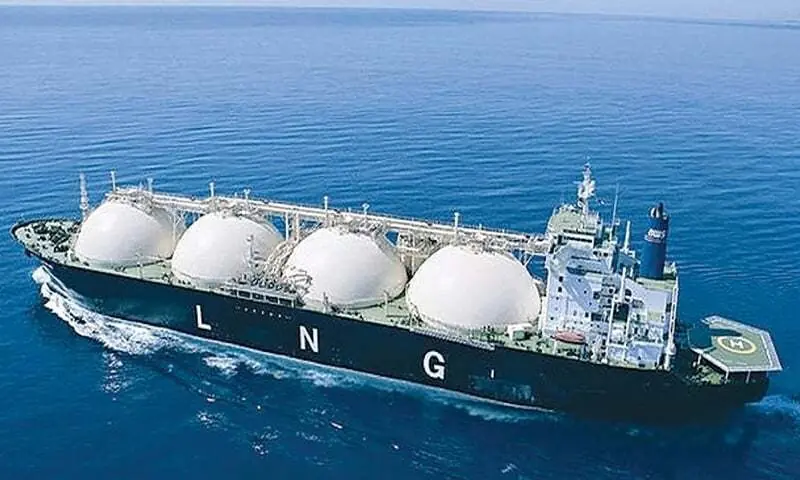
ISLAMABAD: After a gap of 28 months, state-run Pakistan LNG Limited (PLL) on Thursday floated urgent tenders to import three LNG cargoes for delivery between April 27 and May 8 amid rising temperatures and a power shortfall. PLL has set April 24 (Friday) as the deadline for bids, which will be opened the same day, given the urgent need to meet power demand that fell short by more than 4,500MW at peak, resulting in six to seven hours of loadshedding. The tender was issued following Qatar’s reluctance to dispatch LNG cargoes stranded in the Gulf due to the closure of the Strait of Hormuz.
Three LNG cargoes meant for Pakistan had earlier returned from Hormuz for security reasons. All three tenders are for cargoes of 140,000 cubic metres each, to be delivered on a delivered ex-ship (DES) basis. Each cargo typically supplies around 100 million cubic feet per day (mmcfd) to Pakistan.
Last month, the Oil and Gas Regulatory Authority (Ogra) notified a massive 19–22 per cent increase in the price of regasified liquefied natural gas (RLNG) to $12.50–$14 per million British thermal units for sale at the distribution stage by the two Sui gas companies for March. The increase was mainly due to higher terminal charges amid lower import volumes and a minor rise in import prices, data from the authority showed. The basket RLNG price was based on only two cargoes in March, compared to eight cargoes each in February and March 2026, due to a force majeure declared by Qatar after its gas facilities came under attack and the closure of the Strait of Hormuz.
Both cargoes were imported under two LNG contracts between PSO and QatarGas at an average price of about $7.68 per mmBtu (DES), compared to $7.45 per mmBtu last month, but still significantly lower than $8.9 per mmBtu in March last year. PLL, one of the public sector entities responsible for LNG imports, did not import any cargo last month. It had, in fact, imported one cargo a few months earlier after a gap of almost a year at about $7.65 per mmBtu through its old contract with a private entity.
PLL, established almost a decade ago for LNG imports, has become redundant and a net burden on public funds as it has been unable to import LNG cargoes over the past year, despite its executives and board of directors enjoying hefty remuneration along with associated perks and privileges. It had last floated an LNG tender in December 2023 for delivery in January 2024, but later cancelled the tender. Facing criticism over loadshedding even before the onset of summer, the Power Division last week placed an order with the Petroleum Division to arrange around 400 million cubic feet per day (mmcfd) of LNG for power generation, amid hopes for the reopening of international supply routes.
LNG imports stopped early last month after the closure of the Strait of Hormuz following US-Israeli attacks on Iran, which, in retaliation, targeted fuel installations in neighbouring countries, including Qatar, Saudi Arabia, the UAE and Kuwait, among others. Qatar declared force majeure early last month on all its global LNG contracts, including those with Pakistan. Sources said that in the middle of an electricity shortfall, the Power Division made an urgent call for support from all stakeholders for the purchase of LNG cargoes after it learnt about the possibility of Pakistani-flagged ships passing through the Middle Eastern chokepoint.
However, this did not materialise immediately. Sources added that the power shortfall would continue to increase as temperatures rise in the coming days, making it nearly impossible to stabilise the national grid without major power plants, particularly LNG-based plants in Punjab with a total generation capacity of around 6,000MW. On top of that, the utilisation of high-speed diesel (HSD) and even furnace oil at current market prices could push fuel costs through the roof.
In that case, sources said further, even one or two cargoes from the open spot market could be economically viable in the overall power mix compared to diesel and furnace oil. “With the onset of the summer season, electricity demand has started to rise significantly across the country. In this regard, the availability of RLNG remains critical for ensuring optimal power generation and maintaining system stability,” the power division wrote to the petroleum division.
It highlighted that any shortfall in RLNG supply would necessitate increased reliance on expensive alternative fuels such as HSD. “This would not only result in a substantial increase in the overall cost of generation but would also lead to prolonged hours of load management, thereby increasing the fuel cost adjustment (FCA) burden on end consumers,” the power ministry explained. All four mega LNG-based plants of the federal and Punjab governments, along with the medium-sized Nandipur plant, can use HSD as an alternative fuel. The difference in generation cost is normally more than Rs25 per unit, and is currently estimated to be higher give