GEORGE TOWN, April 24 — Penang is strengthening its position as a key hub for automation, test and equipment (ATE) within Malaysia’s semiconductor industry with the launch of a new industry-led ATE campus.Penang chief minister Chow Kon Yeow said the state has the highest concentration of ATE companies and ecosystem partners in the country.“Within this ecosystem, Penang hosts more than 20 local ATE companies and over 80 automation, precision engineering, and component firms,” he said in his opening address at the launch of the ATE Campus in Olive Tree Hotel here.He said many of these companies have grown into strong technology players in which 19 Penang-based companies are listed on Bursa Malaysia, with a combined market capitalisation of approximately RM27 billion as of April 2026.“I am proud to highlight that among these companies, four of them have already surpassed RM500 million in annual revenue, aligning with the aspirations of the National Semiconductor Strategy’s “10+100 local champions” target,” he said.Nationally, machinery, equipment, and parts exports in the country reached RM78.3 billion, accounting for 4.8 per cent of national exports, last year with ATE contributing more than half of the total.Chow said initiatives such as the Penang ATE Campus are expected to accelerate this trajectory by enabling local companies to collaborate, scale and deepen participation in the global semiconductor value chain.“Between 2020 and 2025, Penang recorded RM25 billion in approved manufacturing investments in the machinery and equipment sector, representing 40 per cent of Malaysia’s total investments in the segment,” he said.“This clearly reflects Penang’s significance as a key hub for ATE within Malaysia’s semiconductor industry,” he added.He said the Penang ATE Campus is intended to address collaboration gaps within the ecosystem by creating a platform for local ATE firms, multinational corporations and industry partners to co-develop, integrate and validate solutions for real manufacturing applications.Chow explained that the project will be developed in two phases.Phase one will focus on building an ecosystem between multinational corporations and local ATE firms through shared field labs and training platforms aligned with production needs, he said.Meanwhile, he said phase two will explore the development of a dedicated physical campus inspired by the Brainport Industries Campus model in Eindhoven.It will bring together qualified suppliers under shared production and qualification standards.“Ultimately, the aim is to have Penang ATE Campus becoming a production capability system that MNCs can plug into with confidence,” he said.He said the state government’s commitment to the initiative is the allocation of 10 acres of land valued at approximately RM40 million through the Penang Development Corporation for the future physical campus.Chow said the initiative’s success does not only depend on infrastructure, but also on sustained collaboration between industry, government and ecosystem partners, including support from the federal government.“Today, we will also be handing over the ATE policy recommendation white paper to Miti which outlines proposals to further strengthen the development of Malaysia’s ATE ecosystem,” he said.He said a strong partnership with the federal government is essential to drive the success of the initiative.Chow said later, there will also be an exchange of 10 memoranda of understanding between MNCs and InvestPenang which will strengthen localisation efforts and build a more resilient supply chain.
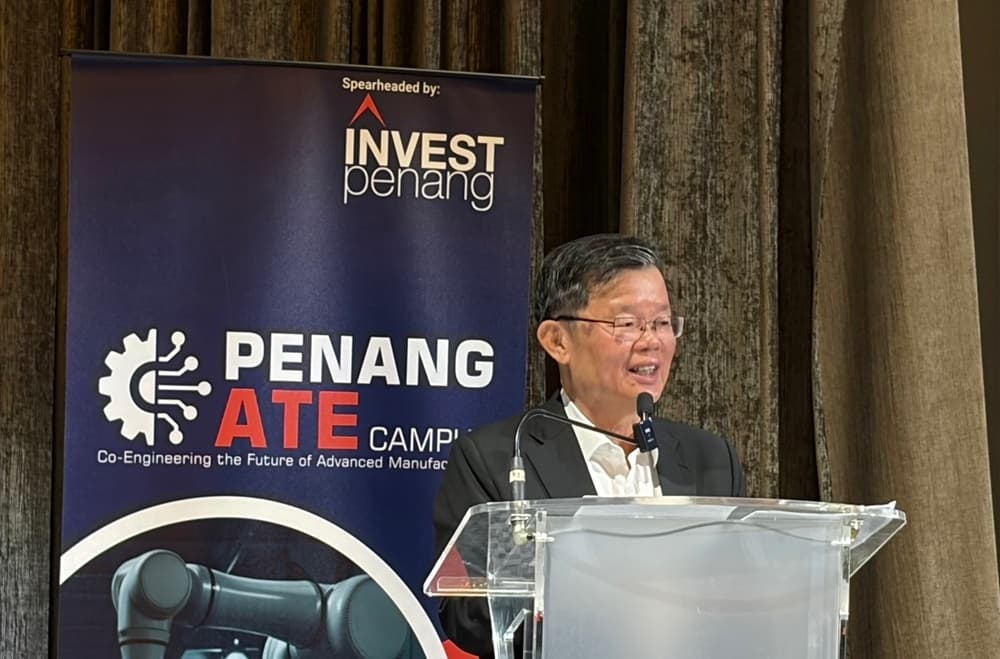
Penang cements role as Malaysia’s automation, test and equipment hub with launch of collaborative campus initiative
Opalyn Mok·Malay Mail··3 min read
M
Continue reading on Malay Mail
This article was sourced from Malay Mail's RSS feed. Visit the original for the complete story.