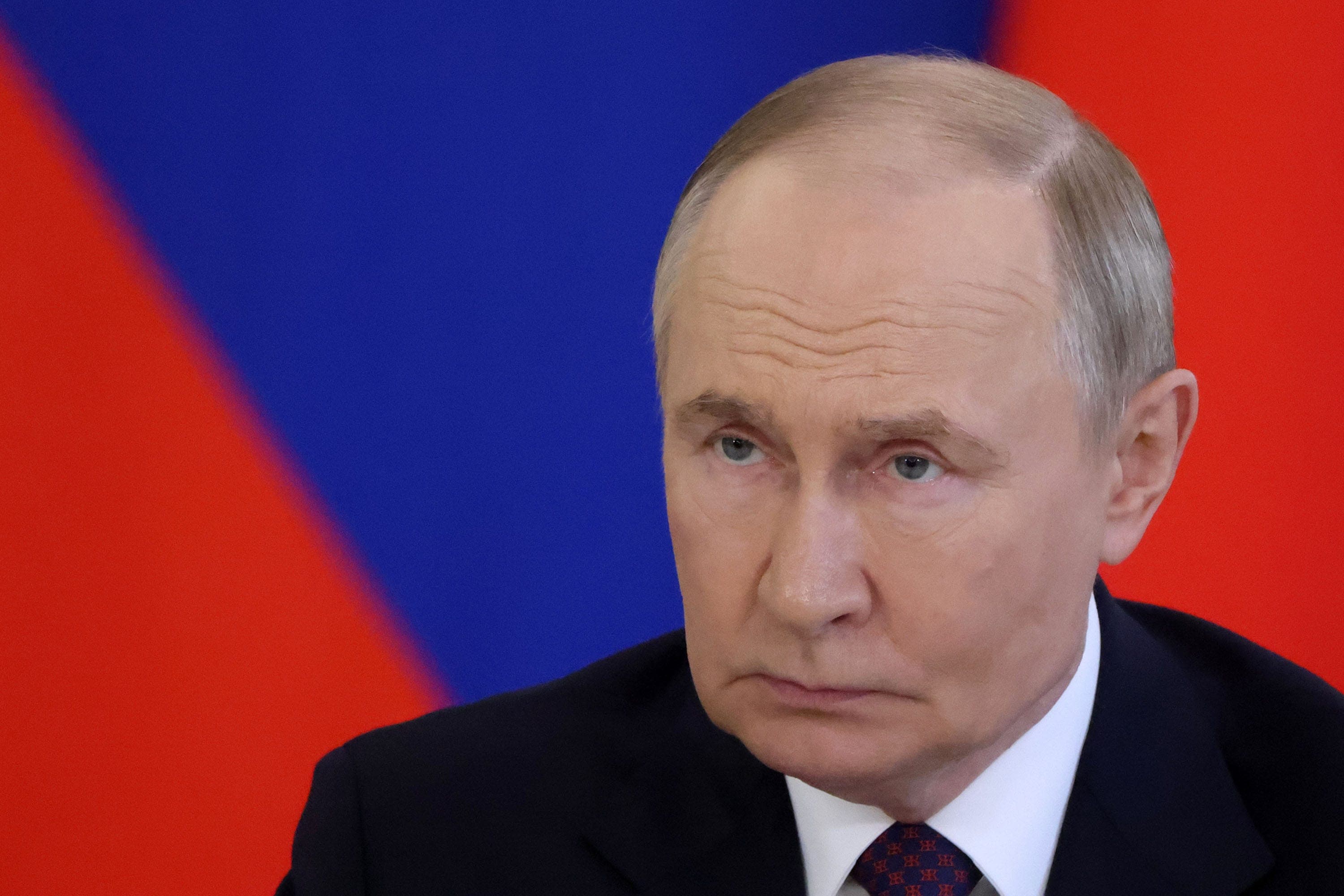
(Photo: Getty Images)HIS APPROVAL RATINGS ARE SAGGING. His foreign war is floundering while economic woes multiply at home. His erstwhile loyal supporters are rebelling, and there are elections coming up.
Donald Trump? Yes, but his role model in the Kremlin is having the same problems.Not exactly the same, of course. Vladimir Putin’s war in Ukraine is now in its fifth year, and the Russian economy has been previously saved from collapse by being retooled as a war machine.
Putin’s recent drop in approval ratings has left the share of Russians who say they trust him at 72 percent, which Trump could only dream about; but that’s still down nearly 7 points from two months ago, and in official surveys by the government’s own polling agency. Of course, as expatriate political analyst Abbas Galyamov points out, under a borderline totalitarian regime such questions primarily measure “the level of fear.” Notably, when approval is measured in a way that doesn’t force respondents to state directly that they don’t trust Putin—by asking Russians which politicians they trust—Putin gets the nod from only 29 percent, and that figure is down from 35 percent at the end of last year.Another big difference between Trump and Putin, obviously, is that the elections to the state Duma coming up in September are very unlikely to pose a threat to Putin: Over his twenty-six years in power as president and prime minister, the Russian political system has perfected the art of both rigging the vote and keeping undesirables off the ballot in the first place to such a point that only a genuine tsunami of popular anger might be able to break through.Yet alarm bells are going off.
At a recent televised meeting of high-level officials, a petulant Putin demanded to know “why the trajectory of macroeconomic indicators is currently below expectations.” Despite still being fueled by military spending, Russia’s GDP grew just 1 percent in 2025—and shrank by nearly 2 percent in January and February of this year. The budget deficit is growing, and oil revenues are falling despite the spike in oil prices caused by the war in Iran—thanks mainly to Ukraine’s remarkable success in taking out, or at least temporarily disabling, Russia’s oil depots and oil-processing facilities. Those strikes are also adding to the general sense of instability: Even the official Russian media have been reporting on the massive fires following two waves of drone strikes at the southern Russian port city of Tuapse, not only a major transport hub but a popular seaside spot.
A viral video shows a tearful Russian woman lamenting that she just wanted to live by the sea with her child, but “now the sea is all fucked up” by oil spills and “those drones are flying around and smashing the fuck out of everything.”Meanwhile, the Russian state continues its war on the internet—a big deal in a country where the digitization of life, especially since the COVID-19 pandemic, was until recently an area of surprisingly rapid progress. With more and more websites blocked and more and more apps disabled, the Roskomnadzor, Russia’s fearsome “Federal Service for Supervision of Communications, Information Technology, and Mass Media,” is halfheartedly trying to fight the use of VPNs, virtual private networks that allow people to bypass the blocks.
Russian VPN users are no longer able to access government websites that provide essential services; some major Russian banks and online shopping companies are blocking them as well. It’s more of a hassle than an insurmountable obstacle, since it means simply that people have to turn the VPN on and off; but regular small hassles can add up to a lot of irritation, in this case unmistakably directed at the government.Join Bulwark+ with a FREE 14-day trialIN THE MIDST OF THIS SIMMERING TURMOIL, an unexpected would-be voice of the people has emerged: Victoria Bonya, а 46-year-old fitness and beauty blogger and former Russian TV personality who now lives in Monaco.
I wrote last month about Bonya’s Instagram video clip denouncing the slaughter of supposedly infected cows in Siberia (and also taking a swipe at the internet shutdowns). Recently, she has upped the ante with an Instagram video billed as “an appeal to Vladimir Vladimirovich Putin from all Russians who care.” It opened with a remarkable statement:Vladimir Vladimirovich, people are afraid of you. The common people are afraid of you.
Bloggers and artists are afraid of you. Governors are afraid of you. But you are the president of our country. It seems to me that we should not be afraid. . . .
I think there is a great, thick wall between you and the people.Bonya then took it upon herself to report to Putin about several problems on which she believed he was not being adequately informed: recent floods in Dagestan, oil spills in the southern Anapa Bay (this one apparently unrelated to Ukrainian drones), the cow slaughter in Siberia, and the internet blockings. To some extent, this is a standard “good tsa