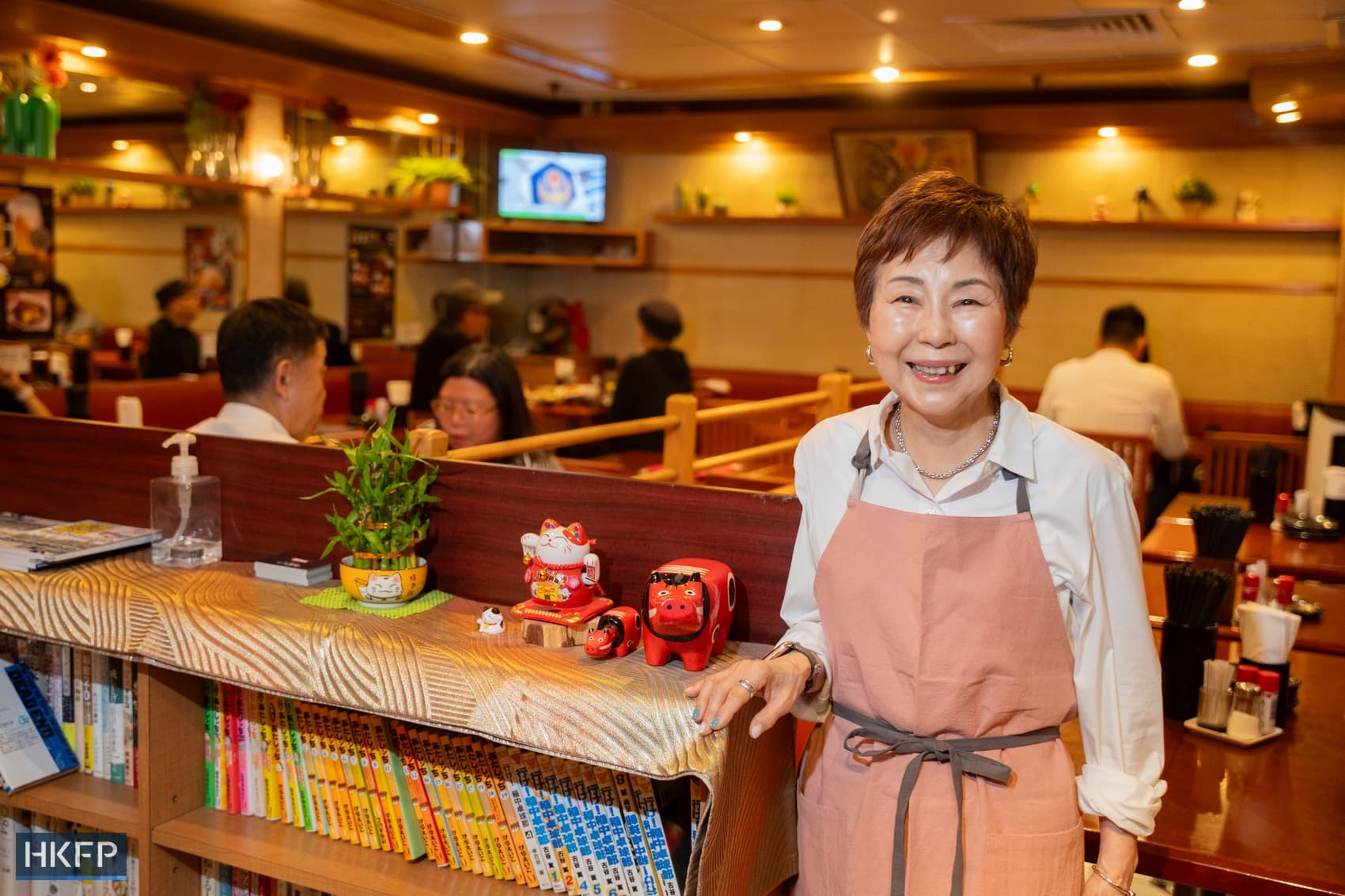
Ippei-an Ramen & Bar, a Japanese restaurant that has been in operation for 42 years, is located in what people may say is one of Hong Kong’s worst locations. Energy Plaza, a commercial building in Tsim Sha Tsui East, is no longer a lively spot. Quite a number of restaurants have shut down over the past few years.
The lights are dim, and you can hardly find the way to the ramen shop, which is tucked away in the basement. Founder Itsuko Shimada inside Japanese restaurant Ippei-an Ramen & Bar in Tsim Sha Tsui East in April 2026. Photo: Kyle Lam/HKFP.
Yet diners fill the 800-square-foot restaurant at lunch and dinner. Office workers, construction workers, secondary school students and tourists seek comfort in affordable, generous bowls of broth and noodles. Opened in 1984, Ippei-an bills itself as Hong Kong’s first ramen restaurant.
Its founder, Itsuko Shimada, emigrated to Hong Kong 55 years ago. “I am almost a Hongkonger… I have spent more time in Hong Kong than in Japan,” Shimada spoke to HKFP in English mixed with Cantonese and Japanese. “My life has had its ups and downs here.” Now in her early 70s, Shimada was a teenager when she and her parents moved from Tokyo to Hong Kong in 1971.
More than a decade later, Shimada, then newly divorced, founded Ippei-an. Her younger son, Kosei Kamatani, was one year old at that time. He later took over the family business after working for a multinational firm.
At its peak, their business had nearly a dozen restaurants across Hong Kong. However, it has been hard hit over the past three years, forcing the closure of several outlets, the mother and son told HKFP. Diners enjoying lunch at Ippei-an Ramen & Bar in April 2026.
Photo: Kyle Lam/HKFP. After suffering significant monthly losses, three restaurants have shuttered since the end of last year, including the 21-year-old branch in Mira Place, a shopping mall in Tsim Sha Tsui. Their business was not immune to the spate of closures that affected the city’s restaurant and retail sectors in recent years.
“It’s sad to see so many shops and restaurants shutting down in Hong Kong. I’ve never seen this in all my years here,” said Shimada. ‘Too naive to be scared’ When Shimada opened her first ramen restaurant in Energy Plaza in 1984, just a year after the building opened, Hong Kong’s economy was booming.
Tsim Sha Tsui East was a burgeoning business centre at the time, teeming not only with offices but also with nightclubs, discotheques, and restaurants. Shimada recalled that Energy Plaza’s basement housed a popular discotheque back then. Ippei-an operated from 12pm to 12am, serving mainly white-collar office workers during the day and predominantly clubbers and hostesses at night.
A kitchen staff member prepares ramen at Japanese restaurant Ippei-an in April 2026. Photo: Kyle Lam/HKFP. “It was a time when everybody came [to Tsim Sha Tsui] to enjoy themselves.
One person could spend HK$2,000, HK$3,000 in one night [at a nightclub], giving HK$1,000 in tips,” Shimada said. Born in Japan, Shimada never imagined a life in Hong Kong. However, her parents were adventurers who loved travelling to different countries, she said.
In her youth, her mother was a dancer with the renowned Shochiku Kagekidan – Tokyo’s legendary all-female revue, while her father was a manager there. They often travelled abroad for performances as well as for pleasure. After Shimada’s mother retired from dancing, the couple opened a snack bar named Ippei in Tokyo.
“But they didn’t want to just run a small shop in Tokyo. They hoped to explore other opportunities,” said Shimada. Her parents chose Hong Kong because they had friends in the city.
The couple also wanted her to go with them, she said, “because I was their only child.” After a few years of settling in, they opened a karaoke nightclub in Tsim Sha Tsui in 1978, introducing karaoke, which had become popular in Japan, to Hong Kong. Itsuko Shimada (left) and restaurant staff taste new dishes at Ippei-an in April 2026. Photo: Kyle Lam/HKFP.
There were no karaoke venues in Hong Kong at the time, Shimada said. “My parents shipped karaoke equipment from Japan to Hong Kong. But at that time, there were no private rooms.
People just sang in the hall.” After marrying in Japan, Shimada’s then-husband also moved to Hong Kong to assist her parents with the nightclub business. The young couple got divorced a few years later, leaving Shimada to raise her two sons. To support her family, Shimada decided to follow in her parents’ footsteps and become an entrepreneur.
Instead of running a nightclub, she was more interested in the catering business. “Coincidentally, a friend introduced me to the owner of a renowned Nagasaki ramen restaurant. I ganbatte [persevered] and went to Nagasaki many times to beg him to teach me the recipe, especially the soy sauce-based broth,” Shimada said. Back then, there were no ramen restaurants in Hong Kong, Shimada said, yet she found the courage to be the first entrepreneur to introduce aut