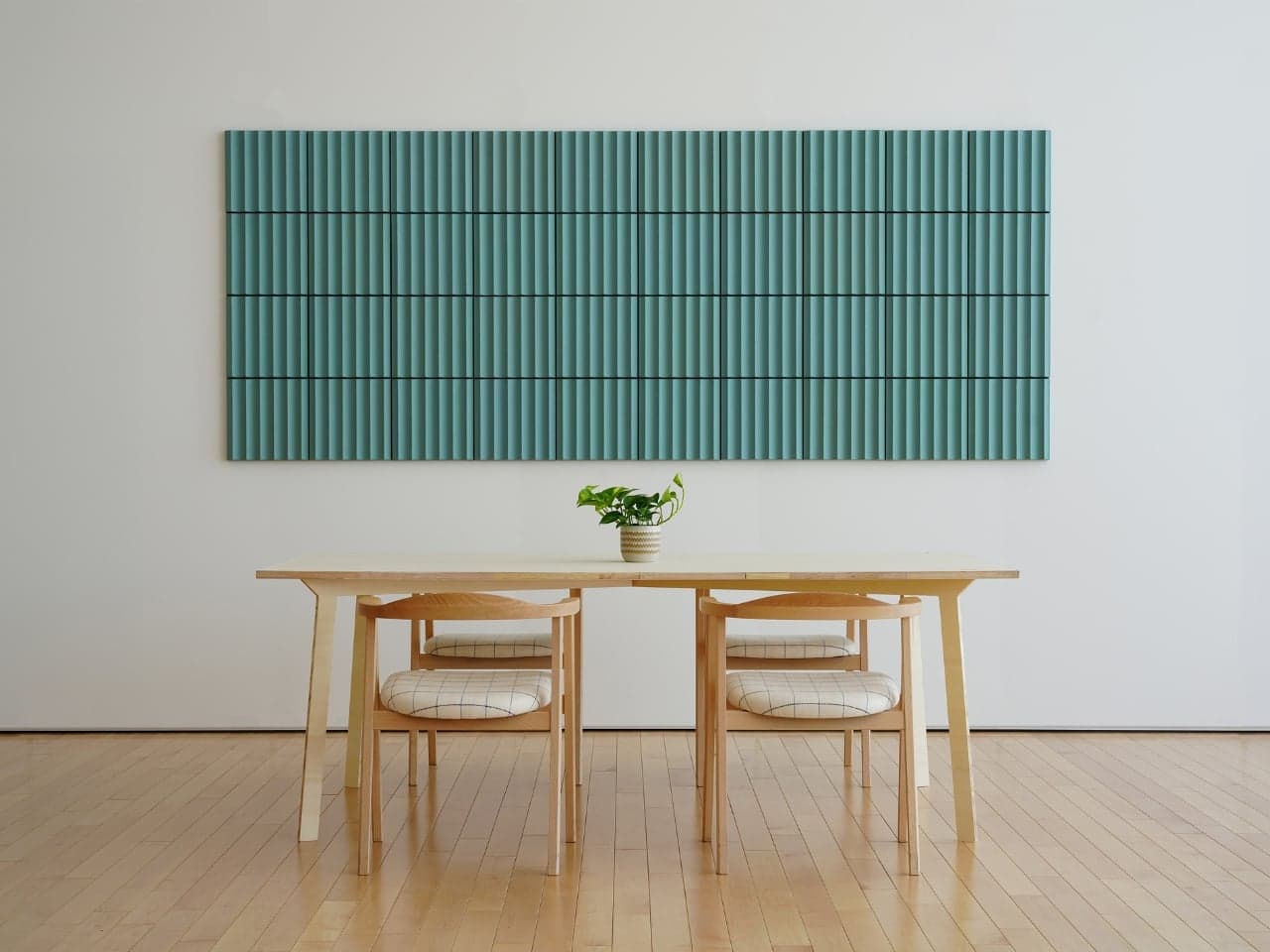
Most acoustic panels exist as a necessary evil. You know the type: thick foam squares in aggressive wedge shapes, usually in black or grey, installed in a recording studio or conference room with zero consideration for how the space actually looks. They do their job.
They do it without any grace. And for years, that was the trade-off we accepted without question. LIBGRAPHY’s REBORN PULP acoustic panel doesn’t accept that trade-off.
The Japanese design studio has been quietly building a case for what acoustic treatment can look like when the people behind it actually care about both problems at once, and the more you learn about this piece, the more you understand why it’s been turning heads. Designer: LIBGRAPHY The material story alone is worth paying attention to. REBORN PULP is made entirely from 100% recycled paper pulp, with no plastics and no synthetic adhesives.
It is fully biodegradable. In a category where polyester fiber and foam are the default, a panel that begins its life as discarded paper and can return to the earth when it’s done is a genuinely radical proposition. The name “Reborn” isn’t just branding.
It’s a philosophy the whole product is built around. What makes the engineering here quietly impressive is the dual-layer construction. The outer shell is molded pulp, giving the panel its form and texture, while the interior is packed with loose pulp fiber.
That combination works together to absorb sound across a wide frequency range, which is the part that matters most if you’re actually trying to fix a room’s acoustics. Getting a material to absorb sound consistently across low, mid, and high frequencies is not a trivial engineering challenge, and the dual-layer approach suggests LIBGRAPHY took that technical problem seriously before worrying about how the final product would photograph. A lot of design-forward acoustic products look pretty and perform modestly.
This one appears to take both seriously. Then there’s the aesthetic angle, which is where I think the design conversation gets most interesting. LIBGRAPHY drew inspiration from Karesansui, the traditional Japanese dry landscape garden.
If you’ve ever stood in front of one of those carefully raked sand gardens and felt an inexplicable sense of calm wash over you, you already understand the logic. The surface of the REBORN PULP panel carries that same quiet, rhythmic quality. Ridges and textures that reference raked sand, rendered in recycled paper.
It’s an unusual and genuinely poetic translation. The color palette reinforces this. The panel is available in shades drawn from traditional Japanese color naming: natural, pale grey, celadon, and indigo.
These aren’t colors chosen because they’re trendy. They’re colors with cultural weight, and they communicate a kind of restraint that a lot of contemporary design products desperately try to fake. I’ll admit I have a soft spot for design that refuses to treat function and beauty as separate departments.
We’ve spent decades watching sustainability get squeezed into products as an afterthought, announced via small text on the packaging while the object itself looks like it came out of the same mold as everything else. REBORN PULP doesn’t do that. The recycled material is the design.
The environmental commitment is legible in the texture, the color, the form. You can see it. That last point matters more than it might seem.
The conversation around sustainable design has a credibility problem right now. Too many products wear their eco-credentials as a badge without earning them through actual material and process decisions. REBORN PULP earns it.
The sustainability isn’t a layer added on top. It’s the whole premise, and the design thinking follows from there rather than working around it. Whether REBORN PULP finds its way into homes, offices, or commercial spaces beyond Japan remains to be seen.
But as a piece of thinking, it’s the kind of design that makes the field feel purposeful again. Old paper, turned into something that quiets a room and looks like a zen garden doing it. That’s not a bad outcome for something that was headed for the recycling bin. The post Recycled Paper Turned Into a Japanese Zen Garden for Your Walls first appeared on Yanko Design.