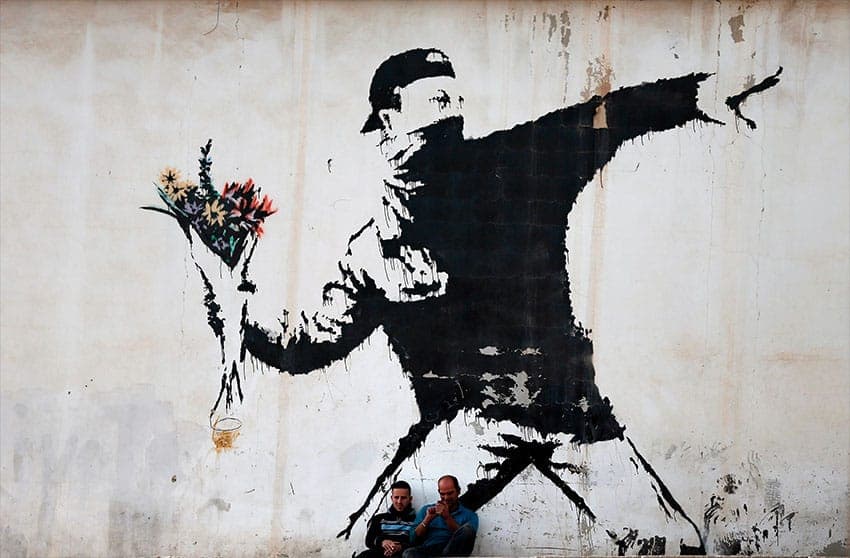
It’s not every day that the world’s most famous — or infamous — street artist hops across the pond from the United Kingdom to spend time in the jungles of Chiapas, a region of Mexico most known for its coffee production, revolutionary movements and Maya ruins. Even rarer is when that artist is doing it as part of a community-centered football club with a sociopolitical goal to unite oppressed communities around the world. “Love is in the Air,” a 2003 Banksy stencil mural in the West Bank, territory that is claimed by both Israel and Palestine.
Banksy has repeatedly traveled to troubled locations around the world and done public art, often with social justice themes. (Sotheby’s) When Banksy became a footballer I’m talking about Banksy — the faceless graffiti guerrilla whose globally renowned work once sold for more than US $25 million — and the time he came to southern Mexico as a goalkeeper and member of Bristol’s Easton Cowboys and Cowgirls Sports and Social Club (nowadays known as the Easton Cowfolk). The English club’s origins and its socially minded mission — which the book “Freedom Through Football: The Story of the Easton Cowboys and Cowgirls” by Will Simpson outlines in great detail — can be traced back to the late 1980s.
In 1992, the team was formally organized from a ragtag pick-up team to an actual club by a group of punk rockers and anarchists to represent the working-class aspirations of amateur footballers. Over the years, the team’s reputation as a vehicle for civic engagement and social betterment allowed them to travel to struggling parts of the world — Palestine, South Central Los Angeles and Mexico — to unite disparate communities through sports. Enter Banksy, who cut his teeth around Bristol’s underground graffiti circuit as a teenager, and whose use of street art stencils with anti-establishment messaging eventually gained him notoriety as a mysterious, universally sought-after artist.
Banksy signed up with the Easton Cowboys as the team’s goalie. What Banksy left behind in Chiapas Banksy’s “Resistencia” mural in Chiapas. (Internet) In 2001, Chiapas was in the international spotlight for its Indigenous mobilization to demand social justice and human rights, led by the militarized Zapatista Army of National Liberation (EZLN). Banksy made the trek with the Easton Cowboys to Chiapas’ mountainous communities to lend his support, both on and off the pitch.
A few years prior, in the late 1990s, the Acteal massacre had occurred, in which 45 Indigenous people in Chiapas were murdered by a pro-government paramilitary group. This had reignited the EZLN, which had previously signed a peace treaty with the Mexican government. The BBC reported that Banksy had helped the football club with its charity fundraising for Chiapas, creating a painting that was raffled off to raise money for water projects there.
There are also vintage photos of the street art that Banksy left around the state, including a mural that declared “resistencia” and that featured armed soldiers being confronted by the local community. Its message encouraged community members to stay informed and knowledgeable. Another mural, perhaps even more iconic, portrayed masked EZLN members in mid-air while unleashing a chilena, or bicycle kick.
It was framed by the text, “A la libertad por el fútbol.” (To freedom through football). Other remnants of Banksy’s time in Chiapas can be found in a few of his stencils — one shows a group of EZLN freedom fighters armed with AK-47s and playing football. Another shows a mariachi gripping his guitar like a weapon and playing music that is symbolized by bombs being dropped (i.e., music as a form of combating oppression).
Banksy’s legacy in Chiapas Banksy also left this stencil in Chiapas, along with a larger mural. (Banksy Unofficial) It’s unclear whether these relics remain visible in Chiapas or if they have been painted over. One thing is certain, though: Chiapas has since transformed into a hotspot for street art, with Condé Nast Traveler documenting the parts of Chiapas that are veritable outdoor museums. Sadly, Chiapas is facing just as many social issues and environmental concerns as when Banksy originally visited over two decades ago.
In the past year, the state has experienced a severe water crisis — despite being a naturally abundant and largely tropical region, but clean-water access has been a problem in the state for a lot longer. Protesters have repeatedly confronted corporations in the state — most notably, Coca-Cola — over their levels of water consumption, which have impacted populated areas like San Cristóbal de las Casas. Paradoxically, Chiapas supplies around 30% of Mexico’s water.
According to the We Are Water Foundation and designated by the National Water Commission (Conagua), Chiapas “possesses one of the 10 largest groundwater reserves in the world.” Yet, Chiapas struggles with water access and neglect. The federal statistics agency INEGI’s 2020 Population and Housing Census rev