Shoot and Kill. The U.S.-Iran conflict is evolving from a hot war of dueling air strikes to a nautical stalemate with lots of piracy and saber (cutlass?) rattling. The two-week ceasefire between the two countries that was supposed to expire Wednesday has since morphed into an indefinite pause in direct hostilities.
Neither side is actively bombing the other at the moment. But face-to-face negotiations have not restarted either. In lieu of directly shooting at each other, the U.S. and Iran have taken to harassing shipping in the region.
On Thursday, the U.S. Department of War posted footage of Marines boarding a tanker in the Indian Ocean, claiming it was shipping Iranian oil. Overnight, U.S. forces carried out a maritime interdiction and right-of-visit boarding of the sanctioned stateless vessel M/T Majestic X transporting oil from Iran, in the Indian Ocean within the INDOPACOM area of responsibility.
We will continue global maritime enforcement to… pic.twitter.com/SWF6Jt9Ci4 — Department of War (@DeptofWar) April 23, 2026 U.S. Central Command claims to have redirected 33 ships during its blockade of Iranian coastal waters. Iran also released footage on Thursday showing a swarm of small boats seizing two tankers in the Strait of Hormuz.
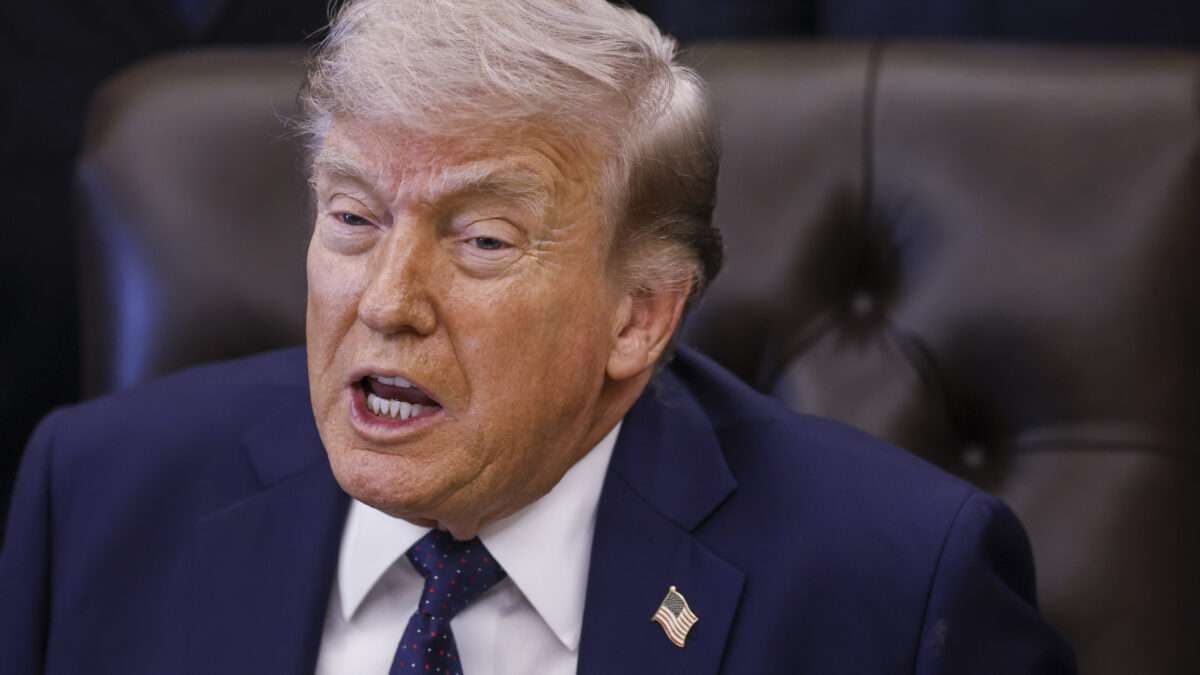
Iran's use of a swarm of small, fast boats to seize two container ships near the Strait of Hormuz could undermine suggestions that US forces have disabled its naval threat and reveals the challenges facing reopening the oil export route https://t.co/uqyZNLjzU4 pic.twitter.com/CjD9x4dhmi — Reuters (@Reuters) April 23, 2026 Iran also reportedly attacked a third ship but did not capture it. In response, President Donald Trump said on Truth Social that he'd ordered the U.S. Navy "to shoot and kill any boat, small boats" because they may be laying mines in the strait.
The president told reporters on Thursday that he was in no rush to end the war and would hold out for the best deal. California's doomed mask ban. Masked federal agents roaming America's streets are most libertarians' nightmare.
But a recent ruling from a panel of the 9th Circuit Court of Appeals makes clear that states can't do much to make the secret police show their faces. Earlier this week, a unanimous three-judge panel issued a preliminary injunction that blocks the state from enforcing its No Vigilantes Act, which requires nonuniformed police, both state and federal, to display identification. While not all state regulations that touch on federal activity are per se unconstitutional, the U.S Constitution's "Supremacy Clause does bar direct state regulation of the federal government," wrote Judge Mark Bennett in the panel's opinion.
"And that is precisely what the No Vigilantes Act does." That law was passed in September 2025 in response to the Trump administration's very public deployment of masked federal immigration enforcement agents to California's cities. A related law, the No Secret Police Act, passed at the same time forbade federal agents from covering their faces in public.
In December 2025, the Trump administration sued to block enforcement of both laws on the argument that the U.S. Constitution's Supremacy Clause forbade states from regulating the on-the-job conduct of federal agents. In a February ruling, District Court Judge Christina Snyder partially sided with the Trump administration by blocking enforcement of the No Secret Police Act's mask ban, while allowing the No Vigilantes Act's identification requirement to go into effect.
Snyder ruled that the mask ban, which only applied to federal agents and not state police, was unreasonably discriminatory. She reasoned that the state's identification mandate, which applies to both state and federal agents, was not discriminatory and did not impede federal agents' ability to do their jobs. Bennett wrote in his opinion that the minimal impact of the state's identification mandate was beside the point.
"If a state law directly regulates the conduct of the United States, it is void irrespective of whether the regulated activities are essential to federal functions or operations, and irrespective of the degree to which the state law interferes with federal functions or operations," reads his opinion. In response to Snyder's ruling, California lawmakers introduced a new mask ban that would apply to federal and state police. Under Bennet's ruling, that amendment wouldn't save the law.
A puzzling marijuana rescheduling. People are advised not to look a gift horse in the mouth, particularly if that gift horse is a Republican presidential administration lessening regulation on marijuana. Nevertheless, the order Acting Attorney General Todd Blanche signed yesterday to reschedule state-legal medical marijuana from Schedule I (the federal government's most restrictive classification for controlled substances) to Schedule III presents some "legal and scientific puzzles," writes Reason's Jacob Sullum. Blanche's order moves only state-legal medical marijuana into