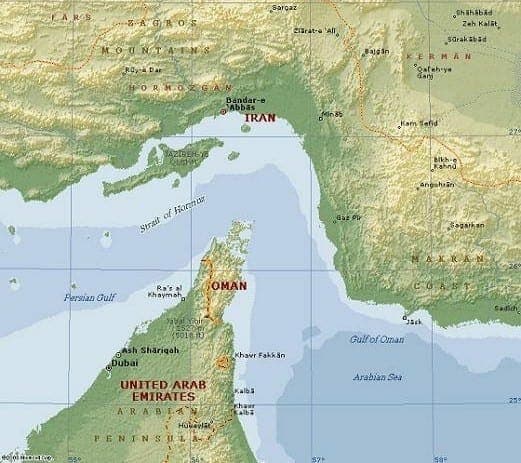
Iran has shut down the Strait of Hormuz. Shipping of 20% of the world’s petroleum, along with significent amounts of fertilizer, helium, bromine, aluminum, sulfuric acid, and probably some other things, has stopped. This, according to some economists, is the largest petroleum disruption ever.
Shortages are showing up in Asia and will spread to the rest of the world. This is likely to lead to a major world recession. Even Americans, those mythical people immune to all bad things, are seeing gasoline rise in price.
The last ship to pass through the Strait is now in its home port. Every day the Strait is closed, the likelihood and length of a worldwide recession increase. At some point, oil wells will have to be shut down.
That will require months to reverse, and the wells are likely to produce less afterwards. We must get the Strait open as soon as possible. Donald Trump would like to move on to his beautiful ballroom or triumphant arch or painting the Reflecting Pool blue.
It’s the same strategy he used to avoid managing COVID. His underling, Pete Hegseth, believes that MOAR BOMBING will solve the problem. I have my doubts.
I’ve recently been thinking about the problem that strategy and analysis face in Trump. Trump’s ignorance of statecraft, governing, and other subjects useful to a president draw the country into dreadful situations like the war on Iran. There are conventional ways of discussing statecraft, governing, and those other subjects, but those ways are irrelevant to Trump’s processes.
NONETHELESS The rest of the world, and even parts of the US government, still operate mostly through strategy and analysis. So understanding that experience is not without value. The problem is how to integrate that understanding with what Trump is doing.
There has been a genre of analytical writing that has proceeded as if Trump is a normal president, with suggestions that he adjust his National Security Council procedures to include some new facts or that he encourage Cabinet members in a particular direction. The vision of Trump working with Kristi Noem or Markwayne Mullin to achieve a fairer immigration policy, for example, is ludicrous. On the other hand, to accept Trump’s flitting from self-incurred problem to problem with random disasters as a given that cannot be changed is to accept disaster in situations like COVID or the Strait of Hormuz closure.
Saying that the normal rules don’t apply to Trump is a confession of defeat. It provides no guidance on how to achieve goals that he may stand in the way of. Until we can remove him, we have to find ways around Trump’s limitations.
In the case of COVID, some damage was averted by encouraging his Warp Speed program to develop a vaccine. The Europeans have found that playing up to his ego in some cases and resisting him in others can avert some of his worst inclinations. William Burns, one of the premier diplomats of our time, has an op-ed in the New York Times outlining a rather conventional path forward (gift link).
It is easy to dismiss this as one of those articles that imagines a different Donald Trump. I’ve struggled with that divergence between normal analysis and what Trump does. I’ve come to the conclusion that, while some types of advice to Trump or “the government” are indeed ludicrous, we can’t ignore normal strategy.
Burns’s op-ed lays out a normal path forward. The next step is to figure out how to push or cajole Trump onto that path, or to find a way around him. That’s the way to combine normal analysis with Trump’s peculiarities.