This story was originally published by Inside Climate News and is reproduced here as part of the Climate Desk collaboration. Some Texas oil wells gush hundreds of barrels of oil a day. But many are like the wells on Jackie Chesnutt’s ranch in West Texas that only trickle out a couple barrels a month.
Chesnutt, a retired engineer, claims the five wells operating on her ranch are out of compliance with state rules and should be shut down. The company, CORE Petro, says that it’s struggling to break even, let alone pay to plug the wells. But it says that all its wells are in compliance.
There are thousands of oil and gas wells around Texas like these: low-producing wells leased by companies operating on a shoestring. About two-thirds of the active oil wells in Texas, or 99,000 wells, produce less than 10 barrels of oil a day, according to the state regulator. To remain active, oil wells in Texas must produce at least five barrels for three consecutive months or at least one barrel for 12 consecutive months.
Companies will often maintain a minimal amount of oil production instead of plugging a well, which can cost tens of thousands of dollars. Landowners like Chesnutt argue that this pattern can lead to pollution and burdensome equipment on their land. Chestnutt poses for a portrait on her property in Knickerbocker, Texas.Paul Ratje/Inside Climate News Oil industry analysts and environmental advocates say they have heard claims that companies report the bare minimum of oil production to avoid plugging wells.
“The wells on the lease are all producing,” said Railroad Commission spokesperson Bryce Dubee. Advocates of reforming the oil and gas industry say that stricter rules are needed to ensure companies plug wells in a timely manner and assume the costs so that it does not fall to the state. In a 2022 report on Texas’ orphan well problem, the nonprofit organization Commission Shift wrote companies should not be able to “indefinitely ‘produce’ a teaspoon of crude or a cubic foot of gas simply to avoid paying for decommissioning.” Texas has more than 159,000 inactive wells.
If the operator of an inactive well goes out of business, the unplugged well eventually becomes an orphan. Texas is facing a record-high backlog of more than 11,000 orphan wells. “We’re not financially able to plug a bunch of oil wells.
That’s not why we’re in this business.” Chesnutt is the rare landowner who is fighting back against this broken system. The 69-year-old and her now-deceased husband bought the 375-acre property outside San Angelo in 1998. After retiring from a career working at a pharmaceutical company in San Angelo, she now tends goats and sheep on the ranch.
Her complaints to the Railroad Commission, which regulates oil and gas, have gone nowhere, she said. She has resorted to shutting off power to CORE Petro’s wells because she says they are out of compliance with state production rules. CORE Petro responds that it’s Chesnutt who is breaking the law by shutting off power and, without electricity, they have no way to produce oil at the wells.
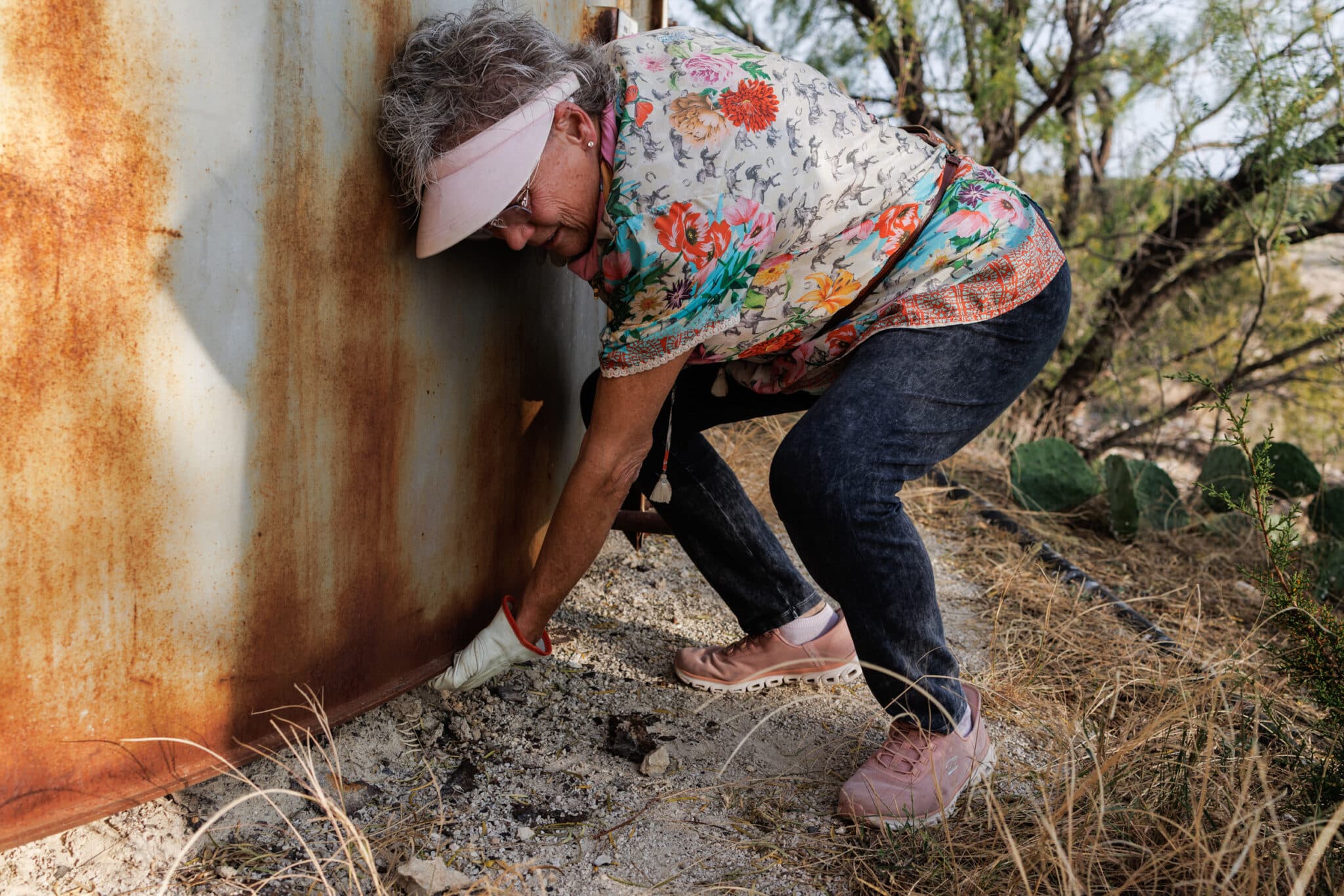
Chestnutt feels underneath a tank that is rusted out on its base. It’s one of several on her property owned by CORE Petro.Paul Ratje/Inside Climate News “We’re between a rock and hard place,” said Cassie Ohlhausen, who runs CORE Petro with her husband, Kent. “We’re not financially able to plug a bunch of oil wells.
That’s not why we’re in this business. We’re in this business to produce oil wells.” Chesnutt’s growing frustration has spilled over into confrontations with CORE Petro and commission staff. The Railroad Commission alleges that Chesnutt physically assaulted staff members and endangered them with aggressive driving.
The agency has instructed her to put all communications in writing to avoid future incidents. The owners of CORE Petro say she has threatened them with a gun. Chesnutt disputes these claims.
The Railroad Commission declined to answer numerous questions about the oil lease on Chesnutt’s ranch. Instead, commission staff provided a letter sent to Chesnutt that described altercations with staff members. The Railroad Commission has not issued any fines to CORE Petro.
Chesnutt’s ranch is one small window into the vast problem of Texas’ aging oil assets. Existing financial mechanisms are not enough to retire the thousands of low-producing oil wells littered across the Texas countryside. The problem eventually falls to the state or becomes a thorn in the side of landowners like Chesnutt.
Persimmon Creek Ranch lays where the desert scrubland of the Trans Pecos region meets the rocky woodlands of the Texas Hill Country. The ranch, about 200 miles northwest of Austin, gets its name from the native persimmons she collects to make preserves. “One of the biggest things we have focused on out here since we’ve bought the place is water, water, water,” she said.
Chesnutt, now widowed, relies on a windmill-operated well to provide water for her residence and animals. Chesnutt’s ho