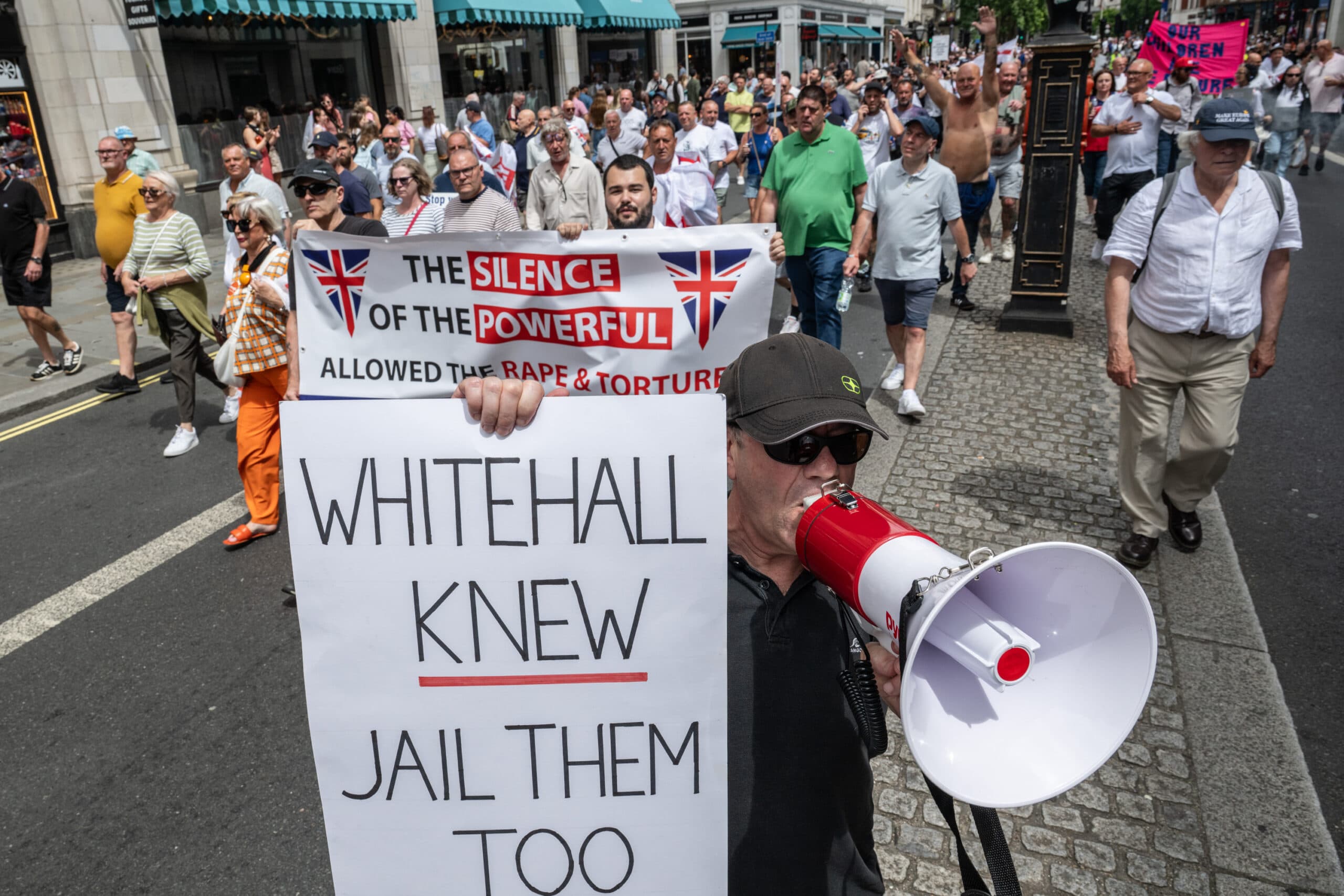
UK Special Coverage The Grooming Gangs’ Unexamined Organized Crime Angle The “grooming gangs” framing has obscured that black-market commercial element of child abuse. UK Special Coverage (Photo by Guy Smallman/Getty Images) In March this year, trading standards officers in the West Midlands town of Dudley closed down a number of “rogue” businesses, mostly mini-marts and vape shops, due to links to organized criminal gangs. Their priority criterion was not tax evasion or counterfeit goods.
It was the grooming threat to children. The shops are staffed by a continuous flow of migrant workers, including men from Kurdistan and Afghanistan, many of whom arrived in the “Boriswave” of migration, the surge of non-EU immigration that took place while Boris Johnson was prime minister. In one shop, officers found a book in Kurdish which listed English chat-up phrases.
At another, intelligence indicated that men were driving children as young as 12 to unknown locations. “We get the people behind the counter to empty their pockets, and they’ve got reams of condoms” Kuldeep Maan, principal trading standards officer at Dudley Council, told a Channel 4 reporter. This is not the grooming gangs story most British people think they know.
That story has a familiar cast: Pakistani men, working-class white girls, takeaways and taxis, and authorities too frightened of being called racist to intervene. That story is true. It is also radically incomplete.
And its incompleteness—the way it has fixed public attention on one pattern, one demographic, one era—has allowed the underlying problem to evolve, expand, and embed itself ever more deeply into British criminal life while the national conversation was framed in a different direction. In the 2000s and 2010s, the grooming gangs typically operated through the nighttime economy, primarily the takeaways and taxis which subsequently became part of the known grooming gang story. In the 2020s, the shopfronts may have changed but the underlying structure is recognizable: loosely organized networks, often rooted in shared background or kinship, operating across multiple criminal markets and adapting to new opportunities as they arise.
At the same time, a new wave of criminal infrastructure, imported alongside legitimate migration, has turbocharged a problem Britain always had and never fully solved. To understand how we got here we need to start with what these networks actually are, because the term that has defined this debate for 15 years is wrong, or at least insufficient. These are not grooming gangs.
They are child trafficking and slavery networks, operating within Britain’s criminal economy, structured around ethnic kinship ties, and enabled by an institutional failure that has persisted across decades and governments. Until the law, the police, and the public understand it in those terms the response will remain inadequate—and children will keep paying the price. Let’s start with the crime itself.
What is actually being described when we talk about “grooming gangs”? The gangs first entered public consciousness with the reporting of Andrew Norfolk, a journalist for the Times. Norfolk’s focus was on crimes in the Midlands, where, he reported, groups of men were befriending girls aged 11–16 on the streets and entrapping them—he referred to the crime as “on-street grooming.” “Most of the victims are white and most of the convicted offenders are of Pakistani heritage, unlike other known models of child-sex offending in Britain,” Norfolk reported in his first article on the matter in January 2011, setting the stage for the current understanding of what a grooming gang is.
But in the same article, he cited a 2009 report by the Child Exploitation and Online Protection Centre [CEOP] which had found that “Kurds are identified as being dominant in the North East of England, but Anglo-Asian [predominantly British-born Bangladeshi and Pakistani] groups appear to be in control in the Midlands. There are... suggestions that in London, West Indian (Caribbean) and Bangladeshi networks are similarly exploiting... females for sex.” What CEOP was describing was a patchwork of criminal networks forming along lines of trust and familiarity, then competing for control of illicit markets.
That distinction matters enormously. This is how organized crime works everywhere. Networks form along lines of trust—family, kinship, shared background—and then compete for control of illicit markets.
The ethnicity of a network reflects who its members trust: Pakistani gangs in Rotherham, Kurdish networks in the Northeast, West Indian operations in London. Different communities, same criminal methods. The grooming model at the heart of these networks, often referred to as the “Romeo Pimp” or “Loverboy” method, confirms this.
Norfolk described older boys luring a much younger girl into a fake relationship before passing her on to others. Julie Bindel watched the scene unfold a step further in 2007, reporting in