If the answer once lay firmly in the negative – tucked away behind stable doors, dimly lit, and purely functional – today’s most compelling examples suggest a decisive pivot. Across polo estates, working ranches and European riding schools, the tack room is being given renewed attention. What was once a utilitarian space for saddles and bridles now reads closer to a private dressing room on Savile Row, or even a collector’s cabinet – deeply personal, materially rich and, increasingly, designed to be lingered in.
Leather is polished rather than hidden, brass hardware gleams under considered lighting, saddle racks are arranged with expert precision. And like any well-curated interior, these rooms tell stories – of horses, certainly, but also of their owners. See also: Equestrian Escapes That Let You Travel With Your Four-Legged Friend ©Blackburn Architects For designer Lindsay Gerber, that sense of narrative sits at the heart of her own compact tack room in San Francisco, which moves beyond back-of-house function to become a highly considered space.
“This tiny tack room design evolved in such an organic way and showcases a handful of treasures I’ve collected over the years,” she explains. A deep, mossy green plaster from the Color Atelier collection by Douglas Friedman – in a shade aptly named Oil – wraps the space, echoing the surrounding oak trees, while bridles hang beneath hand-painted BDDW cowboy tiles depicting members of Gerber’s family. Hardware and hooks by Nickey Kehoe are illuminated by a vintage pendant sourced from Obsolete which casts a warm glow overhead.
A saddle from Gerber’s junior hunter days is displayed in front of an 18th-century blanket chest sourced via 1stDibs, and even the flooring tells a story, combining François & Co limestone in a herringbone pattern with leftover timber planks. “Putting a little effort into the most unexpected places enhances the daily experience,” she says. “I feel transported and so happy every time I unlatch the door and walk in.” ©Blackburn Architects That idea – of elevating the everyday rituals of equestrian life – is echoed at a larger structural scale by Blackburn Architects, whose work charts the evolution of the tack room from practical necessity to highly personalized sanctuary.
“Decades ago, barns were more utilitarian,” says Nancy Easter White. “Functionality was prioritized over fancy lighting and luxury materials.” Today, however, the brief has broadened. While the horse’s wellbeing remains paramount – with careful attention paid to airflow, ventilation and site orientation – the tack room has become a canvas for expression.
“There is no ‘perfect’ tack room,” White suggests. “These spaces are reflections of an owner’s personality.” Some read as pristine, show-ready galleries; others lean into a more nostalgic layering of well-worn halters, boots, and blankets. What unites them is a balance between aesthetic and efficiency – climate-controlled storage, bespoke joinery, even rotating tack walls and integrated lounges.
Increasingly, these rooms are designed not just for storage, but for pause – places where riders might sit, regroup and, occasionally, entertain. This intersection of heritage and hospitality is beautifully expressed in an equestrian project in California by London-born, Los Angeles-based designer, Martyn Lawrence Bullard. The working barn was transformed into a richly layered entertaining space, drawing on the tradition of English barn conversions.
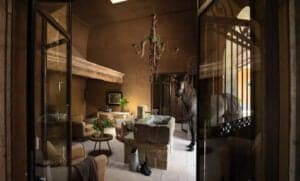
“The client wanted to use the front part of the barn for entertaining,” Bullard explains. “So, I created an eclectic look inspired by the barns I knew from my childhood.” Antique horse memorabilia sourced from flea markets and vintage fairs sits alongside comfortable seating, allowing the stable-adjoined room to function as both tack room and salon. “You could dine and entertain, or sit and read a book in these beautiful surroundings,” he says, “with a horse peeking in to keep you company.” ©Reschio Hotel Similarly, the emphasis on atmosphere and experience is particularly evident at Reschio Hotel in Umbria, where Count Benedikt Bolza – a trained architect who leads the estate’s design work from the on-site B.B. for Reschio studio – has shaped the spectacular tack room as a social heart, connected to the Teatro Equestre where weekly dressage performances unfold.
Here, beneath salvaged wood paneling and shafts of natural light, riders and guests gather around an enormous table – once a kitchen workhorse – for everything from post-ride conversation to calligraphy classes. An ancient stone sink anchors the indoor-outdoor room, while a fireplace draws guests in during winter months. Every detail – from the reused materials to the horse-named pegs – reinforces a philosophy of stewardship and respect, not just for the horses but for the building itself. ©St Giles House In some cases, this shift extends beyond the tack room altogether. At St Giles House in Dorset, the restored 17th-century Riding