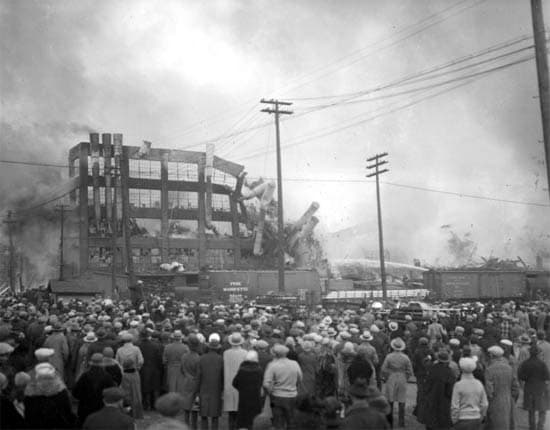
On April 23, 1927, a fire broke out at the Briggs auto plant in Detroit. It killed 21 workers. This terrible incident is a window into the racialized forms of dirty, dangerous labor that defined early twentieth century workplaces for black laborers.
The Briggs plant in Detroit was a huge factory that produced car bodies for several major car companies, including Packard, Dodge, and Chrysler. It was a highly segregated facility–it mostly hired black workers, who had migrated in huge numbers in recent years from the South, but the foreman was of course white. The factory was totally unsafe.
A survivor noted why the fire started because it happened right next to him. There was a mercury lamp above the workers’ heads. It had a hole in it.
The burning vapor leaked on tanks of paint made of something called pyroloxylin, which is extremely flammable. The survivor saw it and took off running. He made it about 100 feet before the plant exploded.
It still knocked him over like a bomb in a war, but he made it just far enough. 21 workers died that day. 17 were black. 3 of the 4 white were immigrants, one each from Russia, Poland, and Argentina. And there was 1 native born white. Some believed that there were a lot more workers in the rubble of what was a completely destroyed factory.
The entire incident and its demographic makeup say a lot about work in Detroit in the late 20s. First, safety standards were absolutely abysmal. Remember that the two men responsible for 146 dead workers at the Triangle Fire not only never saw jail time and not only just reopened other sweatshops where they still locked the doors and risked women’s lives, but they in fact made money on the whole incident thanks to their insurance coverage.
Things had not improved over the previous decade. In fact, in many ways it had gotten worse. Employers pushed for sped-up work, pushing workers’ bodies ever farther in search of greater profits.
With black workers relegated to the lowest rungs of hard, dirty labor, white foremen brought racialized management tactics to go to ever greater lengths to control labor. The auto industry probably doesn’t have the same reputation as a “dirty industry” as steel or chemicals, but it was plenty dirty. The paint shops were especially nasty and as the Briggs fire shows, the combination of chemicals could be deadly.
The level of indifference toward human life in what was still very much Gilded Age America was shocking as well. Detroit had a big rise of the Ku Klux Klan in the early 20s as black workers moved north, which reinforced a political system that wanted to do as little as possible for these new arrivals in the first place. The city had engaged in some public health improvements, which were entirely possible by this time.
For example, it had finally created a clean water supply by chlorinating the water, reducing typhoid deaths. The city passed an anti-smoke ordinance in the early 20s too that forced companies to reduce air pollution. But black workers were shoved into an overcrowded and unsafe ghetto, leading to a rapid rise in deaths from tuberculosis.
This was completely unnecessary and avoidable, but no one in power cared. Add Fordism to this mix. Henry Ford still sometimes gets a good reputation for his $5 day, but he was a monster of a human being and he made the lives of workers must worse.
Oh, they got their $5 alright–if they lived up to his moral standards. But he demanded full fealty. Other employers adopted his methods of turning individuals into machines with no concern for their work or lives, but often without the $5, which by 1927 had lost a lot of its purchasing value anyway, so even if employers matched Ford, the workers still lived in poverty.
What Fordism also did was to transform supply chains, effectivey creating the modern integrated system that demanded rapid production. That had massive environmental impacts, both in terms of inputs and outputs, with trees and metal and rubber and everything entering those supply chains rapidly and with pollution and poison being excreted from it. In the middle were the workers, exposed to these horrors through the process.
The Briggs workers were just at one point of the horror and this incident was a famous moment in which people could–if they chose–consider the larger problems. But from workers in the production industries both in the U.S. and increasingly overseas to the workers in the factories to the working class living near the pollution as the middle classes escaped it, Fordism led to systems of massive environmental inequality. It’s not as if some of this wasn’t understood already.
Dirty industry was funding studies on the impact of pollution, including in auto. As early as the 1910s, industrial officials noted how filthy and dangerous Ford’s assembly lines were. But they just didn’t care. Rather, in this era of strengthened managerial control, the demand for greater efficiency and profit led to more injuries, more accidents, and more industr