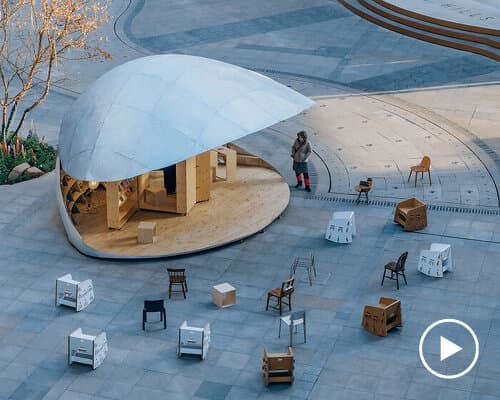
a playful reading space for beijing LUO Studio’s Shell Book Pavilion occupies a public plaza of Xiangyun Town, a commercial district of Beijing. Taking the form of a clamshell which opens and closes, the tiny library shapes a small but active space for reading, gathering, and pause. The project begins from familiarity.
The architects describe prior visits with family, where the plaza’s mix of installations and child-friendly openness established a pattern of use that felt casual and community-focused. This commission extends that memory into a built response, asking how a small intervention might support the daily life of the area while introducing a new reason to stop. image © Yumeng Zhu luo studio crafts a Pavilion in Motion The Shell Book Pavilion in Beijing addresses its site through three direct concerns: it draws people in, it holds presence from every direction, and it maintains openness to the surrounding flows.
The architects at LUO Studio design the structure to avoid any fixed front or back, so that it presents a continuous perimeter that can be approached from all sides. This leads to a departure from conventional enclosure. Instead of a defined volume, the pavilion reads as a low, curved shell that hovers just above a circular timber platform.
Around it, movable seating pieces scatter loosely across the plaza, extending the pavilion’s influence beyond its footprint and allowing occupation to shift throughout the day. occupying a Beijing plaza, the Shell Book Pavilion invites people to read, gather, and pause A Space That Adjusts according to community needs At the core of the design is a vertical opening system that allows the shell to lift and settle in incremental positions. The pavilion moves through a sequence of states, from fully open to nearly closed, each condition shaping a different spatial atmosphere. When raised, the structure creates a broad canopy with generous clearance, drawing people inward.
When lowered, it compresses into a more contained volume, holding a quieter interior. This transformation is gradual and visible. During events, the movement itself becomes part of the experience, as the interior reveals itself in stages.
The architecture participates in the activity, shifting alongside the people who occupy it, rather than remaining fixed as a backdrop. the project responds to the needs of an existing community space Interior Atmosphere and Use Inside, the pavilion is lined with timber shelving and seating elements that support reading and informal gathering. The curved underside of the metal shell reflects light softly across the interior, while the wood platform introduces a warmer surface underfoot. The contrast between metal and timber remains direct and legible, with each material carrying a distinct role in structure and occupation.
The scale supports extended use. With a footprint of over 40 square meters and a height that ranges from 2.5 to over 4 meters when open, the space accommodates small groups, children at play, and quieter moments of reading. The perimeter stays porous, allowing visual and physical exchange with the plaza. its shell-like form creates a 360 degree presence that can be approached from every direction the aluminum shell structure Behind the pavilion’s light appearance sits a technically resolved system.
The primary frame is constructed from aerospace-grade aluminum alloy, selected for its strength and reduced weight, enabling the lifting mechanism to operate reliably across repeated cycles. The opening system integrates mechanical components with a precision that required coordination across multiple fabrication methods, including CNC machining and welding. The wooden interior elements are integrated into this structure, balancing the precision of the metal frame with a more tactile environment.
The junctions between these systems are handled with restraint, allowing the construction logic to remain visible without becoming overstated. the pavilion can open and close to become an open platform or sheltered interior Building Under Constraint The Shell Book Pavilion was completed within a compressed timeline of roughly twenty days, requiring tight coordination between fabrication and on-site assembly. The plaza surface introduced further complexity, with variations in level that had to be corrected to ensure the moving structure could operate accurately. Installation took place during nighttime hours, compressing lifting, alignment, and testing into limited windows.
These constraints are absorbed into the final work. What appears as a smooth and continuous form carries the adjustments and calibrations required to make it function in place. timber seating and shelving support reading and informal gathering inside the structural shell is crafted with aerospace-grade aluminum construction required rapid coordination and nighttime installation project info: name: Shell Book Pavilion architect: LUO Stud