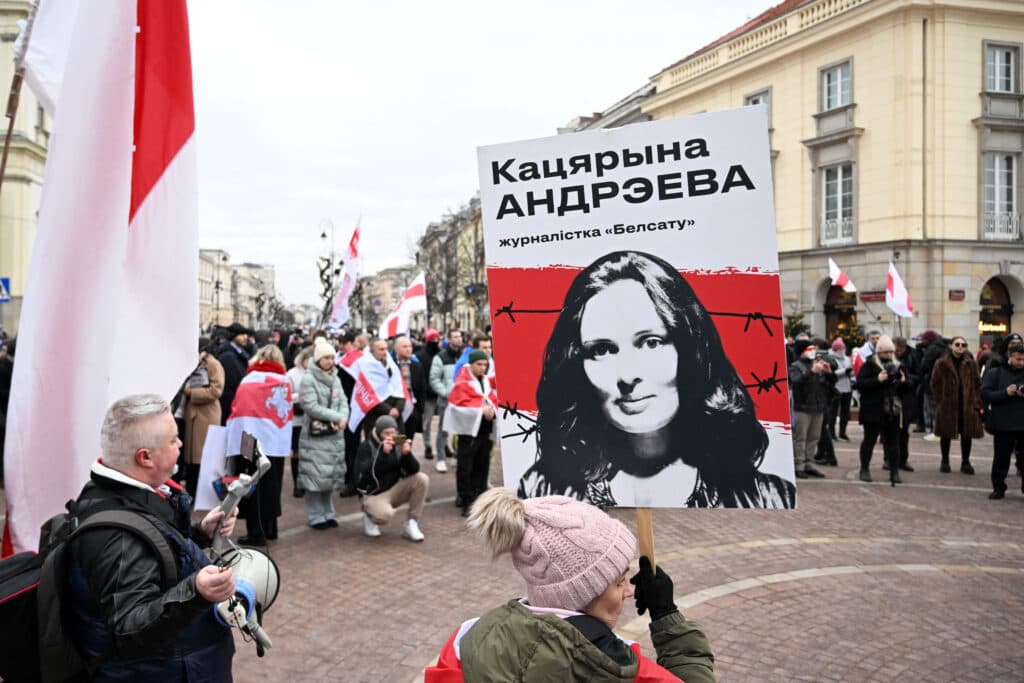
Few people experience such a sudden reversal in their lives: from being held captive in a KGB prison by one of the world’s most brutal regimes to freedom in Europe. Journalist Katsiaryna Andreeva is one of them. Arrested in 2020 for filming a protest against Belarusian strongman Alexander Lukashenko from a 14th-floor window, Andreeva was first sentenced to two years in prison on charges of “violating public order.” In July 2022, she was hit with a second charge, treason, and condemned to another eight years behind bars.
Then, U.S. President Donald Trump intervened, easing sanctions against Belarus in exchange for the release of political prisoners following booze-fueled negotiations between Lukashenko and an American envoy. Andreeva’s release in March came ahead of what Lukashenko has described as a potential “big deal” with the U.S., which is ostensibly designed to lure him away from Russia’s orbit.
Andreeva is grateful. In one of her first interviews after being released, she thanked the U.S. president “first of all.” And yet, she told POLITICO, this is no happy ending. More than two dozen journalists remain incarcerated in Belarus — among them her husband, Ihar Ilyash, who is currently serving a four-year sentence.
Out of the 1,300 prisoners Trump promised would be released, so far only 500 have been let go, leaving hundreds behind. “These people are waiting to be freed,” said Andreeva, whose dramatic story has now inspired an HBO film. Speaking from Warsaw, where she now lives in exile, she described the impossible trade-off between holding tyrannical leaders accountable and saving individual lives, including that of her husband.
“By releasing me but keeping him in prison, they have created a situation where I feel they’ve kept a hostage,” she said. “I will only truly feel free once my husband is back by my side.” This conversation has been edited for clarity and length. To start, how are you?
It’s complicated. It’s been difficult to adapt and get used to this new reality. I feel as though I didn’t spend five years in prison, but 10 or 15.
For me, these five years have felt longer than any year of my life before prison. Initially you were sentenced to two years. Then, you were given an additional eight years for treason.
Why do you think you were treated so harshly? I made it clear to the Belarusian authorities that first sentence didn’t scare me, that I would continue working as a journalist and that I wasn’t afraid. It was part of a pressure campaign against those working on sensitive topics that the authorities considered dangerous.
Like those who covered the events of 2020 without censoring themselves, especially those who conducted broadcasts or carried out investigations, who dared to speak about Russia’s actions against Ukraine. Honest journalism scares the officials in Minsk. And, like in any totalitarian state, the first response to fear is violence.
They used it, against me and against my husband. Maybe we’ll still talk about him later. Let’s go there now. Ihar Ilyash, your husband, is still in prison.
My husband wasn’t just my romantic partner, he was also my professional role model. In 2020, we wrote a book together about Belarus’ participation in eastern Ukraine, about how Belarusians who’d participate in hostilities on Russia’s side returned home and were never held accountable for their actions. The book must have been a major source of irritation to the Belarusian authorities.
But they couldn’t jail us then, it was a different time. I think later they took revenge on us for that too, and made us pay for it. How did Ihar react when you were arrested?
My husband always supported me, though he urged me to be careful, especially when the protests began in 2020. He told me to take care of myself, not to go out if I didn’t need to work that day. That’s how he tried to protect me, and he worried about me a lot.
When I was eventually jailed, he said he wouldn’t leave Belarus while his wife was in a penal colony. He said he would stay close and be there for me until the day I was released. And he really was.
He looked after my parents, and he would bring me warm pastries, croissants — still warm! — to prison. Talk about real romance! Yes.
In October 2024, on the eve of new presidential elections, he was arrested too. He was accused of aiding an extremist organization — essentially for giving interviews to media outlets that the Belarusian authorities have labeled as extremist. He was also charged with discrediting Belarus, allegedly for making false statements about the human rights situation in our country.
But in reality, he mostly spoke about me. He was trying to draw attention to my case and secure my release. My husband was fighting for me. A woman holds a placard depicting jailed Katsiaryna Andreeva during a rally in Warsaw on January 26, 2025. | Sergei Gapon/AFP via Getty Images By releasing me but keeping him in prison, they have created a situation where I feel they’ve kep