LONDON — Peter Mandelson’s appointment as U.S. ambassador despite security concerns — and the subsequent dissection of that process in public — have caused consternation among Britain’s intelligence-sharing partners, according to two people briefed on the matter. The latest twist in the tale of Keir Starmer’s doomed decision to send Mandelson to Washington has centered on his ascent to the key post despite issues that were flagged by the U.K.’s vetting agency after carrying out background checks. The Guardian first reported that Mandelson had “failed” security vetting last week.
Former Foreign Office boss Olly Robbins — sacked by Starmer for his role in the scandal — later characterized the decision as “leaning towards recommending that clearance be denied.” Mandelson went on to gain access to sensitive information in his role as ambassador, while the ins and outs of the process by which he was approved have been debated in parliament and splashed across front pages for days. The two people briefed — a British official and an official from one of the “Five Eyes” countries with which the U.K. routinely shares classified intelligence, both of whom were granted anonymity to speak about sensitive matters — said the saga had been a source of concern to allies.
The U.K. official said they had encountered partners’ “anger” that “we might have had someone out there who did not meet our own standards.” They added that the public scrutiny of STRAP — protocol for handling extremely sensitive intelligence — and how the British government mitigates security risks was seen as regrettable by the U.K. security community, where officials are generally discouraged from openly discussing such topics. The official from a Five Eyes country stated that all of those in the network rely on “strong security vetting” which is of paramount importance “even and especially for close partners.” Others played down the significance of the row.
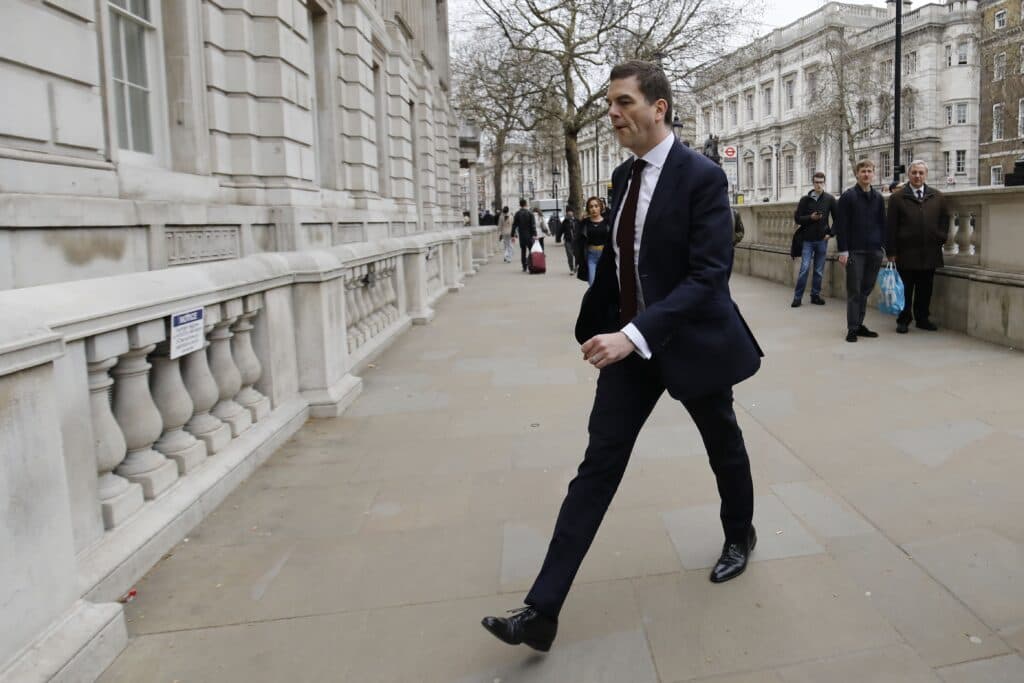
A European diplomat said they had “noted” the vetting issue but that it was not a cause for wider concern as Mandelson appeared to be “a particular case.” However, Robbins, who opted to grant clearance to Mandelson, publicly voiced concern over the level of disclosure that the government has offered about the vetting process when he gave evidence to parliament this week. “British national security does not benefit from that, so we have to ask whose does,” he told the Commons Foreign Affairs Committee on Monday. He added: “I reflect honestly on my wonderful colleagues who are sat in the British embassy in Moscow or in the British embassy in Beijing and are subjected to incredible pressure… and of course I find myself wondering who this helps.” Olly Robbins is pictured in Whitehall, London on March 22, 2019. | Tolga Akmen/AFP via Getty Images He also condemned the leak to the Guardian, which is now being investigated by the government, as “a grievous breach of national security.” It is not known why Mandelson was not initially recommended for clearance, although Robbins specified in his evidence that it did not relate to his friendship with the late convicted pedophile Jeffrey Epstein, over which he was eventually fired as ambassador.
The latest revelations about Mandelson and sacking of Robbins as head of the diplomatic service unfolded just as Britain’s King Charles prepares to visit to the United States with transatlantic relations at a low ebb. Starmer said this week that despite the criticism aimed at him for nominating Mandelson in the first place, “nothing is going to distract me from delivering for our country.” The Foreign, Commonwealth and Development Office declined to comment, but pointed to Foreign Secretary Yvette Cooper’s remarks in the Commons promising “a full investigation” by retired judge Adrian Fulford “into this entire process and what was known, as well as the whole vetting process.”