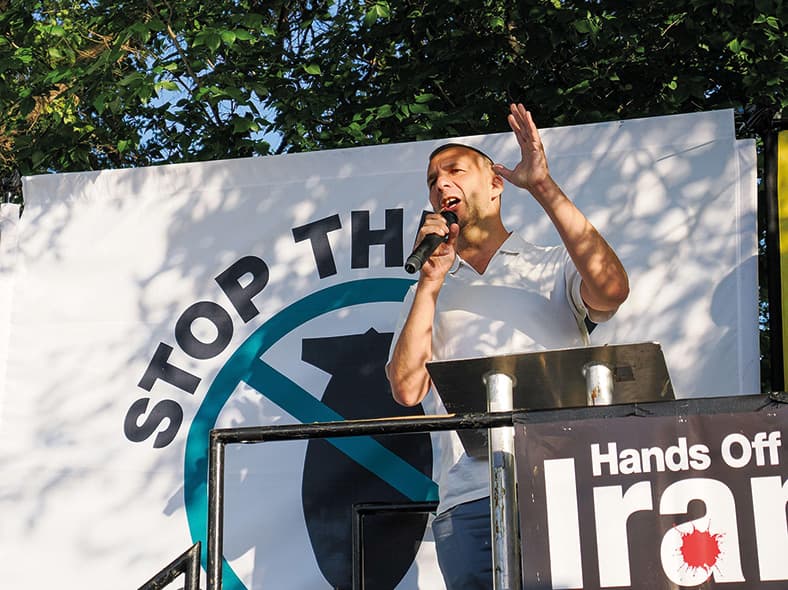
Zack Polanski is standing in the drizzle on a patch of woodland, on the edge of a car park in the quiet village of Forest Row, East Sussex, waiting to be introduced. “I thought there would be about 20 people,” Rachel Millward, the deputy leader of the Green Party, shouts excitedly to the crowd of hundreds that has gathered, on a weekday morning, with less than 24 hours’ notice, to see the Green Party leader. These are people of all ages, dressed in colourful clothes, excited.
“I see people who do yoga together,” Millward declares. “Who sing together! Who dance together!” As co-deputy leader of the Greens, she says, it is her duty to “speak the truth – my truth – and to speak hope”.
The crowd looks emotional. Polanski steps up, picking up the theme. “The thing that people say to me over and over again – it would become repetitive if it wasn’t beautiful – is I’m feeling hope!” The crowd erupts in agreement.
“I’m feeling hopeful, too, both as a leader of a political party, but frankly, as someone who lives in this country,” he continues. “It was starting to feel pretty grim. It was starting to feel like the managed decline of the Labour government was just warming the plate to hand that over to Nigel Farage and a Reform government.
What I’m here to say today is none of that is inevitable.” The crowd beams up at him. One woman holds a placard of a Marmite jar that reads “Spread Love, Reject Hate.” “Love that,” Polanski says, pointing at the sign. When he finishes his speech and steps off the platform from which he addressed the crowd, he is quickly mobbed – that’s the only word for it.
The crowd wants selfies, signatures, photos of him with a book they’ve written. His bodyguard bundles him towards a car, but supporters rush alongside him, insisting they must tell him about this project or that idea, handing his advisers documents, pressing plans into their hands. It becomes increasingly urgent, almost aggressive.
I am rushed into the car alongside him, the door is slammed shut, and then, finally, there is silence. Yes, it is always like this, Polanski tells me with a smile when I ask. Zack Polanski has been leader of the Green Party for just seven months, having been elected on an “eco-populist” platform in September last year.
At that point, he could walk down the street mostly unrecognised. Now, he goes on visits with a bodyguard, gets stopped by teenagers on the Tube, and hosts club nights where crowds of young people cheer his name. It is strikingly, unmistakeably, reminiscent of the Corbyn mania of 2017.
“My life’s absolutely transformed,” he says, when we sit down on the train back to London together, munching on a bag of popcorn – his lunch, the best vegan option available at East Grinstead station. The Green Party has been transformed as well. It is enjoying a swell in support, tapping into the national despondency towards Keir Starmer.
Membership has grown from 60,000 when Polanski took over, to 226,000. The Greens have surged in the polls, and in February, won their first Westminster by-election. The Polanski recipe is simple enough: “hope”, with a heavy dash of populism.
Corbynism has found its heir. Will the Green moment end as quickly as it began, or is the party now a permanent force to be reckoned with? Polanski is determined to make sure it lasts.
He sees the parallels with Labour under Corbyn, the last major surge on the British left. Over the course of our train journey back to London, he tells me about the lessons he is drawing from that project. He is quick to emphasise the differences too, though.
One major difference, of course, is Polanski himself. While Corbyn was the same politician in the 1970s as he is today, ever consistent in his convictions, Polanski is barely recognisable as the man he was even a decade ago. How did he become the left leader he is today, a figurehead so many now look to for an alternative to Starmer’s Labour?
Let’s just say he has been on a journey. Zack Polanski was not born Zack Polanski, but became him. The young boy who grew up in the Jewish community of Salford, Manchester, in the 1980s was called David Paulden.
He had a difficult upbringing. He was deeply affected by his parents’ divorce, and as a teenager was bullied at school for being Jewish and gay. He changed his name aged 18, choosing the Jewish family name that had been dropped when the Polanskis arrived in Britain, fleeing pogroms in eastern Europe in the early 20th century, and “Zack” for the Jewish character in Goodnight Mister Tom, a children’s novel set during the Second World War.
“Growing up as a practising Jew, having a bar mitzvah, there’s lots of joy and community to that,” he tells me. “There’s also an immense amount of pain, an immense amount of resilience of the Jewish community and situations we’ve faced.” He was reclaiming his identity, recognising “the determination and pride in the face of unimaginable circumstances” that generations of persecuted Jews have faced. He had another reaso