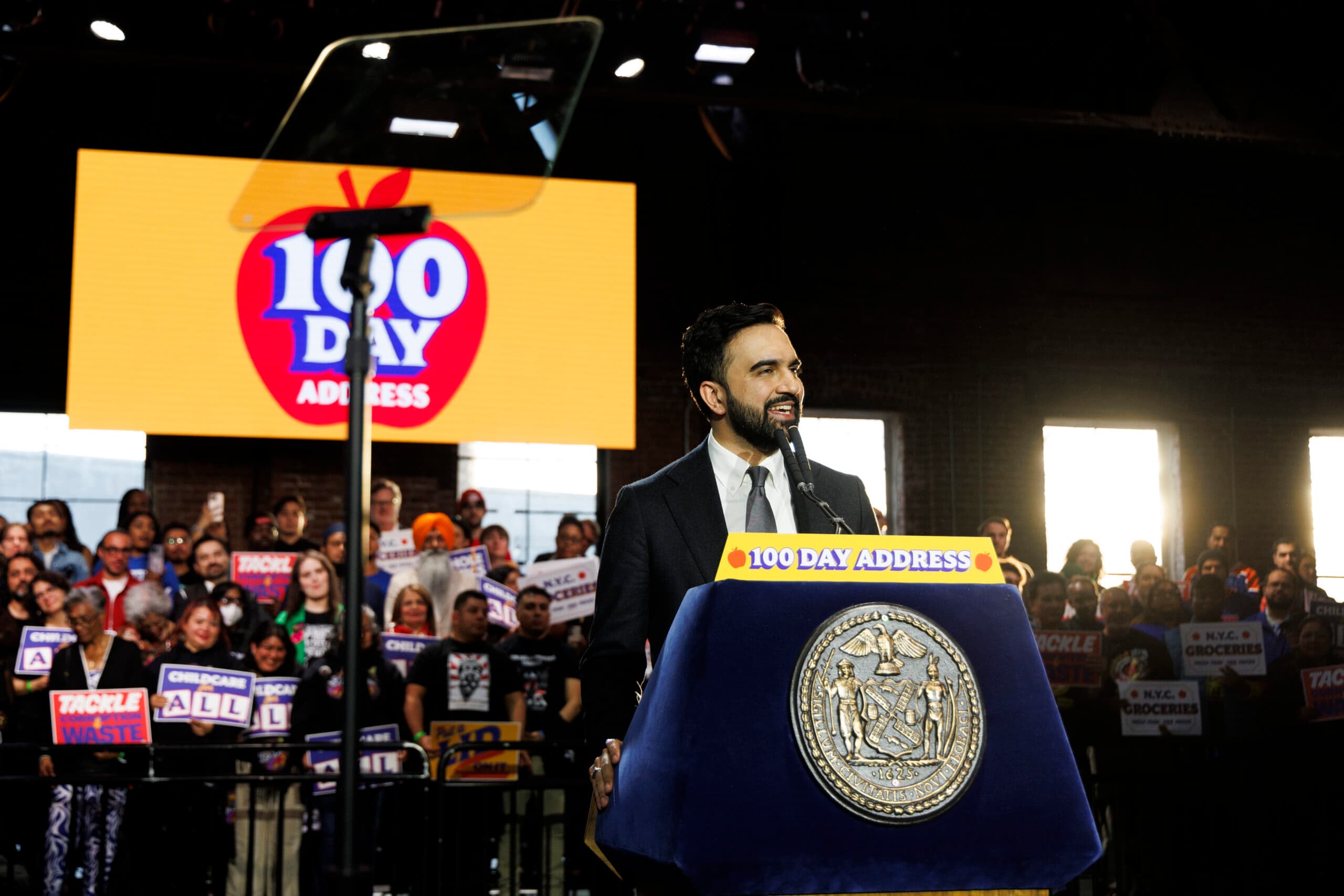
Politics Zohran Mamdani Is Doing Exactly What He Said He Would So far, the doomsday predictions haven’t materialized. (Photo by Matthew Hoen/NurPhoto via Getty Images) It has been more than 100 days since Zohran Mamdani took office, and New York City hasn’t imploded in the ways critics had warned it would. You don’t have to like Mamdani or agree with his progressive politics to recognize a core truth: The 34-year-old democratic socialist is governing New York City in line with the agenda he laid out on the campaign trail in the fall of 2025, and the sky has yet to fall. Less than a year after defeating former New York Gov.
Andrew Cuomo in a race that stunned much of the Democratic establishment, Mamdani has quickly translated campaign rhetoric into policy. From advancing taxes on the wealthy to launching plans for city-owned grocery stores, he has begun implementing the economic agenda that helped carry him into Gracie Mansion. “To be told a city-run grocery store is implausible, but $500 million a day to kill people in Iran and Lebanon is necessary, speaks to a broken politics,” Mamdani told NPR days after his widely-publicized grocery store announcement.
The mayor’s criticism of a federal government obsessed with tax-funded war spending wasn’t finished there. Mamdani, who has cultivated a surprisingly friendly relationship with President Donald Trump, asked why spending public money to address affordability concerns in America’s biggest cities draws the ire of conservative critics who applaud immense spending on wars in the Middle East. “We’re talking about a federal administration that has spent close to $30 billion killing thousands of people at a time when working-class people across this country cannot afford the bare minimum,” Mamdani told NPR on the same weekend that Trump and Israel’s war in Iran stretched into its seventh week.
The mayor went further in an interview with Al Jazeera in early April, speaking against “a war that has killed thousands of civilians” before noting that his controversial economic policies would “cost a fraction” of the tens of billions of dollars being spent on the Iran war. “Tupac said it decades ago, it continues to be true,” Mamdani said before quoting the late rapper Tupac Shakur. “We always seem to have money for war but not to feed the poor.
That is not the way politics should be, that is not what Americans want politics to be.” While critics in the business community argue that his policy agenda could weaken the city’s economic competitiveness, predictions of large-scale capital flight have not yet materialized in any clear or measurable way. In fact, corporate America is actually expanding its footprint in Mamdani’s New York, and some of the city’s wealthiest residents have publicly signaled their willingness to remain in the city despite proposed tax increases. Mamdani, for his part, has governed with consistency grounded in the assurances he made on the campaign trail.
For moderates and independents who were uncertain what a democratic socialist administration would look like in practice, his early tenure offers a vivid and straightforward demonstration. Mamdani’s early tenure has been marked by unusually high political visibility. Following a major winter storm in February, he was seen participating in cleanup efforts alongside residents, part of a broader pattern of hands-on public appearances.
The mayor has also made high-profile appearances alongside figures such as former President Barack Obama and players from the New York Knicks in Harlem, reinforcing his standing within both national Democratic politics and local culture. At the same time, early polling narratives regarding Mamdani’s approval ratings have become a point of political dispute. Outlets such as the New York Post highlighted his 48 percent approval rating in a March Marist poll, describing it as a “dismal report card.” However, a closer analysis of those very same numbers show strong approval ratings across four of New York City’s boroughs, with overall ratings weighed down primarily by more negative responses in Staten Island, the city’s most conservative borough.
Supporters of Mamdani point to the fact that New York City just recorded one of its lowest murder levels in the first three months of any year on record. Yet crime rates and perceptions of political leadership do not always move in tandem, particularly in areas such as Staten Island, where skepticism toward city leadership is already well established. Some of Mamdani’s fiercest ideological critics, particularly on the right, have argued that his economic proposals represent an unrealistic expansion of government into daily life.
From that perspective, proposals such as municipal grocery stores represent a departure from the traditional limits on public-sector authority, regardless of their stated intention to address affordability. Yet many of those same critics have supported expansive federal spending in other domains, most rece