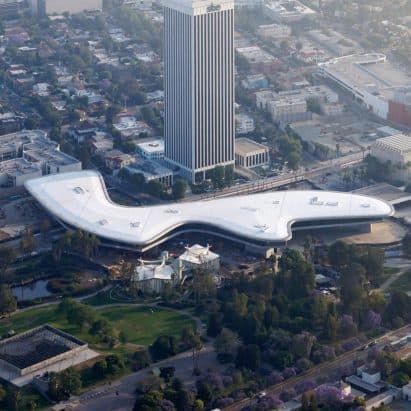
As Peter Zumthor's highly anticipated Los Angeles County Museum of Art opens, local writer Shane Reiner-Roth examines how the structure reflects the current moment. The CEO and director of the Los Angeles County Museum of Art (LACMA), Michael Govan seems to believe that the highs and lows of quick decision-making are irrelevant in the pursuit of immortality. Since joining 20 years ago, Govan has transformed a publicly funded cultural institution of moderate acclaim into a laboratory for global stardom by commissioning distinctive permanent works by contemporary artists.
His first commission, Chris Burden's Urban Light (2008), a grid of restored street lamps near the entrance, positioned LACMA as one of the city's most popular tourist destinations. Others, such as Michael Heizer's Levitated Mass (2012), which clumsily positions a 340-ton boulder above a desolate walking path in a 2.5-acre sand pit, have drawn ridicule – the more common consequence of impetuousness. But no commission, for better and worse, will ever be as consequential as the recently opened David Geffen Galleries, the new home of LACMA's permanent collection.
The layout allows for a fragmentation of self-awareness on the museum's part The project has attracted local criticism and concern since day one. This is the first project built in the United States to be designed by Zumthor, the Swiss architect world-famous for minimalist works of remarkable spatial and material sensitivity. It is also his largest by far, with 347,000 square feet (32,237 metres) spread across 3.5 acres (and yet it only offers 110,000 square feet of gallery space – 10,000 fewer than in the galleries it replaces).
Composed of more than two million cubic feet of concrete (65,000 cubic metres), and boasting a price tag of $750 million (125 million of which would come from local taxes), the project even dares to span a major boulevard, like a freeway overpass – a visual statement about the fast-moving and elevated position of the art market in Los Angeles, perhaps. But if all that could somehow be put aside, the public may well experience the final product as one that captures the strangeness of our times. It is overwhelming in multiple ways; some are sublime, as art should be, while others are distracting, as life often is today.
Unlike the neoclassical Metropolitan Museum of Art in New York, which neatly arranges rooms within a windowless grid, visitors here navigate a vast open floor plan that treats the time and space of art history as visual playthings. Read: Art installations bring colour to Peter Zumthor's austere LACMA addition It is certainly not obvious at first, but the gallery space is geographically split into four sections, each one loosely inspired by a different oceanic network of cultural exchange. The main entrance brings visitors to the Pacific Ocean, where 14th-century Chinese pottery and Spanish-colonial paintings drift in a sea of concrete alongside Raymond Loewy's own custom-designed Studebaker Avanti.
This awareness of these complex global exchanges is evident even in the smaller, monastery-like gallery spaces scattered throughout the space, designed to provide brief moments of concentration amid windowless walls and mood lighting. The layout allows for a fragmentation of self-awareness on the museum's part. Picturing the American West, for instance, treats that region as both a real place and a myth by juxtaposing 19th-century Anglo-American paintings of Sequoia with contemporary Indigenous responses to their consumptive romanticism.
The cross-cultural dialogue grows louder when one notices that the installation is labeled with a sponsorship from the state of Qatar. Together, these reveal art's tricky relationship with exposing power dynamics while being caught up within them. Is the building's suspension in service to the public, or is it just a symptom of its monumentality?
Thanks to Zumthor's madcap idea of hoisting the entire gallery space 30 feet (nine metres) above the ground, the artwork is additionally engaged in dialogue with unobstructed views of the museum campus and the city beyond. While the original museum buildings turned their backs on the treasures of its immediate surroundings, such as the Pavilion for Japanese Art, designed by Bruce Goff in 1988, Zumthor frames them as an artwork in themselves. Even Wilshire Boulevard gets the star treatment, inviting visitors to turn their backs on the artworks to contemplate traffic patterns.
If you weren't already overwhelmed by the juxtaposition of art, the awareness of the city only adds to the feeling. With the bridge over the boulevard and the views, is the building's suspension in service to the public, or is it just a symptom of its monumentality? At a time when cultural institutions struggle to compete with the allure of our smartphones, LACMA has created a museum space that feels as though one is swimming through the bottomless scroll of Instagram. Viewers follow a trail of dopamine hit